
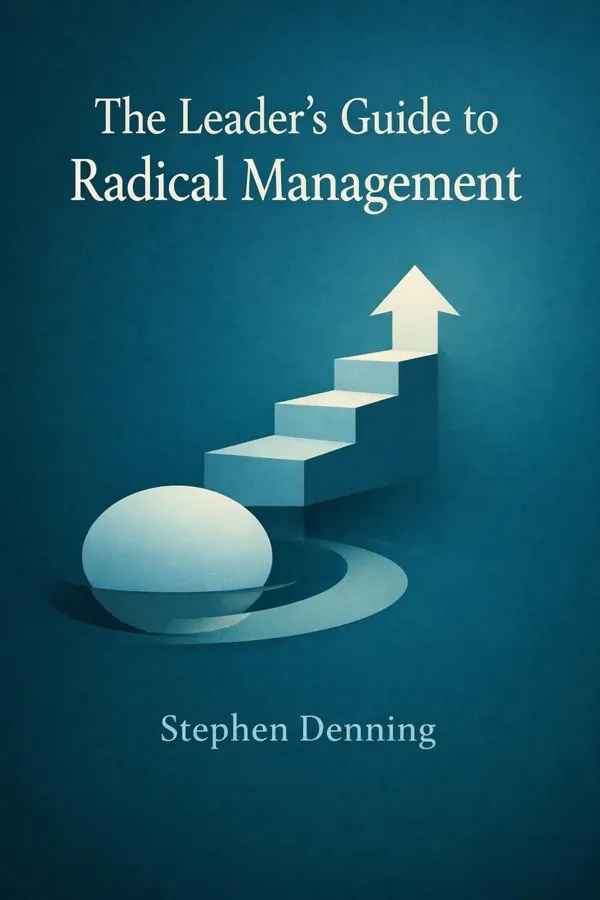
The Leader's Guide to Radical Management: Reinventing the Workplace for the 21st Century: Summary & Key Insights
 10 min12 chaptersAudio available
What Is The Leader's Guide to Radical Management: Reinventing the Workplace for the 21st Century About?
The Leader's Guide to Radical Management: Reinventing the Workplace for the 21st Century by Stephen Denning is a leadership book spanning 12 pages. In this influential management book, Stephen Denning presents a radical new approach to leadership and organizational management. He introduces seven interlocking principles designed to foster continuous innovation, customer delight, and self-organizing teams. The book challenges traditional hierarchical management models and offers practical guidance for leaders seeking to transform their organizations for the 21st century.
This FizzRead summary covers all 12 key chapters of The Leader's Guide to Radical Management: Reinventing the Workplace for the 21st Century in approximately 10 minutes, distilling the most important ideas, arguments, and takeaways from Stephen Denning's work. Also available as an audio summary and Key Quotes Podcast.
The Leader's Guide to Radical Management: Reinventing the Workplace for the 21st Century
In this influential management book, Stephen Denning presents a radical new approach to leadership and organizational management. He introduces seven interlocking principles designed to foster continuous innovation, customer delight, and self-organizing teams. The book challenges traditional hierarchical management models and offers practical guidance for leaders seeking to transform their organizations for the 21st century.
Who Should Read The Leader's Guide to Radical Management: Reinventing the Workplace for the 21st Century?
This book is perfect for anyone interested in leadership and looking to gain actionable insights in a short read. Whether you're a student, professional, or lifelong learner, the key ideas from The Leader's Guide to Radical Management: Reinventing the Workplace for the 21st Century by Stephen Denning will help you think differently.
- ✓Readers who enjoy leadership and want practical takeaways
- ✓Professionals looking to apply new ideas to their work and life
- ✓Anyone who wants the core insights of The Leader's Guide to Radical Management: Reinventing the Workplace for the 21st Century in just 10 minutes
Want the full summary?
Get instant access to this book summary and 100K+ more with Fizz Moment.
Get Free SummaryAvailable on App Store • Free to download
Key Chapters
For over a century, organizations have been managed according to principles of control and efficiency derived from factory production. Managers measured success by output per unit of input, by standardization, and by adherence to hierarchy. These practices were highly effective in an age dominated by mass production and predictable markets, but they have now become liabilities in a world that demands constant adaptation.
Traditional management, I explain, creates a mindset of predict-and-control, treating employees as instruments to optimize processes rather than agents capable of creativity. It focuses excessively on cost reduction and process optimization while neglecting value creation for customers. The result is a widening disconnect between what companies produce and what customers actually want. Employees lose engagement, customers lose excitement, and organizations lose relevance.
I often draw parallels with how large institutions such as the World Bank, where I worked for years, had become paralyzed by bureaucratic routines that punished innovation and rewarded caution. The tragedy is not that these organizations lack talented people—it is that their management systems inhibit the people from using their talents. Hierarchical systems encourage passivity, not initiative. They prefer plans to experiments and reports to results.
The deeper issue is that efficiency in isolation has ceased to be a competitive advantage. When competitors can match your efficiency—and technology shortens every lead time—what distinguishes a thriving organization is not process perfection but emotional resonance with its customers. Radical management starts with that recognition. It is time to shed the comfort of old metrics and embrace the vibrancy of constant renewal.
The first step in radical management is redefining purpose. The purpose of a business is not to generate shareholder returns; it is to delight its customers so profoundly that value creation becomes inevitable. When we begin with delight, the organization’s energy aligns around human impact. Delight differs from satisfaction—it is emotional, memorable, and contagious. It transforms transactional relationships into enduring bonds.
In practice, this means seeing customers not as recipients of products or services but as partners in a shared journey. Amazon’s obsession with customer experience, or Apple’s focus on design and usability, reflect this principle. These companies exist to improve lives, not merely to extract profit. Ironically, this deeper intention tends to yield extraordinary financial success.
As leaders, we must cultivate a mindset of empathy. We must understand the customer’s world, anticipate unmet needs, and design experiences that surprise and inspire. When we aim for delight, cost-efficiency follows naturally because teams are motivated by purpose rather than compliance. The organization ceases to be a machine and becomes a mission-driven community.
+ 10 more chapters — available in the FizzRead app
All Chapters in The Leader's Guide to Radical Management: Reinventing the Workplace for the 21st Century
About the Author
Stephen Denning is a former World Bank executive and a leading thinker in the field of leadership and management innovation. He is known for his work on storytelling in organizations and for advocating management practices that promote agility, innovation, and customer focus.
Get This Summary in Your Preferred Format
Read or listen to the The Leader's Guide to Radical Management: Reinventing the Workplace for the 21st Century summary by Stephen Denning anytime, anywhere. FizzRead offers multiple formats so you can learn on your terms — all free.
Available formats: App · Audio · PDF · EPUB — All included free with FizzRead
Download The Leader's Guide to Radical Management: Reinventing the Workplace for the 21st Century PDF and EPUB Summary
Key Quotes from The Leader's Guide to Radical Management: Reinventing the Workplace for the 21st Century
“For over a century, organizations have been managed according to principles of control and efficiency derived from factory production.”
“The first step in radical management is redefining purpose.”
Frequently Asked Questions about The Leader's Guide to Radical Management: Reinventing the Workplace for the 21st Century
The Leader's Guide to Radical Management: Reinventing the Workplace for the 21st Century by Stephen Denning is a leadership book that explores key ideas across 12 chapters. In this influential management book, Stephen Denning presents a radical new approach to leadership and organizational management. He introduces seven interlocking principles designed to foster continuous innovation, customer delight, and self-organizing teams. The book challenges traditional hierarchical management models and offers practical guidance for leaders seeking to transform their organizations for the 21st century.
You Might Also Like

Extreme Ownership
Jocko Willink
10 min
Dare to Lead
Brene Brown
10 min
Leaders Eat Last
Simon Sinek
10 min
The 21 Irrefutable Laws of Leadership
John Maxwell
10 min
Start With Why
Simon Sinek
10 min
How to Lead When You're Not in Charge
Clay Scroggins
10 minBrowse by Category
Ready to read The Leader's Guide to Radical Management: Reinventing the Workplace for the 21st Century?
Get the full summary and 100K+ more books with Fizz Moment.