
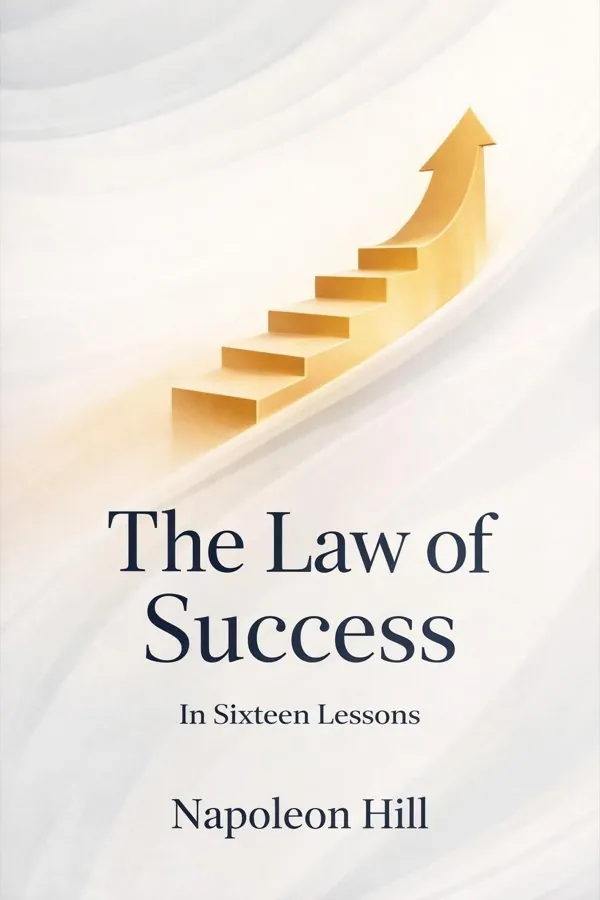
The Law of Success: In Sixteen Lessons: Summary & Key Insights
 10 min16 chaptersAudio available
What Is The Law of Success: In Sixteen Lessons About?
The Law of Success: In Sixteen Lessons by Napoleon Hill is a leadership book spanning 16 pages. Originally published in 1928 by Ralston University Press, this foundational work by Napoleon Hill presents sixteen lessons on personal achievement and success principles derived from interviews with prominent business leaders of the early 20th century. The book outlines Hill’s philosophy of success, emphasizing self-discipline, initiative, imagination, and the power of thought as key elements for attaining wealth and personal fulfillment.
This FizzRead summary covers all 16 key chapters of The Law of Success: In Sixteen Lessons in approximately 10 minutes, distilling the most important ideas, arguments, and takeaways from Napoleon Hill's work. Also available as an audio summary and Key Quotes Podcast.
The Law of Success: In Sixteen Lessons
Originally published in 1928 by Ralston University Press, this foundational work by Napoleon Hill presents sixteen lessons on personal achievement and success principles derived from interviews with prominent business leaders of the early 20th century. The book outlines Hill’s philosophy of success, emphasizing self-discipline, initiative, imagination, and the power of thought as key elements for attaining wealth and personal fulfillment.
Who Should Read The Law of Success: In Sixteen Lessons?
This book is perfect for anyone interested in leadership and looking to gain actionable insights in a short read. Whether you're a student, professional, or lifelong learner, the key ideas from The Law of Success: In Sixteen Lessons by Napoleon Hill will help you think differently.
- ✓Readers who enjoy leadership and want practical takeaways
- ✓Professionals looking to apply new ideas to their work and life
- ✓Anyone who wants the core insights of The Law of Success: In Sixteen Lessons in just 10 minutes
Want the full summary?
Get instant access to this book summary and 100K+ more with Fizz Moment.
Get Free SummaryAvailable on App Store • Free to download
Key Chapters
In human effort, no single mind ever achieves greatness alone. The Master Mind principle is the starting block of all enduring success. When two or more people coordinate their knowledge and energy in a spirit of harmony toward a definite purpose, they create what I call a 'third mind'—a power greater than the sum of their individual talents. I observed this in the partnerships between Edison and his laboratory team, and between Henry Ford and his close associates. Their combined enthusiasm and cooperation generated results that no one man could have conceived or executed by himself.
The Master Mind alliance is not merely about surrounding oneself with capable people; it is about aligning thought vibrations in unity of purpose. This harmony creates an invisible current of energy that multiplies intelligence and creativity. Success becomes inevitable when minds work together willingly, without envy or discord. In contrast, any alliance riddled with selfishness or suspicion dissolves into weakness. Thus, no enterprise rises above the quality of its Master Mind alliance.
To apply this law, you must first choose your associates with care, selecting those whose abilities complement yours and whose motives resonate with your vision. The strength of such cooperation extends beyond business—it infiltrates one’s moral and spiritual growth. Each partner uplifts the other, fostering courage in moments of doubt and insight in times of confusion. The Master Mind principle teaches that success is achieved through unity, and unity is achieved through trust and purpose.
Every great accomplishment begins with one clearly defined purpose. Without a definite aim, your energy disperses like a river spilling into a swamp—busy perhaps, but directionless. A person who knows what they want and why they want it commands both mind and circumstance to act in harmony with their objective. This is what I call the ‘Definite Chief Aim,’ the cornerstone of all achievement.
In my study, I found that every prosperous individual had a clear central goal. Andrew Carnegie’s aim was to produce steel more efficiently than anyone in the world. Thomas Edison’s was to harness electricity for the benefit of mankind. Their successes were no accident—they were the direct product of focused intention. When you define a specific and compelling aim, every faculty of your mind rallies behind that purpose, and the universe seems to rearrange itself to assist you.
To bring your Definite Chief Aim to life, write it down. Memorize it. Repeat it daily until your subconscious mind accepts it as a command. This practice transforms your aim from a wish into a mental blueprint that guides your choices and attracts opportunities. The law is simple but unbreakable: you cannot drift into success; you must sail toward it with a steady hand and a fixed destination.
+ 14 more chapters — available in the FizzRead app
All Chapters in The Law of Success: In Sixteen Lessons
About the Author
Napoleon Hill (1883–1970) was an American self-help author best known for his works on success and personal development. His research into the habits and philosophies of successful individuals led to the creation of 'The Law of Success' and later 'Think and Grow Rich', which became one of the most influential motivational books of all time.
Get This Summary in Your Preferred Format
Read or listen to the The Law of Success: In Sixteen Lessons summary by Napoleon Hill anytime, anywhere. FizzRead offers multiple formats so you can learn on your terms — all free.
Available formats: App · Audio · PDF · EPUB — All included free with FizzRead
Download The Law of Success: In Sixteen Lessons PDF and EPUB Summary
Key Quotes from The Law of Success: In Sixteen Lessons
“In human effort, no single mind ever achieves greatness alone.”
“Every great accomplishment begins with one clearly defined purpose.”
Frequently Asked Questions about The Law of Success: In Sixteen Lessons
The Law of Success: In Sixteen Lessons by Napoleon Hill is a leadership book that explores key ideas across 16 chapters. Originally published in 1928 by Ralston University Press, this foundational work by Napoleon Hill presents sixteen lessons on personal achievement and success principles derived from interviews with prominent business leaders of the early 20th century. The book outlines Hill’s philosophy of success, emphasizing self-discipline, initiative, imagination, and the power of thought as key elements for attaining wealth and personal fulfillment.
More by Napoleon Hill




You Might Also Like

Extreme Ownership
Jocko Willink
10 min
Dare to Lead
Brene Brown
10 min
Leaders Eat Last
Simon Sinek
10 min
The 21 Irrefutable Laws of Leadership
John Maxwell
10 min
Start With Why
Simon Sinek
10 min
How to Lead When You're Not in Charge
Clay Scroggins
10 minBrowse by Category
Ready to read The Law of Success: In Sixteen Lessons?
Get the full summary and 100K+ more books with Fizz Moment.