
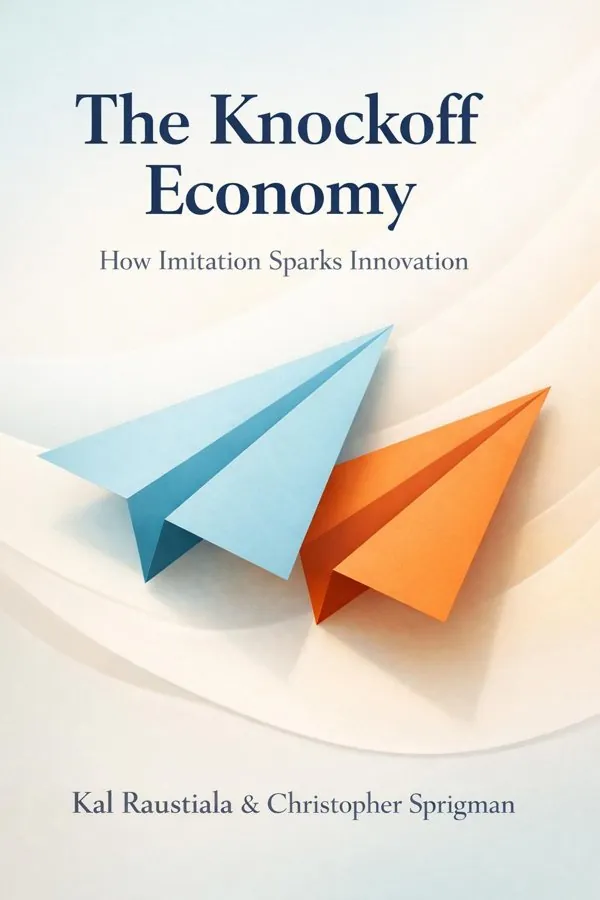
The Knockoff Economy: How Imitation Sparks Innovation: Summary & Key Insights
by Kal Raustiala, Christopher Sprigman
 10 min10 chaptersAudio available
What Is The Knockoff Economy: How Imitation Sparks Innovation About?
The Knockoff Economy: How Imitation Sparks Innovation by Kal Raustiala, Christopher Sprigman is a economics book spanning 10 pages. The Knockoff Economy explores how imitation drives creativity and progress in industries ranging from fashion and food to technology and entertainment. Raustiala and Sprigman argue that copying, often seen as harmful, can actually promote innovation by spreading ideas and encouraging competition. Through case studies, they reveal how markets thrive when imitation is allowed to coexist with originality.
This FizzRead summary covers all 10 key chapters of The Knockoff Economy: How Imitation Sparks Innovation in approximately 10 minutes, distilling the most important ideas, arguments, and takeaways from Kal Raustiala, Christopher Sprigman's work. Also available as an audio summary and Key Quotes Podcast.
The Knockoff Economy: How Imitation Sparks Innovation
The Knockoff Economy explores how imitation drives creativity and progress in industries ranging from fashion and food to technology and entertainment. Raustiala and Sprigman argue that copying, often seen as harmful, can actually promote innovation by spreading ideas and encouraging competition. Through case studies, they reveal how markets thrive when imitation is allowed to coexist with originality.
Who Should Read The Knockoff Economy: How Imitation Sparks Innovation?
This book is perfect for anyone interested in economics and looking to gain actionable insights in a short read. Whether you're a student, professional, or lifelong learner, the key ideas from The Knockoff Economy: How Imitation Sparks Innovation by Kal Raustiala, Christopher Sprigman will help you think differently.
- ✓Readers who enjoy economics and want practical takeaways
- ✓Professionals looking to apply new ideas to their work and life
- ✓Anyone who wants the core insights of The Knockoff Economy: How Imitation Sparks Innovation in just 10 minutes
Want the full summary?
Get instant access to this book summary and 100K+ more with Fizz Moment.
Get Free SummaryAvailable on App Store • Free to download
Key Chapters
If there is any industry that demonstrates how copying can coexist with profitability and relentless creativity, it’s fashion. Here, designs move from runway to retail in a matter of weeks, and imitation is not merely expected — it’s the very mechanism that drives the market forward. We might imagine that without strong intellectual property protection, designers would have no incentive to innovate. Yet the evidence points in the opposite direction.
Fashion enjoys only minimal legal protection under U.S. intellectual property law. Garment designs are largely uncopyrightable, leaving competitors free to reinterpret silhouettes, patterns, and color palettes almost as soon as they debut. This legal openness produces not chaos, but vitality. Trends propagate quickly, fueling consumer excitement and constant reinvention. The fashion cycle — that perpetual churn of novelty — depends on this rapid diffusion of ideas.
We illustrate this with examples from the early days of New York’s Seventh Avenue to today’s global fast-fashion brands. When a luxury designer debuts a new cut or motif, mid-tier and budget labels immediately produce their own renditions, translating the idea for wider markets. This imitation does not destroy the high-end brand’s allure; in fact, it amplifies its cultural signal. Consumers still pay for authenticity, craftsmanship, and status, while the broader public gets affordable access to stylistic innovation. The result is a stratified yet dynamic marketplace.
In this environment, what protects designers is not the legal system but reputation, trend leadership, and time. The creative elite stay ahead by constantly reinventing themselves, knowing that copying is inevitable. This pressure, paradoxically, sparks faster cycles of innovation. Fashion thrives not despite the knockoff economy, but because of it. The absence of strict protection nurtures an agile, competitive ecosystem in which imitation and originality dance in continuous tandem.
If fashion proves that copying can accelerate creative cycles, cuisine shows how imitation sustains cultural evolution. In the world’s kitchens, recipes are shared, borrowed, and modified with little concern for ownership. A chef might spend years refining a signature dish, only to see others reinterpret it the following season. Yet rather than descending into bitterness or lawsuits, this exchange of ideas fuels culinary growth.
Legal protection for recipes is nearly nonexistent. You cannot copyright a list of ingredients or a cooking technique. Still, restaurants remain fiercely inventive. What sustains creativity here is the deeply embedded social norm that values both acknowledgment and transformation. When a dish becomes influential, fellow chefs often pay homage through adaptation rather than replication. They tweak textures, add unexpected flavors, or reimagine presentations.
We observed this dynamic among top-tier chefs who perceive imitation as both compliment and challenge. It forces them to evolve. Molecular gastronomy, for example, spread rapidly because its pioneers tolerated and even encouraged experimentation. Once techniques like spherification or foam entered the public domain, they became the foundation for a wave of global imagination. This open exchange created a diverse, continually renewing culinary landscape.
In cuisine, copying does not erase authorship; it enlarges it. A dish that inspires reinterpretation achieves cultural significance beyond its initial creation. Thus, innovation here is cumulative — each borrowing becomes a contribution. This world of open imitation teaches us that creativity thrives in conversation, not isolation.
+ 8 more chapters — available in the FizzRead app
All Chapters in The Knockoff Economy: How Imitation Sparks Innovation
About the Authors
Kal Raustiala is a professor of law at UCLA and an expert in international law and intellectual property. Christopher Sprigman is a professor of law at New York University, specializing in intellectual property and competition law. Together, they examine how legal and social norms shape innovation and creativity.
Get This Summary in Your Preferred Format
Read or listen to the The Knockoff Economy: How Imitation Sparks Innovation summary by Kal Raustiala, Christopher Sprigman anytime, anywhere. FizzRead offers multiple formats so you can learn on your terms — all free.
Available formats: App · Audio · PDF · EPUB — All included free with FizzRead
Download The Knockoff Economy: How Imitation Sparks Innovation PDF and EPUB Summary
Key Quotes from The Knockoff Economy: How Imitation Sparks Innovation
“If there is any industry that demonstrates how copying can coexist with profitability and relentless creativity, it’s fashion.”
“If fashion proves that copying can accelerate creative cycles, cuisine shows how imitation sustains cultural evolution.”
Frequently Asked Questions about The Knockoff Economy: How Imitation Sparks Innovation
The Knockoff Economy: How Imitation Sparks Innovation by Kal Raustiala, Christopher Sprigman is a economics book that explores key ideas across 10 chapters. The Knockoff Economy explores how imitation drives creativity and progress in industries ranging from fashion and food to technology and entertainment. Raustiala and Sprigman argue that copying, often seen as harmful, can actually promote innovation by spreading ideas and encouraging competition. Through case studies, they reveal how markets thrive when imitation is allowed to coexist with originality.
You Might Also Like

Business Adventures
John Brooks
10 min
Nudge
Richard H. Thaler, Cass R. Sunstein
10 min
The Hitchhiker"s Guide to the Galaxy
Douglas Adams
10 minThe Muqaddimah
Ibn Khaldun
10 minThe Outsiders
William N. Thorndike
10 min
A Little History of Economics
Niall Kishtainy
10 minBrowse by Category
Ready to read The Knockoff Economy: How Imitation Sparks Innovation?
Get the full summary and 100K+ more books with Fizz Moment.