
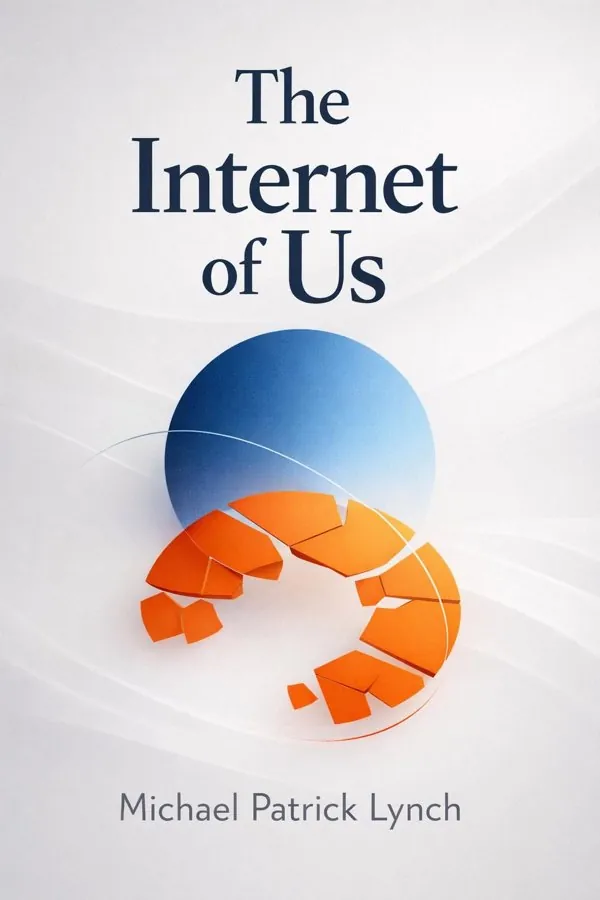
The Internet of Us: Knowing More and Understanding Less in the Age of Big Data: Summary & Key Insights
 10 min6 chaptersAudio available
What Is The Internet of Us: Knowing More and Understanding Less in the Age of Big Data About?
The Internet of Us: Knowing More and Understanding Less in the Age of Big Data by Michael Patrick Lynch is a digital_culture book spanning 6 pages. In this thought-provoking work, philosopher Michael Patrick Lynch explores how the internet has transformed the way we think, know, and understand the world. He examines the paradox of living in an age of unprecedented access to information while often understanding less, questioning how digital technology shapes our beliefs, knowledge, and sense of truth. Lynch argues for the importance of intellectual humility and critical thinking in navigating the digital age.
This FizzRead summary covers all 6 key chapters of The Internet of Us: Knowing More and Understanding Less in the Age of Big Data in approximately 10 minutes, distilling the most important ideas, arguments, and takeaways from Michael Patrick Lynch's work. Also available as an audio summary and Key Quotes Podcast.
The Internet of Us: Knowing More and Understanding Less in the Age of Big Data
In this thought-provoking work, philosopher Michael Patrick Lynch explores how the internet has transformed the way we think, know, and understand the world. He examines the paradox of living in an age of unprecedented access to information while often understanding less, questioning how digital technology shapes our beliefs, knowledge, and sense of truth. Lynch argues for the importance of intellectual humility and critical thinking in navigating the digital age.
Who Should Read The Internet of Us: Knowing More and Understanding Less in the Age of Big Data?
This book is perfect for anyone interested in digital_culture and looking to gain actionable insights in a short read. Whether you're a student, professional, or lifelong learner, the key ideas from The Internet of Us: Knowing More and Understanding Less in the Age of Big Data by Michael Patrick Lynch will help you think differently.
- ✓Readers who enjoy digital_culture and want practical takeaways
- ✓Professionals looking to apply new ideas to their work and life
- ✓Anyone who wants the core insights of The Internet of Us: Knowing More and Understanding Less in the Age of Big Data in just 10 minutes
Want the full summary?
Get instant access to this book summary and 100K+ more with Fizz Moment.
Get Free SummaryAvailable on App Store • Free to download
Key Chapters
To understand the peculiarities of digital knowing, we must begin with philosophy’s ancient question: What does it mean to know something? Traditional epistemology has often pictured knowledge as justified true belief—an individual’s well-grounded conviction about a true proposition. Yet, in the internet age, that model feels outdated. Knowledge today is rarely isolated in a single mind; it circulates through systems, screens, and shared databases. Our ‘knowing’ is entangled with algorithms and collectives.
I argue that the network is not merely a repository of knowledge—it has become part of our cognitive system. Just as writing once extended memory, and books extended the reach of individual reason, the internet extends our cognitive reach. But this expansion brings both power and peril. When I say, ‘I know the capital of Mongolia,’ do I actually know it, or do I merely know how to find it? This subtle shift from possession to access defines much of modern epistemology.
Understanding this requires us to see the internet as both epistemic infrastructure and social mirror. It mirrors our desires for certainty, speed, and relevance, yet it rewards shallow engagement. Thus, we must refine our understanding of knowledge—less as static ownership of truths, more as the active ability to interpret, question, and integrate information into our worldview.
The notion of ‘Google-knowing’ captures a striking feature of our cognitive life. We often feel knowledgeable because the answer is a search away. But this outsourced memory creates a phantom sense of understanding. We experience what I call the illusion of explanatory depth—believing we understand a topic fully when, in fact, our comprehension rests on the scaffolding of others’ expertise and accessible databases.
Think of the last time you debated a political claim or scientific fact. Likely, your confidence sprang from a quick online verification, not deep reasoning. Google-knowing, then, is a kind of intellectual convenience. It offers rapid retrieval but bypasses the slow work of integration and judgment that genuine knowledge requires. There is no shame in depending on search engines—but there is danger in confusing retrieval with reflection. Knowledge, in its fullest sense, demands not just knowing that something is true but understanding why it is true and how it fits into a larger framework of meaning.
Our task is not to reject the convenience of search technology but to become aware of its cognitive implications. The internet expands our capacity for information yet shrinks our patience for ambiguity. To reclaim true intelligence, we must learn to move beyond the query toward the question—to ask not only what is known but how and why we know it.
+ 4 more chapters — available in the FizzRead app
All Chapters in The Internet of Us: Knowing More and Understanding Less in the Age of Big Data
About the Author
Michael Patrick Lynch is a professor of philosophy at the University of Connecticut and director of the Humanities Institute. His research focuses on truth, epistemology, and the philosophy of technology. He is the author of several books on truth and knowledge, including 'True to Life' and 'The Internet of Us'.
Get This Summary in Your Preferred Format
Read or listen to the The Internet of Us: Knowing More and Understanding Less in the Age of Big Data summary by Michael Patrick Lynch anytime, anywhere. FizzRead offers multiple formats so you can learn on your terms — all free.
Available formats: App · Audio · PDF · EPUB — All included free with FizzRead
Download The Internet of Us: Knowing More and Understanding Less in the Age of Big Data PDF and EPUB Summary
Key Quotes from The Internet of Us: Knowing More and Understanding Less in the Age of Big Data
“To understand the peculiarities of digital knowing, we must begin with philosophy’s ancient question: What does it mean to know something?”
“The notion of ‘Google-knowing’ captures a striking feature of our cognitive life.”
Frequently Asked Questions about The Internet of Us: Knowing More and Understanding Less in the Age of Big Data
The Internet of Us: Knowing More and Understanding Less in the Age of Big Data by Michael Patrick Lynch is a digital_culture book that explores key ideas across 6 chapters. In this thought-provoking work, philosopher Michael Patrick Lynch explores how the internet has transformed the way we think, know, and understand the world. He examines the paradox of living in an age of unprecedented access to information while often understanding less, questioning how digital technology shapes our beliefs, knowledge, and sense of truth. Lynch argues for the importance of intellectual humility and critical thinking in navigating the digital age.
You Might Also Like
An Ugly Truth: Inside Facebook’s Battle for Domination
Sheera Frenkel, Cecilia Kang
10 min
Cyber Citizens
Ian Goodfellow
10 min
Digital Minimalism: Choosing a Focused Life in a Noisy World
Cal Newport
10 min
E‑Books & Beyond
Various Authors
10 min
The Future of Media
Various Authors
10 min
This Is Why We Can't Have Nice Things
Whitney Phillips
10 minBrowse by Category
Ready to read The Internet of Us: Knowing More and Understanding Less in the Age of Big Data?
Get the full summary and 100K+ more books with Fizz Moment.