
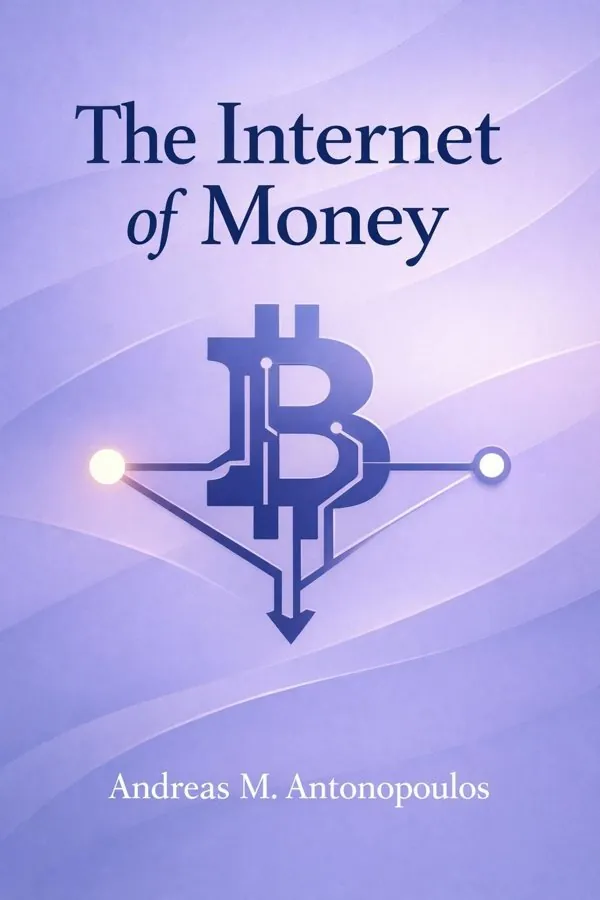
The Internet of Money: Summary & Key Insights
 10 min7 chaptersAudio available
What Is The Internet of Money About?
The Internet of Money by Andreas M. Antonopoulos is a economics book spanning 7 pages. The Internet of Money explores the significance of Bitcoin beyond its technical aspects, focusing on the philosophical, social, and economic implications of decentralized digital currency. Through a series of essays, Antonopoulos explains how Bitcoin represents a fundamental shift in how humanity perceives and uses money, emphasizing its potential to empower individuals and transform global finance.
This FizzRead summary covers all 7 key chapters of The Internet of Money in approximately 10 minutes, distilling the most important ideas, arguments, and takeaways from Andreas M. Antonopoulos's work. Also available as an audio summary and Key Quotes Podcast.
The Internet of Money
The Internet of Money explores the significance of Bitcoin beyond its technical aspects, focusing on the philosophical, social, and economic implications of decentralized digital currency. Through a series of essays, Antonopoulos explains how Bitcoin represents a fundamental shift in how humanity perceives and uses money, emphasizing its potential to empower individuals and transform global finance.
Who Should Read The Internet of Money?
This book is perfect for anyone interested in economics and looking to gain actionable insights in a short read. Whether you're a student, professional, or lifelong learner, the key ideas from The Internet of Money by Andreas M. Antonopoulos will help you think differently.
- ✓Readers who enjoy economics and want practical takeaways
- ✓Professionals looking to apply new ideas to their work and life
- ✓Anyone who wants the core insights of The Internet of Money in just 10 minutes
Want the full summary?
Get instant access to this book summary and 100K+ more with Fizz Moment.
Get Free SummaryAvailable on App Store • Free to download
Key Chapters
Money has always been a mirror of our society—reflecting both our cooperation and our control. Historically, money evolved from barter to coins, then paper, and eventually into digital numbers that mark our lives every day. Every form of money encodes trust. When we use dollars, we trust the institutions that issue and regulate them. When societies used gold, they trusted its scarcity. But all of these are constructs depending on human intermediaries capable of manipulation, corruption, or exclusion.
To understand Bitcoin, we must first understand money as communication. When you send a payment, you are transmitting a message that says, 'I value this'. Bitcoin takes that communication and removes the intermediaries who traditionally manage the message. In doing so, it restores transparency and integrity to the most fundamental conversation humans have: how we exchange value.
My goal in exploring the nature of money has always been to remove the myths surrounding it. Money is not backed by government edict—it is backed by collective belief. Bitcoin exposes this truth directly. Its value is not declared; it is discovered in every transaction made freely, without coercion. This, in turn, forces us to ask difficult but liberating questions: What is value? Who decides what should hold it? Can trust exist without authority?
In the answers to these questions lies the philosophical core of Bitcoin. It transforms money from an instrument of control into an instrument of expression.
For centuries, we have relied on centralized institutions—banks, governments, payment networks—to mediate trust. Bitcoin disrupts this model completely. Instead of trusting a third party, we verify through cryptography. Instead of believing a record keeper, we have an immutable ledger that everyone can inspect.
At the heart of this shift is decentralization. When I speak of decentralization, I don’t mean chaos or anarchy. I mean replacing hierarchical control with a network where every participant is an equal node. This design mirrors the resilience of the Internet itself—distributed, robust, and almost impossible to censor.
Trust in Bitcoin does not come from authority but from computation. The network validates transactions through proof-of-work, creating a collective consensus governed by mathematics. This kind of trust is alien to traditional systems, which rely on identity and reputation rather than transparency and verification. Bitcoin changes that formula; trust becomes not who you are, but what you can prove.
When people grasp this shift, they begin to see Bitcoin not as a financial experiment, but as a model for how we can rebuild more equitable systems. It demonstrates that trust can be designed, encoded, and decentralized. This realization is perhaps the most transformative aspect of Bitcoin—it redefines not only who we trust but why we trust.
+ 5 more chapters — available in the FizzRead app
All Chapters in The Internet of Money
About the Author
Andreas M. Antonopoulos is a technologist, entrepreneur, and one of the world’s foremost Bitcoin and open blockchain experts. He is known for his clear explanations of complex topics and his advocacy for decentralized technologies. Antonopoulos has authored several influential books on cryptocurrency and blockchain technology.
Get This Summary in Your Preferred Format
Read or listen to the The Internet of Money summary by Andreas M. Antonopoulos anytime, anywhere. FizzRead offers multiple formats so you can learn on your terms — all free.
Available formats: App · Audio · PDF · EPUB — All included free with FizzRead
Download The Internet of Money PDF and EPUB Summary
Key Quotes from The Internet of Money
“Money has always been a mirror of our society—reflecting both our cooperation and our control.”
“For centuries, we have relied on centralized institutions—banks, governments, payment networks—to mediate trust.”
Frequently Asked Questions about The Internet of Money
The Internet of Money by Andreas M. Antonopoulos is a economics book that explores key ideas across 7 chapters. The Internet of Money explores the significance of Bitcoin beyond its technical aspects, focusing on the philosophical, social, and economic implications of decentralized digital currency. Through a series of essays, Antonopoulos explains how Bitcoin represents a fundamental shift in how humanity perceives and uses money, emphasizing its potential to empower individuals and transform global finance.
You Might Also Like

Business Adventures
John Brooks
10 min
Nudge
Richard H. Thaler, Cass R. Sunstein
10 min
The Hitchhiker"s Guide to the Galaxy
Douglas Adams
10 minThe Muqaddimah
Ibn Khaldun
10 minThe Outsiders
William N. Thorndike
10 min
A Little History of Economics
Niall Kishtainy
10 minBrowse by Category
Ready to read The Internet of Money?
Get the full summary and 100K+ more books with Fizz Moment.