
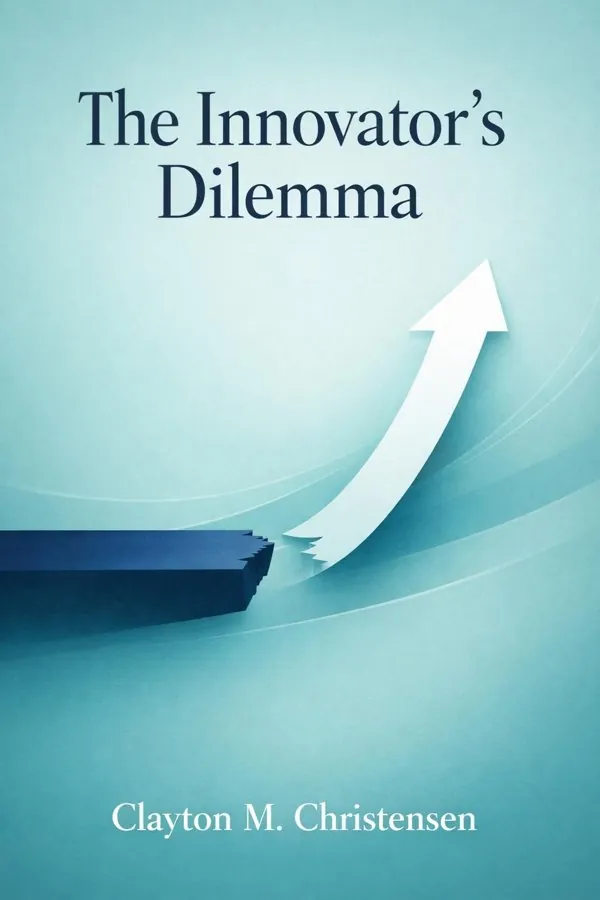
The Innovator's Dilemma: Summary & Key Insights
 10 min10 chaptersAudio available
Key Takeaways from The Innovator's Dilemma
The most dangerous competitive threat rarely looks dangerous at first.
History becomes useful when it repeats with uncomfortable consistency.
One of the book’s most provocative arguments is that customer focus, usually considered a management virtue, can become a strategic liability.
Organizations do not simply execute strategy; they determine which strategies are even possible.
Disruption is not limited to Silicon Valley or digital products.
What Is The Innovator's Dilemma About?
The Innovator's Dilemma by Clayton Christensen is a business book published in 1997 spanning 10 pages. Why do great companies fail precisely when they seem to be doing everything right? That is the unsettling question at the heart of Clayton Christensen’s The Innovator’s Dilemma, one of the most influential business books ever written. Instead of blaming collapse on poor leadership, laziness, or a lack of innovation, Christensen shows that well-managed companies often falter because they listen closely to their best customers, invest in high-performance products, and allocate resources responsibly. In other words, they fail because they follow the logic that usually makes them successful. The problem emerges when a new kind of innovation appears—one that initially looks inferior, serves fringe customers, and offers weaker profits. Christensen calls these disruptive technologies. Over time, they improve, move upmarket, and displace incumbents that ignored them. Drawing on deep research across industries, especially disk drives and heavy equipment, Christensen provides a powerful framework for understanding how markets evolve and why organizational structures can block adaptation. For managers, founders, and investors, this book remains essential because it explains not just how disruption happens, but how leaders can respond before it is too late.
This FizzRead summary covers all 10 key chapters of The Innovator's Dilemma in approximately 10 minutes, distilling the most important ideas, arguments, and takeaways from Clayton Christensen's work. Also available as an audio summary and Key Quotes Podcast.
The Innovator's Dilemma
Why do great companies fail precisely when they seem to be doing everything right? That is the unsettling question at the heart of Clayton Christensen’s The Innovator’s Dilemma, one of the most influential business books ever written. Instead of blaming collapse on poor leadership, laziness, or a lack of innovation, Christensen shows that well-managed companies often falter because they listen closely to their best customers, invest in high-performance products, and allocate resources responsibly. In other words, they fail because they follow the logic that usually makes them successful. The problem emerges when a new kind of innovation appears—one that initially looks inferior, serves fringe customers, and offers weaker profits. Christensen calls these disruptive technologies. Over time, they improve, move upmarket, and displace incumbents that ignored them. Drawing on deep research across industries, especially disk drives and heavy equipment, Christensen provides a powerful framework for understanding how markets evolve and why organizational structures can block adaptation. For managers, founders, and investors, this book remains essential because it explains not just how disruption happens, but how leaders can respond before it is too late.
Who Should Read The Innovator's Dilemma?
This book is perfect for anyone interested in business and looking to gain actionable insights in a short read. Whether you're a student, professional, or lifelong learner, the key ideas from The Innovator's Dilemma by Clayton Christensen will help you think differently.
- ✓Readers who enjoy business and want practical takeaways
- ✓Professionals looking to apply new ideas to their work and life
- ✓Anyone who wants the core insights of The Innovator's Dilemma in just 10 minutes
Want the full summary?
Get instant access to this book summary and 100K+ more with Fizz Moment.
Get Free SummaryAvailable on App Store • Free to download
Key Chapters
The most dangerous competitive threat rarely looks dangerous at first. Christensen’s central insight is that not all innovation works the same way. Sustaining innovations improve established products along dimensions mainstream customers already value: more power, better quality, greater speed, higher reliability, and additional features. These innovations help incumbents because they align with existing capabilities, sales processes, and profit expectations. Disruptive innovations, by contrast, begin as simpler, cheaper, smaller, or more convenient offerings that initially underperform on traditional metrics. That is exactly why leading companies dismiss them. They appear unattractive to core customers and financially insignificant compared with the main business.
The trap is that market demand does not stand still. A technology that starts out inferior can improve faster than customer needs increase. When that happens, the disruptive product becomes good enough for mainstream buyers. By then, the entrant has built experience, cost advantages, and a business model tailored to the new market. The incumbent, still optimized for higher-end customers, struggles to respond.
Think of how low-cost software tools, budget airlines, streaming platforms, or mobile-first banking apps often began by serving overlooked users rather than premium segments. Their early weakness was not a bug; it was part of what allowed them to enter the market.
A practical way to use this distinction is to ask two questions whenever a new technology appears: Does it help my best customers do more of what they already value, or does it attract new or less-demanding customers with a different value proposition? If it is the latter, do not dismiss it because it looks small. Actionable takeaway: Build a habit of classifying innovations as sustaining or disruptive before deciding how seriously to invest in them.
History becomes useful when it repeats with uncomfortable consistency. Christensen’s evidence from the disk drive industry is the book’s most famous case because it offers a clear laboratory for studying technological change. Generation after generation, established companies led sustaining improvements within existing form factors. They built better 14-inch drives, then better 8-inch drives, then better 5.25-inch drives. Yet, when a new architecture emerged that initially served a different market, leadership often changed hands.
The reason was not incompetence. Incumbents generally saw the new technology, invested in it, and understood its technical potential. What they lacked was a business reason to prioritize it. The first 8-inch drives were not attractive to customers buying 14-inch drives. The first 5.25-inch drives did not satisfy minicomputer makers. The first 3.5-inch drives looked underpowered to existing buyers. But each smaller format fit the needs of a different emerging market: minicomputers, desktop computers, portable devices. Entrants focused there, improved rapidly, and eventually invaded the mainstream.
This pattern matters beyond storage hardware. It appears whenever new products enter through overlooked footholds: cheaper education models, simpler medical devices, entry-level electric vehicles, or lightweight SaaS tools replacing complex enterprise systems. The lesson is that market leadership in one generation of technology does not transfer automatically to the next.
Managers can apply this case by mapping where a new offering is first good enough, rather than where it is currently weak. Instead of asking, “Can it win in our core market today?” ask, “Which emerging market already values its unique strengths?” Actionable takeaway: Track fringe and emerging segments as seriously as core segments, because tomorrow’s mainstream often begins as today’s niche.
One of the book’s most provocative arguments is that customer focus, usually considered a management virtue, can become a strategic liability. Well-run companies talk to their best customers, study their needs, and invest where returns are highest. This works beautifully for sustaining innovation because top customers ask for better versions of what they already buy. Sales teams, product managers, and executives then allocate resources to projects that promise stronger margins and immediate demand.
The problem is that disruptive innovations are often irrelevant to those same customers at the beginning. Existing buyers do not want the lower-performing, cheaper, simpler, or more convenient alternative. If leaders rely only on current customers for strategic guidance, they will systematically underinvest in the next wave of growth. In Christensen’s framework, companies are not failing despite listening to customers; in disruptive contexts, they may fail because of it.
Modern examples are easy to spot. Enterprise software firms may ignore self-serve tools because their largest accounts demand customization. Traditional universities may overlook low-cost online alternatives because alumni and premium students prefer campus experiences. Luxury automakers may dismiss affordable EVs because current customers prioritize performance or prestige. In each case, the incumbent’s strongest relationships anchor it to the wrong signals.
This does not mean leaders should stop listening to customers. It means they should broaden the definition of whose voice matters. Companies need mechanisms to study noncustomers, low-end users, and emerging use cases that appear commercially modest at first.
A practical method is to separate discovery work from core account management. Create teams tasked with interviewing people who are not buying the category, or who are overserved by current products. Actionable takeaway: Balance customer obsession with noncustomer curiosity, because future growth often begins outside the demands of your current best buyers.
Organizations do not simply execute strategy; they determine which strategies are even possible. Christensen argues that a company’s capabilities are not limited to its people and money. They also include processes and values: the routines by which work gets done and the criteria by which priorities are judged. These hidden systems are often the real source of strength in established businesses, but they are also what makes disruption difficult to address.
A large company may have brilliant engineers and substantial capital, yet still fail to build a disruptive product because its planning systems favor large markets, its sales force prefers high-ticket accounts, and its margin expectations reject lower-profit opportunities. In that environment, managers do not need to be irrational to avoid disruption. The organization naturally channels resources toward projects that fit existing patterns of success.
That is why simply telling a team to “be innovative” rarely works. If the budgeting process kills small opportunities, if the go-to-market model cannot serve low-end users, or if executive attention goes only to large revenue lines, disruptive initiatives will starve. The issue is structural, not motivational.
You can see this in corporations trying to launch subscription products while their incentives reward one-time sales, or in media firms experimenting with digital formats while measuring success by old advertising economics. The talent may be present, but the operating logic is wrong.
Leaders should regularly audit whether their processes and values fit the opportunity they want to pursue. If a new business requires different margins, sales cycles, customer types, or product rhythms, it may need a different structure. Actionable takeaway: Evaluate innovation through the lens of resources, processes, and values, not just headcount and budget.
Disruption is not limited to Silicon Valley or digital products. Christensen broadens the theory through the excavator industry, showing that the same dynamics apply in heavy machinery. Established manufacturers dominated with cable-actuated excavators and improved them steadily for demanding mainstream customers. Then hydraulic excavators emerged. Early versions were not immediately superior across every dimension, and they appealed first in applications incumbents did not prioritize. As hydraulic technology improved, it redefined the market and displaced leaders tied to the old architecture.
This example matters because it eliminates a common excuse: that disruption is only a feature of fast-moving electronics. Christensen shows that the dilemma stems from managerial logic and market structure, not just technological speed. Whether the product is industrial equipment, medical instruments, retail formats, or software platforms, companies become vulnerable when a new solution gains traction in a marginal segment and then moves upward.
The excavator case is especially useful for leaders in traditional sectors who assume their industry is too physical, regulated, or relationship-driven to be disrupted. Construction, logistics, manufacturing, and energy businesses often believe scale and installed assets provide protection. They do matter, but they do not erase the risk of a simpler architecture or a new business model changing what customers value.
A practical application is to watch for “inferior” alternatives that solve a narrower job more cheaply, safely, or conveniently. They may look specialized at first, but they can evolve into mainstream substitutes. Instead of benchmarking only against your direct premium competitors, examine adjacent solutions and unconventional entrants.
Actionable takeaway: Treat disruption as an industry-agnostic pattern and scan for low-end or niche alternatives even in mature, asset-heavy markets.
What looks like a bad decision in one market can be the smartest move in another. Christensen introduces the idea of value networks to explain why firms behave rationally within one context yet fail in another. A value network is the commercial ecosystem in which a company operates: its customers, cost structures, margin expectations, distribution channels, competitors, and performance standards. Inside a given value network, managers learn what counts as an attractive opportunity and what does not.
This matters because disruptive technologies often become viable first in a different value network from the incumbent’s main business. The new market may tolerate lower margins, reward convenience over performance, or rely on channels the incumbent does not serve well. From the perspective of the established company’s current network, the opportunity looks too small or too unattractive. From the perspective of the emerging network, it looks perfectly sensible.
Consider how cloud software initially appealed to smaller firms that could not afford complex on-premise systems, or how direct-to-consumer brands first succeeded outside traditional retail economics. In each case, the entrant thrived because it operated in a value network where the economics made sense.
For managers, this means strategy should not focus only on product features. It should also examine where a product can win economically and organizationally. A disruptive offering often fails inside the incumbent’s existing business because it is judged by the wrong standards.
A practical response is to ask: In what customer environment would this innovation be considered not inferior, but ideal? Where do its costs, channels, and performance profile fit naturally? Actionable takeaway: Match new ventures to the value network that supports them instead of forcing them into the economics of the core business.
The book does not merely diagnose failure; it challenges traditional strategic instincts. Christensen argues that the management practices taught as universally sound are context-dependent. In stable or sustaining environments, it is wise to invest where customers demand improvement, where margins are strongest, and where market sizes justify capital. In disruptive environments, these same rules can produce blindness.
That means managers need a second playbook. Instead of waiting for large, proven markets, they must be willing to enter small, uncertain spaces. Instead of demanding detailed forecasts, they must tolerate experimentation. Instead of insisting that new initiatives meet existing profitability benchmarks, they must judge them by different expectations. The challenge is not a lack of discipline; it is applying the wrong discipline to the wrong type of opportunity.
Many organizations struggle here because strategy processes reward certainty. Business cases require clear TAM estimates, five-year projections, and visible customer demand. But disruptive markets are often unknowable at birth. The first products are imperfect, the first customers are unusual, and the strongest use cases emerge through trial and adaptation. Leaders who demand proof too early guarantee that they will invest too late.
This insight applies to startups as well as incumbents. Entrepreneurs can misread disruption if they scale too quickly toward mainstream customers before the product is ready, or if they copy incumbents’ metrics too soon.
A practical way forward is to separate exploratory strategy from core planning. Give emerging initiatives permission to learn before they are expected to optimize. Actionable takeaway: Use one set of strategic rules for sustaining innovation and another for disruptive uncertainty, because the same management logic does not fit both.
A disruptive project usually dies not from external competition, but from internal comparison. Christensen’s advice to build independent organizational units is one of the book’s most practical contributions. Because disruptive opportunities start small and often carry lower margins, they are almost impossible to nurture within large divisions built around bigger customers and higher-return products. The core business will always have more urgent needs, stronger political power, and clearer financial logic.
Creating an autonomous unit helps solve this problem. A separate organization can adopt different cost structures, sales models, development cycles, and success metrics. It can focus on customers the parent company considers unimportant. It can also make decisions quickly without being filtered through the assumptions of the existing business. Independence is not symbolic; it is operational. The new unit must have enough authority to build a business that fits the disruptive opportunity rather than imitating the parent.
This logic appears today in corporate venture studios, spinouts, separate digital business lines, and skunkworks teams. Some succeed because they are genuinely free to pursue different economics. Others fail because they remain dependent on the parent’s processes, approvals, and targets.
The key is not separation for its own sake. If a project supports the core value network, integration may be beneficial. But if success depends on serving new customers with a different model, independence becomes essential.
Managers should ask whether the initiative’s size, customer type, margins, and channels fit the parent company. If not, structural separation is often wiser than heroic coordination. Actionable takeaway: Give disruptive initiatives their own organization when the core business would otherwise reject their economics, priorities, or pace.
The hardest strategic question is not how to respond to disruption after it has matured, but how to recognize it while it still looks unimpressive. Christensen offers clues. Early disruptive innovations often target customers incumbents do not value, perform worse on mainstream dimensions, and appear in markets too small to interest leading firms. They may also succeed because they are cheaper, simpler, more portable, or more accessible rather than because they are technically superior.
This creates a paradox: the signals of disruption are easy to see and easy to dismiss. Leaders often confuse low initial performance with low long-term threat. But the more important question is whether the new technology is improving faster than customer requirements. If it is, then a product that is currently inadequate may soon become more than good enough.
In practice, executives can build an early-warning system around trajectory rather than snapshot analysis. Instead of comparing only today’s features, examine rate of improvement, adoption among fringe users, and whether the product changes cost or convenience enough to expand the market. A weak alternative can still be strategically profound if it opens access for people previously excluded or overserved.
Examples include early smartphones replacing specialized devices, low-code tools empowering nonengineers, or telemedicine expanding access before it matched every in-person capability. Their first versions were limited, yet their path of progress mattered more than their starting point.
Actionable takeaway: Watch technologies that are inferior today but improving quickly in overlooked segments, because disruption is defined less by present strength than by future trajectory.
The ultimate lesson of The Innovator’s Dilemma is not that disruption can be eliminated, but that it can be managed with humility and design. Christensen does not promise a perfect defensive strategy. Instead, he shows that leaders improve their odds when they accept several uncomfortable truths: good management can cause failure in the wrong context; small markets can become large; and organizations cannot be expected to do what their structures were not built to do.
Escaping the dilemma therefore requires a portfolio mindset. Companies should continue strengthening the core with sustaining innovation while also creating mechanisms to explore disruptive possibilities. They must be willing to commercialize products that initially look weaker, allow experiments to target nontraditional customers, and tolerate businesses that do not yet matter financially. This is difficult because public markets, internal budgeting, and executive incentives all favor visible near-term returns.
The leaders most likely to succeed are those who replace certainty with learning. They recognize that forecasts are least reliable where disruption is most likely. They test assumptions in market, build structures that fit emerging opportunities, and avoid forcing every initiative through the same decision logic. In today’s environment of AI, climate tech, healthcare redesign, and platform shifts, this mindset is more relevant than ever.
For individual readers, the book offers a broader life lesson as well: success can lock us into habits that stop us from seeing change. Whether running a company or a team, we must remain open to ideas that seem too small, too simple, or too strange.
Actionable takeaway: Defend the core, but deliberately fund small experiments outside it, because adaptation depends on institutionalizing curiosity before crisis makes it urgent.
All Chapters in The Innovator's Dilemma
About the Author
Clayton M. Christensen (1952–2020) was an American academic, author, and business consultant whose work transformed the way leaders think about innovation. A professor at Harvard Business School, he became globally known for developing the theory of disruptive innovation, which explains why successful companies can lose their dominance when new technologies or business models emerge. Before entering academia, Christensen studied economics, worked as a consultant, and gained business experience that informed his practical approach to management theory. He wrote several influential books, including The Innovator’s Dilemma, The Innovator’s Solution, and How Will You Measure Your Life? Admired for combining rigorous research with clear strategic insight, Christensen influenced executives, entrepreneurs, investors, and policymakers across industries. His ideas remain foundational in discussions of growth, competition, and technological change.
Get This Summary in Your Preferred Format
Read or listen to the The Innovator's Dilemma summary by Clayton Christensen anytime, anywhere. FizzRead offers multiple formats so you can learn on your terms — all free.
Available formats: App · Audio · PDF · EPUB — All included free with FizzRead
Download The Innovator's Dilemma PDF and EPUB Summary
Key Quotes from The Innovator's Dilemma
“The most dangerous competitive threat rarely looks dangerous at first.”
“History becomes useful when it repeats with uncomfortable consistency.”
“One of the book’s most provocative arguments is that customer focus, usually considered a management virtue, can become a strategic liability.”
“Organizations do not simply execute strategy; they determine which strategies are even possible.”
“Disruption is not limited to Silicon Valley or digital products.”
Frequently Asked Questions about The Innovator's Dilemma
The Innovator's Dilemma by Clayton Christensen is a business book that explores key ideas across 10 chapters. Why do great companies fail precisely when they seem to be doing everything right? That is the unsettling question at the heart of Clayton Christensen’s The Innovator’s Dilemma, one of the most influential business books ever written. Instead of blaming collapse on poor leadership, laziness, or a lack of innovation, Christensen shows that well-managed companies often falter because they listen closely to their best customers, invest in high-performance products, and allocate resources responsibly. In other words, they fail because they follow the logic that usually makes them successful. The problem emerges when a new kind of innovation appears—one that initially looks inferior, serves fringe customers, and offers weaker profits. Christensen calls these disruptive technologies. Over time, they improve, move upmarket, and displace incumbents that ignored them. Drawing on deep research across industries, especially disk drives and heavy equipment, Christensen provides a powerful framework for understanding how markets evolve and why organizational structures can block adaptation. For managers, founders, and investors, this book remains essential because it explains not just how disruption happens, but how leaders can respond before it is too late.
You Might Also Like





Featured In
Browse by Category
Ready to read The Innovator's Dilemma?
Get the full summary and 100K+ more books with Fizz Moment.