
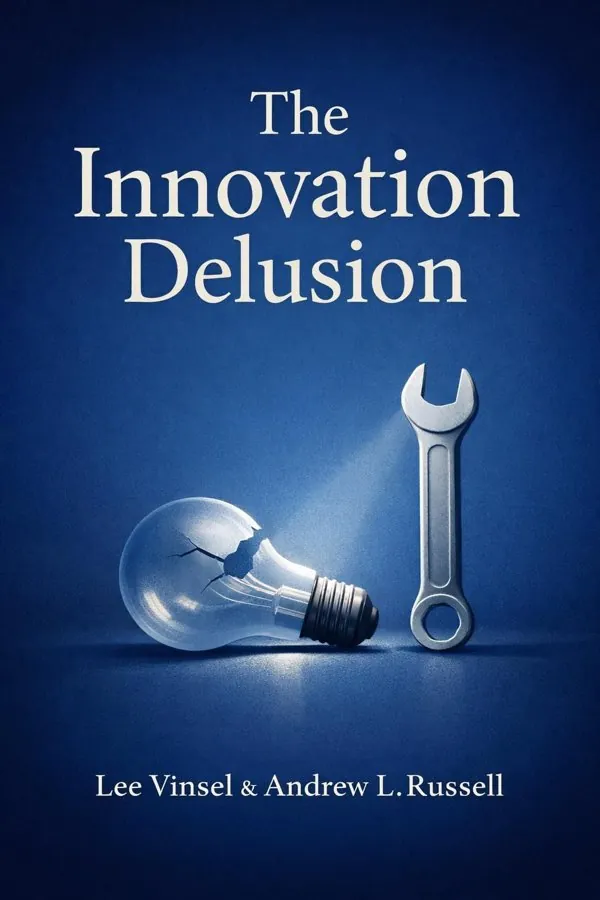
The Innovation Delusion: How Our Obsession with the New Has Disrupted the Work That Matters Most: Summary & Key Insights
by Lee Vinsel, Andrew L. Russell
 10 min4 chaptersAudio available
What Is The Innovation Delusion: How Our Obsession with the New Has Disrupted the Work That Matters Most About?
The Innovation Delusion: How Our Obsession with the New Has Disrupted the Work That Matters Most by Lee Vinsel, Andrew L. Russell is a economics book spanning 4 pages. In this book, Lee Vinsel and Andrew L. Russell challenge the modern fixation on innovation, arguing that society’s obsession with the new has led to the neglect of maintenance, repair, and care—the essential work that keeps our world functioning. They advocate for a cultural shift toward valuing the people and systems that sustain our infrastructure, technology, and institutions, coining the term 'maintenance mindset' as a counterbalance to the innovation delusion.
This FizzRead summary covers all 4 key chapters of The Innovation Delusion: How Our Obsession with the New Has Disrupted the Work That Matters Most in approximately 10 minutes, distilling the most important ideas, arguments, and takeaways from Lee Vinsel, Andrew L. Russell's work. Also available as an audio summary and Key Quotes Podcast.
The Innovation Delusion: How Our Obsession with the New Has Disrupted the Work That Matters Most
In this book, Lee Vinsel and Andrew L. Russell challenge the modern fixation on innovation, arguing that society’s obsession with the new has led to the neglect of maintenance, repair, and care—the essential work that keeps our world functioning. They advocate for a cultural shift toward valuing the people and systems that sustain our infrastructure, technology, and institutions, coining the term 'maintenance mindset' as a counterbalance to the innovation delusion.
Who Should Read The Innovation Delusion: How Our Obsession with the New Has Disrupted the Work That Matters Most?
This book is perfect for anyone interested in economics and looking to gain actionable insights in a short read. Whether you're a student, professional, or lifelong learner, the key ideas from The Innovation Delusion: How Our Obsession with the New Has Disrupted the Work That Matters Most by Lee Vinsel, Andrew L. Russell will help you think differently.
- ✓Readers who enjoy economics and want practical takeaways
- ✓Professionals looking to apply new ideas to their work and life
- ✓Anyone who wants the core insights of The Innovation Delusion: How Our Obsession with the New Has Disrupted the Work That Matters Most in just 10 minutes
Want the full summary?
Get instant access to this book summary and 100K+ more with Fizz Moment.
Get Free SummaryAvailable on App Store • Free to download
Key Chapters
To understand how we arrived at this present imbalance, we need to step back into the twentieth century, when the notion of innovation began its extraordinary ascent. For most of American history, progress was tied to ideas of stewardship, reliability, and public duty. Engineers and public officials once saw themselves as custodians of infrastructure meant to endure—railways, power grids, and water systems built for longevity and resilience. The word 'innovation' was not a buzzword of ambition; in fact, until the mid-twentieth century, it often had negative connotations, associated with disruption and instability.
All that changed after World War II. As the United States entered a period of affluence and global leadership, innovation became synonymous with national strength. The Cold War accelerated that shift, spurring federal research funding and glorifying scientists and technologists as heroes of progress. The space race, Silicon Valley, and managerial revolutions in corporate America created a new language of innovation—one that turned novelty into an end in itself.
This history matters because it illuminates how the innovation ideal became detached from material improvement. Slogans like 'innovate or die' replaced sober assessments of maintenance and lifecycle costs. By the late twentieth century, presidents, CEOs, and consulting firms paraded innovation as a panacea for every problem, from education reform to city governance. Few asked whether these innovations worked or whether they were necessary. It was enough to brand something as innovative to secure legitimacy and investment.
Meanwhile, the infrastructure built during mid-century was aging. The deferred repairs on bridges, power lines, water systems, and public institutions quietly accumulated. Our culture, trained to glorify disruption, had lost sight of the simple truth that anything innovative must eventually be maintained. Without care, systems fail; without maintenance, innovation collapses on itself.
When we treat innovation as an unquestioned virtue, we generate perverse incentives that ripple through every level of society. Consider how corporations chase short-term gains under the banner of innovation—rolling out new products and software updates not for user benefit but for stock market appeal. Governments, too, succumb to this logic, funding flashy new projects while neglecting the mundane maintenance of public systems. We lionize startups that promise world-changing disruption but often leave behind broken markets and social costs.
This obsession has consequences that are both tangible and moral. On a physical level, our infrastructure is crumbling. Researchers estimate that the United States faces trillions in deferred maintenance costs across roads, bridges, and public facilities. Technological advancement, meanwhile, has not solved this crisis—it has often made it worse. Digital systems multiply complexity and demand constant upkeep, yet the people responsible for this work receive little recognition or reward.
On an organizational level, the delusion corrodes culture. Workers are encouraged to see themselves as innovators but are denied the time and support to do the ongoing care work that keeps systems functional. Maintenance budgets are cut to fund speculative R&D. Knowledge of systems’ inner workings erodes, leaving institutions brittle and vulnerable. Our research with The Maintainers community revealed stories from technicians, IT staff, and municipal workers across the country—all describing a quiet frustration: their dedication to keeping things running was invisible, their expertise undervalued.
The psychological toll is deep. A society obsessed with novelty breeds insecurity; employees chase relevance by constantly reinventing themselves, while institutions chase the next reform wave rather than tending to enduring imperfections. When applause is reserved for disruption, care begins to look like failure. This is the hidden damage of the innovation delusion—it degrades our collective ability to sustain what we most depend on.
+ 2 more chapters — available in the FizzRead app
All Chapters in The Innovation Delusion: How Our Obsession with the New Has Disrupted the Work That Matters Most
About the Authors
Lee Vinsel is an associate professor of science, technology, and society at Virginia Tech, known for his research on the social aspects of technology and innovation. Andrew L. Russell is a historian of technology and the dean of the College of Arts and Sciences at SUNY Polytechnic Institute. Together, they co-founded The Maintainers, a research network focused on maintenance, repair, and care in technology and society.
Get This Summary in Your Preferred Format
Read or listen to the The Innovation Delusion: How Our Obsession with the New Has Disrupted the Work That Matters Most summary by Lee Vinsel, Andrew L. Russell anytime, anywhere. FizzRead offers multiple formats so you can learn on your terms — all free.
Available formats: App · Audio · PDF · EPUB — All included free with FizzRead
Download The Innovation Delusion: How Our Obsession with the New Has Disrupted the Work That Matters Most PDF and EPUB Summary
Key Quotes from The Innovation Delusion: How Our Obsession with the New Has Disrupted the Work That Matters Most
“To understand how we arrived at this present imbalance, we need to step back into the twentieth century, when the notion of innovation began its extraordinary ascent.”
“When we treat innovation as an unquestioned virtue, we generate perverse incentives that ripple through every level of society.”
Frequently Asked Questions about The Innovation Delusion: How Our Obsession with the New Has Disrupted the Work That Matters Most
The Innovation Delusion: How Our Obsession with the New Has Disrupted the Work That Matters Most by Lee Vinsel, Andrew L. Russell is a economics book that explores key ideas across 4 chapters. In this book, Lee Vinsel and Andrew L. Russell challenge the modern fixation on innovation, arguing that society’s obsession with the new has led to the neglect of maintenance, repair, and care—the essential work that keeps our world functioning. They advocate for a cultural shift toward valuing the people and systems that sustain our infrastructure, technology, and institutions, coining the term 'maintenance mindset' as a counterbalance to the innovation delusion.
You Might Also Like
Business Adventures
John Brooks
10 min
Nudge
Richard H. Thaler, Cass R. Sunstein
10 min
The Hitchhiker"s Guide to the Galaxy
Douglas Adams
10 minThe Muqaddimah
Ibn Khaldun
10 minThe Outsiders
William N. Thorndike
10 min
A Little History of Economics
Niall Kishtainy
10 minBrowse by Category
Ready to read The Innovation Delusion: How Our Obsession with the New Has Disrupted the Work That Matters Most?
Get the full summary and 100K+ more books with Fizz Moment.