
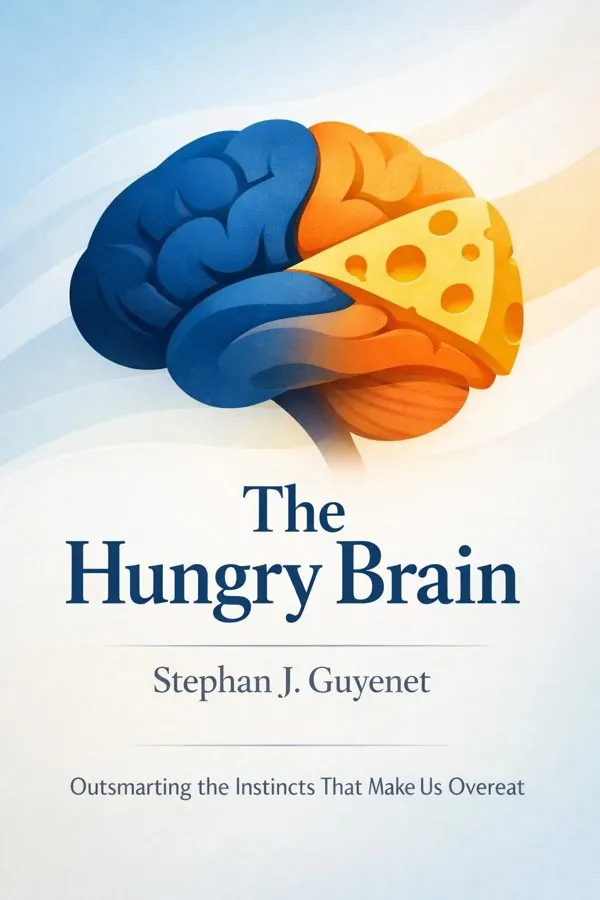
The Hungry Brain: Outsmarting the Instincts That Make Us Overeat: Summary & Key Insights
 10 min7 chaptersAudio available
What Is The Hungry Brain: Outsmarting the Instincts That Make Us Overeat About?
The Hungry Brain: Outsmarting the Instincts That Make Us Overeat by Stephan J. Guyenet is a neuroscience book spanning 7 pages. In this book, neuroscientist Stephan Guyenet explores how the brain’s reward systems, hunger signals, and evolutionary instincts drive overeating in the modern food environment. Drawing on decades of research in neuroscience and metabolism, he explains why our brains are wired to crave calorie-dense foods and how this wiring conflicts with today’s abundance of processed foods. The book offers insights into how understanding these mechanisms can help individuals make better choices and maintain a healthy weight.
This FizzRead summary covers all 7 key chapters of The Hungry Brain: Outsmarting the Instincts That Make Us Overeat in approximately 10 minutes, distilling the most important ideas, arguments, and takeaways from Stephan J. Guyenet's work. Also available as an audio summary and Key Quotes Podcast.
The Hungry Brain: Outsmarting the Instincts That Make Us Overeat
In this book, neuroscientist Stephan Guyenet explores how the brain’s reward systems, hunger signals, and evolutionary instincts drive overeating in the modern food environment. Drawing on decades of research in neuroscience and metabolism, he explains why our brains are wired to crave calorie-dense foods and how this wiring conflicts with today’s abundance of processed foods. The book offers insights into how understanding these mechanisms can help individuals make better choices and maintain a healthy weight.
Who Should Read The Hungry Brain: Outsmarting the Instincts That Make Us Overeat?
This book is perfect for anyone interested in neuroscience and looking to gain actionable insights in a short read. Whether you're a student, professional, or lifelong learner, the key ideas from The Hungry Brain: Outsmarting the Instincts That Make Us Overeat by Stephan J. Guyenet will help you think differently.
- ✓Readers who enjoy neuroscience and want practical takeaways
- ✓Professionals looking to apply new ideas to their work and life
- ✓Anyone who wants the core insights of The Hungry Brain: Outsmarting the Instincts That Make Us Overeat in just 10 minutes
Want the full summary?
Get instant access to this book summary and 100K+ more with Fizz Moment.
Get Free SummaryAvailable on App Store • Free to download
Key Chapters
To understand our modern eating behavior, we must begin with our evolutionary past. The human brain did not evolve in a world of supermarkets and fast-food chains; it evolved in environments where finding food required effort and where survival hinged on efficiently obtaining calories. Our ancestors’ brains became finely tuned to recognize and seek out signals of energy—fat, sugar, salt—because those nutrients were precious and rare.
Natural selection shaped a brain that is acutely sensitive to calorie-rich foods. Those who were most motivated to pursue sweet fruits or fatty meats during periods of scarcity were more likely to survive and reproduce. The neural architecture that rewarded these behaviors became deeply embedded in our species. The trouble is, our environment has changed radically while our biology has not. The modern world supplies a constant flood of calorie-dense options, yet our brain’s ancient appetite circuits still behave as though famine might strike at any time.
This mismatch—between a brain wired for scarcity and an environment of abundance—is what I call the evolutionary trap of modern eating. The very mechanisms that once ensured survival now promote chronic overeating and weight gain. Our instincts that once guaranteed life now work against our long-term health. Recognizing this mismatch is the first step to understanding why rational knowledge alone cannot overcome instinctive drives.
Deep in the brain lies a network that determines what we find pleasurable and worth pursuing. Central to this network is the neurotransmitter dopamine, which reinforces behaviors that lead to rewards—food being one of the most ancient and powerful of them.
When you see or smell food, your brain’s reward system lights up, predicting the pleasure and energy that eating will bring. This dopamine-driven response is not rational; it’s automatic, ancient, and, in today’s environment, constantly triggered. Modern processed foods—rich in sugar, fat, and flavor—activate this system more strongly than almost any natural food could. This is why we can find ourselves craving snacks even when we're full: our reward pathways are lured by sensory cues rather than genuine need.
Through neuroimaging and behavioral research, we’ve seen that the brains of individuals who tend to overeat often display a heightened response to these cues and a diminished response to the actual consumption of food. In other words, the wanting remains strong even when the liking fades. This craving cycle—powerful anticipation followed by fleeting satisfaction—keeps us returning again and again to hyper-palatable foods. The modern food industry has learned, often unintentionally, to exploit this biology, creating products optimized for maximum neural appeal rather than nutritional balance.
+ 5 more chapters — available in the FizzRead app
All Chapters in The Hungry Brain: Outsmarting the Instincts That Make Us Overeat
About the Author
Stephan J. Guyenet, Ph.D., is a neuroscientist and science writer who has studied the neurobiology of body fat regulation and eating behavior. He earned his doctorate in neuroscience from the University of Washington and has published research on obesity, metabolism, and brain function. Guyenet is also known for his writing on health and nutrition at his website, Whole Health Source.
Get This Summary in Your Preferred Format
Read or listen to the The Hungry Brain: Outsmarting the Instincts That Make Us Overeat summary by Stephan J. Guyenet anytime, anywhere. FizzRead offers multiple formats so you can learn on your terms — all free.
Available formats: App · Audio · PDF · EPUB — All included free with FizzRead
Download The Hungry Brain: Outsmarting the Instincts That Make Us Overeat PDF and EPUB Summary
Key Quotes from The Hungry Brain: Outsmarting the Instincts That Make Us Overeat
“To understand our modern eating behavior, we must begin with our evolutionary past.”
“Deep in the brain lies a network that determines what we find pleasurable and worth pursuing.”
Frequently Asked Questions about The Hungry Brain: Outsmarting the Instincts That Make Us Overeat
The Hungry Brain: Outsmarting the Instincts That Make Us Overeat by Stephan J. Guyenet is a neuroscience book that explores key ideas across 7 chapters. In this book, neuroscientist Stephan Guyenet explores how the brain’s reward systems, hunger signals, and evolutionary instincts drive overeating in the modern food environment. Drawing on decades of research in neuroscience and metabolism, he explains why our brains are wired to crave calorie-dense foods and how this wiring conflicts with today’s abundance of processed foods. The book offers insights into how understanding these mechanisms can help individuals make better choices and maintain a healthy weight.
You Might Also Like
Anxious
Joseph LeDoux
10 min
Hallucinations
Oliver Sacks
10 min
The Biological Mind: How Brain, Body, and Environment Collaborate to Make Us Who We Are
Alan Jasanoff
10 min
The Feeling of Life Itself: Why Consciousness Is Widespread but Can't Be Computed
Christof Koch
10 min
The No-Nonsense Meditation Book
Steven Laureys
10 min
A General Theory of Love
Thomas Lewis, Fari Amini, Richard Lannon
10 minBrowse by Category
Ready to read The Hungry Brain: Outsmarting the Instincts That Make Us Overeat?
Get the full summary and 100K+ more books with Fizz Moment.