
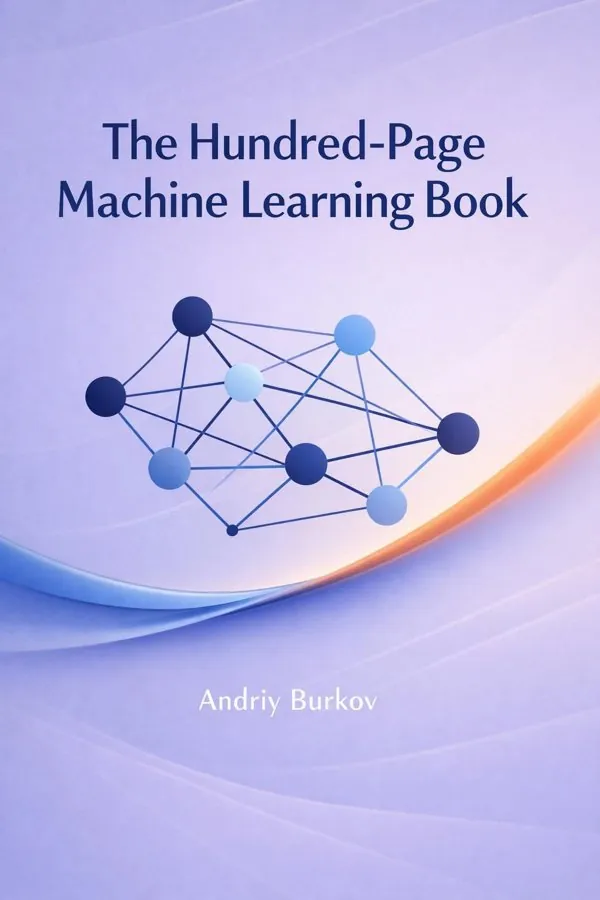
The Hundred‑Page Machine Learning Book: Summary & Key Insights
 10 min5 chaptersAudio available
What Is The Hundred‑Page Machine Learning Book About?
The Hundred‑Page Machine Learning Book by Andriy Burkov is a ai_ml book spanning 5 pages. The Hundred‑Page Machine Learning Book is a concise yet comprehensive guide to the field of machine learning. Written by Andriy Burkov, it covers fundamental concepts, algorithms, and practical applications in a clear and accessible manner. The book is designed to provide readers with a solid understanding of both theoretical foundations and real-world implementation, making it suitable for beginners and professionals alike.
This FizzRead summary covers all 5 key chapters of The Hundred‑Page Machine Learning Book in approximately 10 minutes, distilling the most important ideas, arguments, and takeaways from Andriy Burkov's work. Also available as an audio summary and Key Quotes Podcast.
The Hundred‑Page Machine Learning Book
The Hundred‑Page Machine Learning Book is a concise yet comprehensive guide to the field of machine learning. Written by Andriy Burkov, it covers fundamental concepts, algorithms, and practical applications in a clear and accessible manner. The book is designed to provide readers with a solid understanding of both theoretical foundations and real-world implementation, making it suitable for beginners and professionals alike.
Who Should Read The Hundred‑Page Machine Learning Book?
This book is perfect for anyone interested in ai_ml and looking to gain actionable insights in a short read. Whether you're a student, professional, or lifelong learner, the key ideas from The Hundred‑Page Machine Learning Book by Andriy Burkov will help you think differently.
- ✓Readers who enjoy ai_ml and want practical takeaways
- ✓Professionals looking to apply new ideas to their work and life
- ✓Anyone who wants the core insights of The Hundred‑Page Machine Learning Book in just 10 minutes
Want the full summary?
Get instant access to this book summary and 100K+ more with Fizz Moment.
Get Free SummaryAvailable on App Store • Free to download
Key Chapters
Supervised learning is the cornerstone of modern machine learning. Here, the machine learns by example — much like a child who learns to recognize dogs after seeing enough labeled pictures of them. We start by defining a relationship between inputs and outputs: the inputs are our features, and the outputs are the labels we want predicted. This learning paradigm rests on datasets that act as teachers — every example teaches the system what correct behavior looks like.
In this section, I explain two major problems under the supervised learning umbrella: regression and classification. Regression deals with continuous outputs — predicting values like house prices, temperature, or sales numbers. Classification, on the other hand, concerns discrete categories — determining whether an email is spam or not, or whether a medical image shows a benign or malignant tumor. Both tasks share similar logic: find patterns in past examples that can guide decisions on unseen data.
You’ll learn how we represent these relationships through cost functions — mathematical expressions of error that guide the learning process. Minimizing these errors means finding the best possible model parameters. Here lies one of the most elegant intuitions in machine learning: the notion that learning can be formalized as optimization. A model improves when it finds parameter values that make it best fit the training data, while still generalizing to unseen data.
We'll also discuss how sample size, noise, and complexity influence the quality of learning. Too small a dataset and the model overfits — memorizing rather than learning. Too simple a model and it underfits — failing to capture the richness of reality. Through examples, I show how linear regression can draw simple straight lines through data points, while logistic regression learns to separate classes by estimating probabilities. Each algorithm introduces a new way of thinking about relationships between variables — but the foundational logic remains consistent: learn from examples to predict future outcomes.
When you finish this section, you’ll feel the precision behind the term 'supervised.' It’s about guidance, structure, and generalization. You’ll understand why these algorithms remain at the heart of most practical applications today.
+ 3 more chapters — available in the FizzRead app
All Chapters in The Hundred‑Page Machine Learning Book
About the Author
Andriy Burkov is a computer scientist and machine learning expert based in Canada. He is known for his work in artificial intelligence and data science, and for authoring The Hundred‑Page Machine Learning Book, which has become a popular reference among practitioners and students of machine learning.
Get This Summary in Your Preferred Format
Read or listen to the The Hundred‑Page Machine Learning Book summary by Andriy Burkov anytime, anywhere. FizzRead offers multiple formats so you can learn on your terms — all free.
Available formats: App · Audio · PDF · EPUB — All included free with FizzRead
Download The Hundred‑Page Machine Learning Book PDF and EPUB Summary
Key Quotes from The Hundred‑Page Machine Learning Book
“Supervised learning is the cornerstone of modern machine learning.”
“Unlike supervised learning, unsupervised learning dives into raw, unlabeled data to uncover its natural structure.”
Frequently Asked Questions about The Hundred‑Page Machine Learning Book
The Hundred‑Page Machine Learning Book by Andriy Burkov is a ai_ml book that explores key ideas across 5 chapters. The Hundred‑Page Machine Learning Book is a concise yet comprehensive guide to the field of machine learning. Written by Andriy Burkov, it covers fundamental concepts, algorithms, and practical applications in a clear and accessible manner. The book is designed to provide readers with a solid understanding of both theoretical foundations and real-world implementation, making it suitable for beginners and professionals alike.
You Might Also Like
Life 3.0
Max Tegmark
10 min
Superintelligence
Nick Bostrom
10 min
TensorFlow in Action
Thushan Ganegedara
10 min
AI Made Simple: A Beginner’s Guide to Generative AI, ChatGPT, and the Future of Work
Rajeev Kapur
10 min
AI Snake Oil
Arvind Narayanan, Sayash Kapoor
10 min
AI Superpowers: China, Silicon Valley, and the New World Order
Kai-Fu Lee
10 minBrowse by Category
Ready to read The Hundred‑Page Machine Learning Book?
Get the full summary and 100K+ more books with Fizz Moment.