
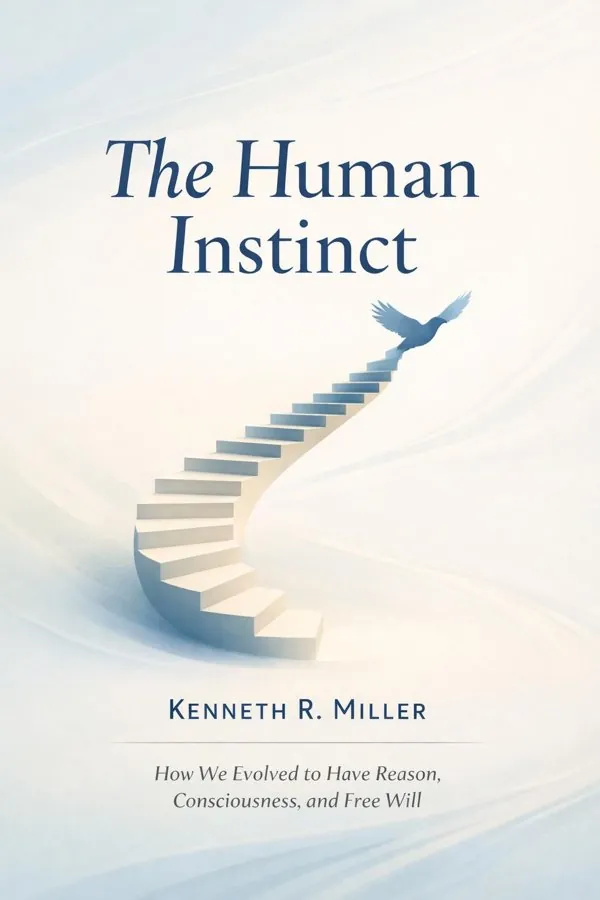
The Human Instinct: How We Evolved to Have Reason, Consciousness, and Free Will: Summary & Key Insights
 10 min9 chaptersAudio available
What Is The Human Instinct: How We Evolved to Have Reason, Consciousness, and Free Will About?
The Human Instinct: How We Evolved to Have Reason, Consciousness, and Free Will by Kenneth R. Miller is a neuroscience book spanning 9 pages. In this book, biologist Kenneth R. Miller explores how evolution shaped the human mind, consciousness, and sense of free will. He argues that rather than diminishing humanity, evolutionary science reveals the natural origins of our creativity, morality, and rationality. Drawing on biology, neuroscience, and philosophy, Miller presents a defense of human uniqueness grounded in science.
This FizzRead summary covers all 9 key chapters of The Human Instinct: How We Evolved to Have Reason, Consciousness, and Free Will in approximately 10 minutes, distilling the most important ideas, arguments, and takeaways from Kenneth R. Miller's work. Also available as an audio summary and Key Quotes Podcast.
The Human Instinct: How We Evolved to Have Reason, Consciousness, and Free Will
In this book, biologist Kenneth R. Miller explores how evolution shaped the human mind, consciousness, and sense of free will. He argues that rather than diminishing humanity, evolutionary science reveals the natural origins of our creativity, morality, and rationality. Drawing on biology, neuroscience, and philosophy, Miller presents a defense of human uniqueness grounded in science.
Who Should Read The Human Instinct: How We Evolved to Have Reason, Consciousness, and Free Will?
This book is perfect for anyone interested in neuroscience and looking to gain actionable insights in a short read. Whether you're a student, professional, or lifelong learner, the key ideas from The Human Instinct: How We Evolved to Have Reason, Consciousness, and Free Will by Kenneth R. Miller will help you think differently.
- ✓Readers who enjoy neuroscience and want practical takeaways
- ✓Professionals looking to apply new ideas to their work and life
- ✓Anyone who wants the core insights of The Human Instinct: How We Evolved to Have Reason, Consciousness, and Free Will in just 10 minutes
Want the full summary?
Get instant access to this book summary and 100K+ more with Fizz Moment.
Get Free SummaryAvailable on App Store • Free to download
Key Chapters
To understand where human consciousness and reason come from, we must first go back to the foundation of evolutionary theory itself. Darwin’s idea of natural selection remains one of the most potent intellectual revolutions in history. It showed that complexity is not imposed from above but arises through countless small changes preserved by differential survival. Life does not move toward perfection but toward diversity and adaptation.
In this framework, every trait we now regard as uniquely human—language, self-awareness, empathy—has antecedents rooted in simpler forms. Evolution builds by modification. The human brain, that pinnacle of adaptive sophistication, did not appear fully formed. It is the cumulative outcome of millions of years of neural experimentation, from the first sensory networks of primitive organisms to the intricate cerebral cortex of our species.
What makes this story compelling is not just biological detail but philosophical implication. If intelligence and consciousness emerged through natural processes, then meaning itself is natural. There is no cosmic boundary separating us from the rest of life; instead, we represent life becoming conscious of itself.
When I explain this to students, I often emphasize that evolution gives rise to complexity the way art emerges from practice—small innovations that accumulate until something entirely new appears. The spark of self-reflection is one such emergent property. It could not be predicted from the behavior of single neurons, but it becomes inevitable when networks of sufficient complexity interact.
In short, evolution laid down the fertile ground from which our cognitive sophistication could grow. It tells us that our reason has natural roots—and that acknowledging those roots deepens rather than trivializes the wonder of being human.
We are part of nature, yet we transcend it in certain extraordinary ways. Our powers of symbolic representation, language, and moral judgment stand at an intersection where biology meets abstraction. The challenge is to understand how such capacities could evolve without invoking mysticism.
When we compare ourselves to our nearest relatives—the chimpanzees and bonobos—we see an evolutionary continuity in emotional and social behavior. Yet the gulf in cognitive expression is astounding. We communicate ideas across generations through symbols and art, encode history in language, and create moral codes that regulate behavior beyond instinct.
The key lies in the recursive depth of human thought—the ability to represent representations themselves. Language gives form to abstract ideas, and this linguistic flexibility enables complex reasoning. From an evolutionary standpoint, these abilities offered practical advantages: better coordination, planning, and empathy within social groups. But once such features evolved, they opened a door to reflection and imagination.
This evolution of uniqueness did not occur apart from nature; it was nature’s daring experiment. Our brains are not alien inventions—they are the result of biological ingenuity. Even morality, which seems above biological function, has evolutionary roots. Cooperation, fairness, and empathy are deeply tied to the survival of social species.
Thus our uniqueness is not an escape from evolution but its crowning expression. The narrative of human emergence shows that biology itself has creative potential. To recognize that humankind arose through natural means is to see life’s creativity reflected in our own minds.
+ 7 more chapters — available in the FizzRead app
All Chapters in The Human Instinct: How We Evolved to Have Reason, Consciousness, and Free Will
About the Author
Kenneth R. Miller is an American cell biologist and professor at Brown University. He is known for his work on evolution and for advocating the compatibility of science and faith. Miller has authored several acclaimed books on evolution and human nature.
Get This Summary in Your Preferred Format
Read or listen to the The Human Instinct: How We Evolved to Have Reason, Consciousness, and Free Will summary by Kenneth R. Miller anytime, anywhere. FizzRead offers multiple formats so you can learn on your terms — all free.
Available formats: App · Audio · PDF · EPUB — All included free with FizzRead
Download The Human Instinct: How We Evolved to Have Reason, Consciousness, and Free Will PDF and EPUB Summary
Key Quotes from The Human Instinct: How We Evolved to Have Reason, Consciousness, and Free Will
“To understand where human consciousness and reason come from, we must first go back to the foundation of evolutionary theory itself.”
“We are part of nature, yet we transcend it in certain extraordinary ways.”
Frequently Asked Questions about The Human Instinct: How We Evolved to Have Reason, Consciousness, and Free Will
The Human Instinct: How We Evolved to Have Reason, Consciousness, and Free Will by Kenneth R. Miller is a neuroscience book that explores key ideas across 9 chapters. In this book, biologist Kenneth R. Miller explores how evolution shaped the human mind, consciousness, and sense of free will. He argues that rather than diminishing humanity, evolutionary science reveals the natural origins of our creativity, morality, and rationality. Drawing on biology, neuroscience, and philosophy, Miller presents a defense of human uniqueness grounded in science.
You Might Also Like
Anxious
Joseph LeDoux
10 min
Hallucinations
Oliver Sacks
10 min
The Biological Mind: How Brain, Body, and Environment Collaborate to Make Us Who We Are
Alan Jasanoff
10 min
The Feeling of Life Itself: Why Consciousness Is Widespread but Can't Be Computed
Christof Koch
10 min
The No-Nonsense Meditation Book
Steven Laureys
10 min
A General Theory of Love
Thomas Lewis, Fari Amini, Richard Lannon
10 minBrowse by Category
Ready to read The Human Instinct: How We Evolved to Have Reason, Consciousness, and Free Will?
Get the full summary and 100K+ more books with Fizz Moment.