
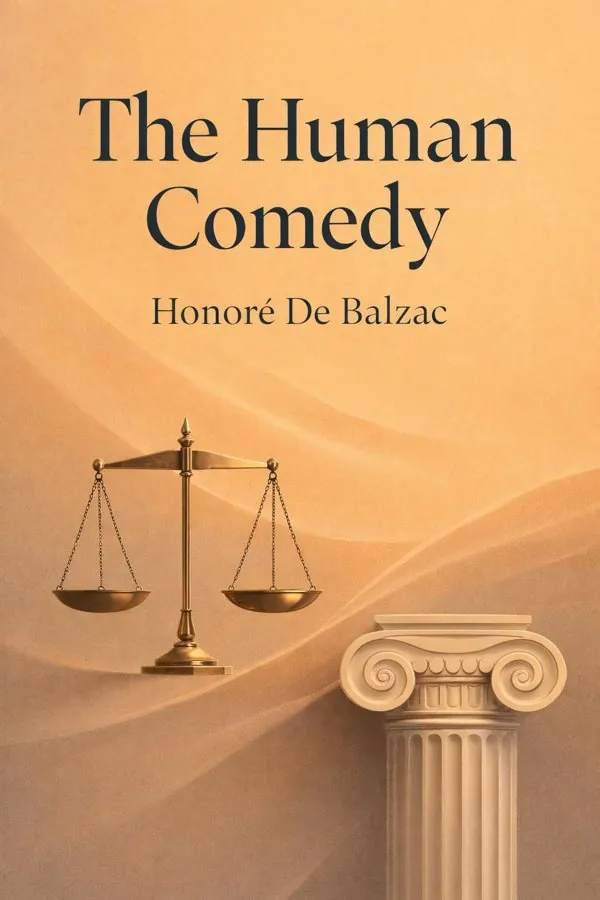
The Human Comedy: Summary & Key Insights
 10 min4 chaptersAudio available
What Is The Human Comedy About?
The Human Comedy by Honoré De Balzac is a classics book spanning 4 pages. The Human Comedy is a monumental collection of over ninety works written by Honoré de Balzac between 1829 and 1850. It presents a comprehensive portrait of French society during the Restoration and the July Monarchy, exploring all social classes and human passions. Organized into Studies of Manners, Philosophical Studies, and Analytical Studies, this vast literary cycle stands as one of the most ambitious achievements in world literature.
This FizzRead summary covers all 4 key chapters of The Human Comedy in approximately 10 minutes, distilling the most important ideas, arguments, and takeaways from Honoré De Balzac's work. Also available as an audio summary and Key Quotes Podcast.
The Human Comedy
The Human Comedy is a monumental collection of over ninety works written by Honoré de Balzac between 1829 and 1850. It presents a comprehensive portrait of French society during the Restoration and the July Monarchy, exploring all social classes and human passions. Organized into Studies of Manners, Philosophical Studies, and Analytical Studies, this vast literary cycle stands as one of the most ambitious achievements in world literature.
Who Should Read The Human Comedy?
This book is perfect for anyone interested in classics and looking to gain actionable insights in a short read. Whether you're a student, professional, or lifelong learner, the key ideas from The Human Comedy by Honoré De Balzac will help you think differently.
- ✓Readers who enjoy classics and want practical takeaways
- ✓Professionals looking to apply new ideas to their work and life
- ✓Anyone who wants the core insights of The Human Comedy in just 10 minutes
Want the full summary?
Get instant access to this book summary and 100K+ more with Fizz Moment.
Get Free SummaryAvailable on App Store • Free to download
Key Chapters
When I began the *Studies of Manners*, I was convinced that to understand the soul of a nation one must first observe its everyday gestures. Here lies the physical surface of civilization, the constant interplay between individuals and their social conditions. I divided these studies into various ‘scenes,’ each representing a distinct landscape of experience—Private, Provincial, Parisian, Political, Military, and Country Life—because France herself is a mosaic of these realities.
In the *Scenes of Private Life*, I dissect the domestic dramas of the bourgeois household: marriages built on interest, hidden infidelities, and the perpetual tension between sentiment and ambition. Works such as *The Woman of Thirty Years* or *The Lily of the Valley* unmask how innocence collides with experience, how women’s hearts are often the battlefield upon which moral ideals perish. Through such stories, I wanted to show that the family, that most sacred institution, is also the stage where our hypocrisies first germinate.
Then, in the *Scenes of Provincial Life*, the stage widens. France beyond Paris is not inert—it is a realm of thwarted desires and secret ambitions. In *Eugénie Grandet* and *Lost Illusions*, I captured the slow suffocation of talent and spirit under provincial mediocrity. The provinces are miniature worlds where time moves like syrup, where gossip is law, and where a young man’s yearning for Paris becomes the symbol of human aspiration itself. Yet, the moment one reaches Paris, the mirage of success reveals itself as a new form of bondage—pleasure and money taking the place of poverty and simplicity.
*Scenes of Parisian Life* present the capital as the crucible of every vice and triumph. In *Cousin Bette*, *Splendors and Miseries of Courtesans*, and *The Gobseck*, I portray a modern Babylon, a city that devours its children. Here, intelligence is power; virtue, a luxury few can afford. The drawing room, the stock exchange, the journalistic office—all are fronts in the eternal war of cunning versus sincerity. Paris is both heaven and hell, where one’s genius may rise in a blaze or vanish into ruin overnight.
Turning to *Political Life*, I examined the mechanisms of power under the Restoration and the July Monarchy. In *A Murky Affair* and *The Deputy from Arcis*, politics appears less as an arena of ideals than as a theater of human appetites clothed in rhetoric. Corruption, ambition, and ideological masquerade reveal themselves as natural outgrowths of society’s struggle for survival. Beneath the names of parties lie the same passions that drive lovers and criminals alike.
The *Scenes of Military Life* recall the Napoleonic legend, but I did not glorify war. In *The Chouans* or *A Passion in the Desert*, the soldier’s courage coexists with profound disillusionment. The Empire’s fall left countless veterans adrift—men of honor in a dishonorable age—thus symbolizing the tension between heroic past and cynical present.
Finally, in the *Scenes of Country Life*, I returned to the soil, to the France of peasants, landowners, and rural traditions. In *The Peasantry*, the earth itself becomes a character. It nourishes, enslaves, and avenges. I saw in the countryside the stubborn persistence of ancient instincts amid modernization: greed for property, the slow corruption of rustic virtue, and the fading harmony between man and nature. These stories reveal that simplicity, too, is an illusion—a mirage conjured by those who have forgotten toil.
Through this vast panorama, I sought to capture not events but conditions, the fixed and fluid elements of existence. The *Studies of Manners* thus form the phenomenal layer of *The Human Comedy*—the body through which the soul of society pulses.
After tracing human behavior in its social forms, I turned inward to ask why we act as we do. The *Philosophical Studies* probe the realm where passion meets metaphysics, where the visible gestures of daily life spring from invisible causes. In these tales—such as *The Magic Skin*, *Louis Lambert*, and *Seraphita*—I stretched realism until it touched the border of the spiritual. For I believed that science alone cannot explain man; his destiny lies in the mysterious interplay between desire and the infinite.
In *The Magic Skin*, I embody this truth in a talisman that grants every wish but shrinks with each indulgence, consuming the life of its possessor. Ravollet’s tragedy illuminates the paradox of modern ambition: we crave pleasure, power, and love, yet each satisfaction hastens our decay. The story is not a fantasy but an allegory of consumption—of how society itself devours vitality through excess. By making the supernatural seem scientific, I aimed to show that our moral world is governed by laws as inexorable as those of physics.
In *Louis Lambert*, I explored genius as both divine gift and curse. Lambert’s mind, too expansive for the world’s limits, collapses into madness. His intellectual ecstasy mirrors the thinker’s tragic plight in an age worshipping material progress. I meant the novel as both portrait and confession: a reflection of my own battles with inspiration and exhaustion, optimism and despair. Through Lambert, I voice the conviction that thought itself has a cosmic destiny—that ideas, like forces of nature, shape civilizations.
In *Seraphita*, I journey beyond ordinary belief into the realm of mystic androgyny, where the human merges with the divine. Some saw this as mere fantasy, but I considered it the necessary counterpart to my realism. If *The Human Comedy* portrays humanity’s fall into corruption, *Seraphita* gestures toward its redemption. Through the angelic figure who transcends gender and mortality, I explored the ideal of pure love, suggesting that the infinite yearning of human beings is the measure of their kinship with the divine.
These *Philosophical Studies* act as the invisible architecture supporting the edifice of my social panorama. Without them, the reader might mistake my realism for cynicism. In truth, every deceit, every ambition, every fall I describe conceals a metaphysical hunger—the desire to overcome limitation. The carpenter, the banker, the courtesan all pursue fragments of the absolute, though they name it differently. Thus, philosophy transforms judgment into compassion, linking the sinner and the saint under the same law of striving. This was my secret faith: that every human action, however sordid, is a deformed expression of divine energy seeking form.
+ 2 more chapters — available in the FizzRead app
All Chapters in The Human Comedy
About the Author
Honoré de Balzac (1799–1850) was a major French writer of the nineteenth century, regarded as one of the founders of literary realism. His monumental work, The Human Comedy, profoundly influenced European and world literature through its psychological depth and sociological vision of society.
Get This Summary in Your Preferred Format
Read or listen to the The Human Comedy summary by Honoré De Balzac anytime, anywhere. FizzRead offers multiple formats so you can learn on your terms — all free.
Available formats: App · Audio · PDF · EPUB — All included free with FizzRead
Download The Human Comedy PDF and EPUB Summary
Key Quotes from The Human Comedy
“When I began the *Studies of Manners*, I was convinced that to understand the soul of a nation one must first observe its everyday gestures.”
“After tracing human behavior in its social forms, I turned inward to ask why we act as we do.”
Frequently Asked Questions about The Human Comedy
The Human Comedy by Honoré De Balzac is a classics book that explores key ideas across 4 chapters. The Human Comedy is a monumental collection of over ninety works written by Honoré de Balzac between 1829 and 1850. It presents a comprehensive portrait of French society during the Restoration and the July Monarchy, exploring all social classes and human passions. Organized into Studies of Manners, Philosophical Studies, and Analytical Studies, this vast literary cycle stands as one of the most ambitious achievements in world literature.
More by Honoré De Balzac

You Might Also Like




Browse by Category
Ready to read The Human Comedy?
Get the full summary and 100K+ more books with Fizz Moment.