
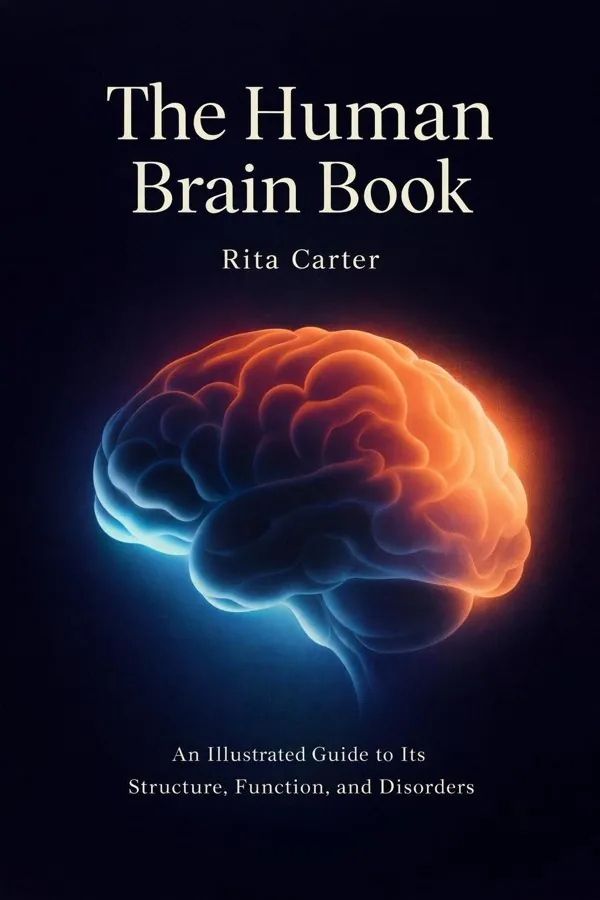
The Human Brain Book: An Illustrated Guide to Its Structure, Function, and Disorders: Summary & Key Insights
by Rita Carter
 10 min8 chaptersAudio available
What Is The Human Brain Book: An Illustrated Guide to Its Structure, Function, and Disorders About?
The Human Brain Book: An Illustrated Guide to Its Structure, Function, and Disorders by Rita Carter is a neuroscience book spanning 8 pages. The Human Brain Book is an illustrated guide that explores the structure, function, and disorders of the human brain. It combines detailed imagery, scientific explanations, and recent advances in neuroscience to provide a comprehensive understanding of the most complex organ in the human body.
This FizzRead summary covers all 8 key chapters of The Human Brain Book: An Illustrated Guide to Its Structure, Function, and Disorders in approximately 10 minutes, distilling the most important ideas, arguments, and takeaways from Rita Carter's work. Also available as an audio summary and Key Quotes Podcast.
The Human Brain Book: An Illustrated Guide to Its Structure, Function, and Disorders
The Human Brain Book is an illustrated guide that explores the structure, function, and disorders of the human brain. It combines detailed imagery, scientific explanations, and recent advances in neuroscience to provide a comprehensive understanding of the most complex organ in the human body.
Who Should Read The Human Brain Book: An Illustrated Guide to Its Structure, Function, and Disorders?
This book is perfect for anyone interested in neuroscience and looking to gain actionable insights in a short read. Whether you're a student, professional, or lifelong learner, the key ideas from The Human Brain Book: An Illustrated Guide to Its Structure, Function, and Disorders by Rita Carter will help you think differently.
- ✓Readers who enjoy neuroscience and want practical takeaways
- ✓Professionals looking to apply new ideas to their work and life
- ✓Anyone who wants the core insights of The Human Brain Book: An Illustrated Guide to Its Structure, Function, and Disorders in just 10 minutes
Want the full summary?
Get instant access to this book summary and 100K+ more with Fizz Moment.
Get Free SummaryAvailable on App Store • Free to download
Key Chapters
Begin with structure, because the form of the brain defines everything that follows. The cerebrum, with its convoluted surface, holds the higher functions of reasoning, sensation, memory, and voluntary motion. It is divided into lobes—the frontal for planning and personality, the parietal for spatial awareness, the temporal for hearing and language comprehension, the occipital for vision. Beneath it lies the cerebellum, that densely packed region responsible for balance and fine-tuned movement. At the base is the brainstem, ancient and indispensable, where breathing and heartbeat are regulated.
In creating the illustrations for this book, I wanted to make anatomy tangible. Each fold and fissure reveals the brain’s evolutionary story—a record of adaptation from primitive forms toward ever greater complexity. The division between right and left hemispheres also tells a tale of specialization—language on one side, spatial imagination on the other—though always working in exquisite harmony.
Understanding structure is not mere memorization of parts; it’s grasping how architecture reflects function. When you trace the pathways of axons through the white matter, you begin to see how distant regions communicate in milliseconds, forming the living web of perception and action. You realize that every thought, from the simplest sensation to the most abstract concept, relies on the dance between these interconnected regions.
At the microscopic level, the brain reveals its most elegant design. Neurons are its fundamental units, each one specialized to receive and transmit signals. Their long extensions—axons and dendrites—form a massive communication network, and the synapse is where one cell’s message meets another.
I have always found the synapse to be a wonder of nature. Within that tiny gap, electrical impulses are converted into chemical signals using neurotransmitters like dopamine, serotonin, and acetylcholine. The precise balance of these molecules determines mood, alertness, and cognitive function. When this chemistry falters, symptoms of disease emerge—depression, Parkinson’s, Alzheimer’s.
It is in these exchanges that emotion and thought gain form. By learning how neurons operate—through action potentials and neurotransmitter release—we understand how the brain communicates both internally and with the body. Every memory begins as the strengthening of a synaptic connection; every skill is encoded in the branching patterns of dendrites. This microscopic dialogue is the biological essence of learning and adaptation.
+ 6 more chapters — available in the FizzRead app
All Chapters in The Human Brain Book: An Illustrated Guide to Its Structure, Function, and Disorders
About the Author
Rita Carter is a British science writer and journalist known for her work in neuroscience and psychology. She has authored several books on the brain and mind and regularly contributes to science communication outlets.
Get This Summary in Your Preferred Format
Read or listen to the The Human Brain Book: An Illustrated Guide to Its Structure, Function, and Disorders summary by Rita Carter anytime, anywhere. FizzRead offers multiple formats so you can learn on your terms — all free.
Available formats: App · Audio · PDF · EPUB — All included free with FizzRead
Download The Human Brain Book: An Illustrated Guide to Its Structure, Function, and Disorders PDF and EPUB Summary
Key Quotes from The Human Brain Book: An Illustrated Guide to Its Structure, Function, and Disorders
“Begin with structure, because the form of the brain defines everything that follows.”
“At the microscopic level, the brain reveals its most elegant design.”
Frequently Asked Questions about The Human Brain Book: An Illustrated Guide to Its Structure, Function, and Disorders
The Human Brain Book: An Illustrated Guide to Its Structure, Function, and Disorders by Rita Carter is a neuroscience book that explores key ideas across 8 chapters. The Human Brain Book is an illustrated guide that explores the structure, function, and disorders of the human brain. It combines detailed imagery, scientific explanations, and recent advances in neuroscience to provide a comprehensive understanding of the most complex organ in the human body.
You Might Also Like
Anxious
Joseph LeDoux
10 min
Hallucinations
Oliver Sacks
10 min
The Biological Mind: How Brain, Body, and Environment Collaborate to Make Us Who We Are
Alan Jasanoff
10 min
The Feeling of Life Itself: Why Consciousness Is Widespread but Can't Be Computed
Christof Koch
10 min
The No-Nonsense Meditation Book
Steven Laureys
10 min
A General Theory of Love
Thomas Lewis, Fari Amini, Richard Lannon
10 minBrowse by Category
Ready to read The Human Brain Book: An Illustrated Guide to Its Structure, Function, and Disorders?
Get the full summary and 100K+ more books with Fizz Moment.