
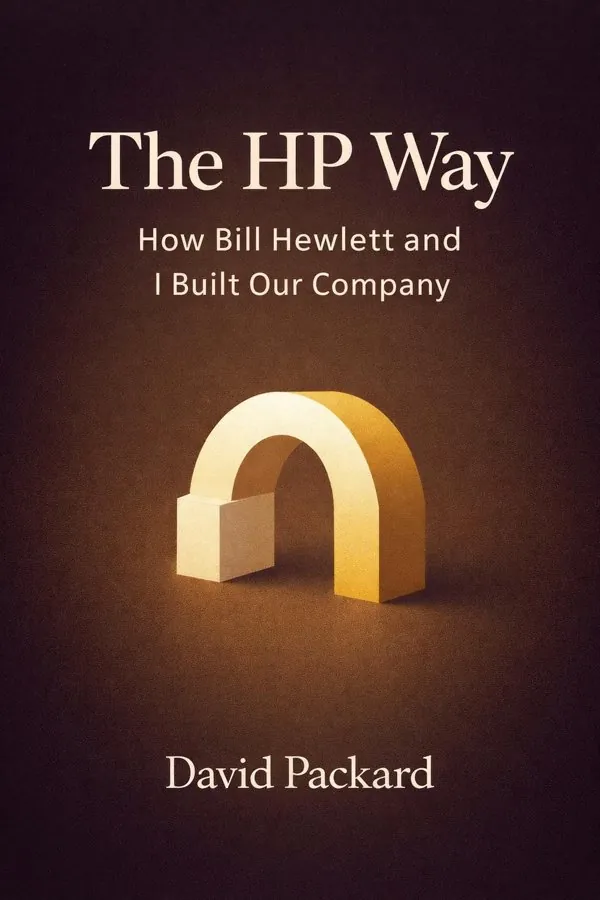
The HP Way: How Bill Hewlett and I Built Our Company: Summary & Key Insights
 10 min10 chaptersAudio available
Key Takeaways from The HP Way: How Bill Hewlett and I Built Our Company
A company’s deepest culture usually begins long before the company exists.
In 1939, he and Bill Hewlett started with little money, basic equipment, and a willingness to solve real technical problems.
Many companies talk about respect, but Packard tried to build systems that made respect operational.
Autonomy without direction creates confusion, while control without autonomy creates disengagement.
Innovation is often romanticized as flashes of genius, but Packard presents it as a managed process rooted in technical excellence, market awareness, and patient investment.
What Is The HP Way: How Bill Hewlett and I Built Our Company About?
The HP Way: How Bill Hewlett and I Built Our Company by David Packard is a leadership book spanning 10 pages. The HP Way is more than a corporate memoir. It is David Packard’s firsthand account of how two young engineers turned a garage startup into one of the world’s most admired companies, while trying to prove that a business could be both profitable and principled. Writing as HP’s co-founder, Packard traces the company’s early experiments, its periods of rapid growth, and the management philosophy that became known as “the HP Way.” At the heart of the book are enduring ideas: trust people, define clear objectives, encourage innovation, stay close to customers, and treat profit not as the sole purpose of business but as a necessary result of doing useful work well. What makes the book matter is its practical relevance. Long before discussions of culture, empowerment, or stakeholder capitalism became mainstream, Packard was building systems that reflected those values. He does not present leadership as charisma or slogans, but as disciplined judgment, integrity, and respect for human dignity. For founders, executives, managers, and anyone interested in values-based leadership, The HP Way offers a rare combination of business history, operating wisdom, and moral clarity from someone who helped shape modern management.
This FizzRead summary covers all 10 key chapters of The HP Way: How Bill Hewlett and I Built Our Company in approximately 10 minutes, distilling the most important ideas, arguments, and takeaways from David Packard's work. Also available as an audio summary and Key Quotes Podcast.
The HP Way: How Bill Hewlett and I Built Our Company
The HP Way is more than a corporate memoir. It is David Packard’s firsthand account of how two young engineers turned a garage startup into one of the world’s most admired companies, while trying to prove that a business could be both profitable and principled. Writing as HP’s co-founder, Packard traces the company’s early experiments, its periods of rapid growth, and the management philosophy that became known as “the HP Way.” At the heart of the book are enduring ideas: trust people, define clear objectives, encourage innovation, stay close to customers, and treat profit not as the sole purpose of business but as a necessary result of doing useful work well.
What makes the book matter is its practical relevance. Long before discussions of culture, empowerment, or stakeholder capitalism became mainstream, Packard was building systems that reflected those values. He does not present leadership as charisma or slogans, but as disciplined judgment, integrity, and respect for human dignity. For founders, executives, managers, and anyone interested in values-based leadership, The HP Way offers a rare combination of business history, operating wisdom, and moral clarity from someone who helped shape modern management.
Who Should Read The HP Way: How Bill Hewlett and I Built Our Company?
This book is perfect for anyone interested in leadership and looking to gain actionable insights in a short read. Whether you're a student, professional, or lifelong learner, the key ideas from The HP Way: How Bill Hewlett and I Built Our Company by David Packard will help you think differently.
- ✓Readers who enjoy leadership and want practical takeaways
- ✓Professionals looking to apply new ideas to their work and life
- ✓Anyone who wants the core insights of The HP Way: How Bill Hewlett and I Built Our Company in just 10 minutes
Want the full summary?
Get instant access to this book summary and 100K+ more with Fizz Moment.
Get Free SummaryAvailable on App Store • Free to download
Key Chapters
A company’s deepest culture usually begins long before the company exists. Packard makes it clear that the principles behind Hewlett-Packard were not invented in a boardroom. They grew out of his upbringing in Pueblo, Colorado, where hard work, straightforward dealing, self-reliance, and personal responsibility were expected rather than celebrated. His engineering education at Stanford gave him technical discipline, but his early life gave him a moral framework: people should be trusted until they prove otherwise, promises matter, and good work is its own form of respect.
This matters because leaders often search for culture-building tools when what actually shapes culture is the behavior they model under pressure. Packard suggests that management philosophy is not mainly a set of techniques. It is an expression of what leaders believe about people. If you believe employees are fundamentally capable, your systems will encourage initiative. If you believe they are problems to control, your systems will become rigid and defensive.
In practical terms, this idea can be applied by founders and managers through hiring and daily habits. Select people for integrity as well as competence. Reward accountability, not office politics. Make sure decisions reflect stated values, especially when short-term incentives push in the other direction. For example, if a team misses a target but acted honestly and learned quickly, the right response may be coaching and support rather than blame.
Packard’s lesson is simple but demanding: organizational philosophy begins with personal philosophy. Actionable takeaway: define the three values you will not compromise as a leader, then make one visible decision this week that proves those values are real.
The famous HP garage has become a symbol, but Packard treats it less as mythology and more as evidence that meaningful enterprises usually begin with modest resources and strong conviction. In 1939, he and Bill Hewlett started with little money, basic equipment, and a willingness to solve real technical problems. Their first major product, the HP 200A audio oscillator, succeeded not because they had scale, but because it delivered value at a better price and design than alternatives available at the time.
The deeper point is that entrepreneurship is rarely about dramatic beginnings. It is about disciplined experimentation. Hewlett and Packard did not begin with a grand plan to dominate an industry. They started by building excellent instruments, listening carefully to customers, and improving product quality through engineering rigor. Their early sale to Walt Disney Studios for use in Fantasia has become a memorable anecdote, but what really mattered was their ability to make something useful enough that respected buyers trusted a tiny company.
For modern builders, this is a powerful reminder that competitive advantage often begins with craftsmanship and customer relevance, not brand prestige. A software startup can apply the same principle by focusing on one painful customer problem and solving it unusually well. A local business can do the same through reliability, responsiveness, and product integrity.
Packard’s story also highlights frugality. Scarcity can sharpen judgment if it forces a company to prioritize what customers truly value. Actionable takeaway: identify the one product or service feature that creates the most concrete value for customers, and concentrate your next round of effort on making that feature unmistakably better.
Many companies talk about respect, but Packard tried to build systems that made respect operational. The HP Way was not a vague slogan for friendliness. It was a management philosophy grounded in the belief that people want to do meaningful work, can be trusted with responsibility, and perform best when they are treated with dignity. This meant open communication, decentralized authority, informality between levels, and a workplace where managers were expected to know what was happening without creating fear.
One of the most recognizable expressions of this philosophy was “management by wandering around,” the idea that leaders should stay in close touch with people and operations through direct human contact rather than relying only on reports. This was not surveillance. It was presence. Managers could spot emerging problems, hear ideas early, and reinforce the sense that every employee mattered.
The HP Way also included practical commitments: fair treatment, opportunities for advancement, concern for employees during difficult periods, and a belief that profit should support the long-term health of the enterprise and its people. In an age when many firms still relied on top-down command structures, Packard’s approach was unusually humane and, importantly, effective.
Today, leaders can apply this idea by reducing unnecessary hierarchy, increasing transparency, and creating forums where employees can speak candidly. A manager might hold regular skip-level conversations, share the reasoning behind decisions, or invite engineers and frontline staff into planning discussions. Trust should not eliminate accountability, but accountability works better when people feel respected.
Packard’s central insight is that culture is built through repeated managerial choices. Actionable takeaway: choose one routine this month that signals trust in your team, such as delegating a decision fully and supporting the person who owns it.
Autonomy without direction creates confusion, while control without autonomy creates disengagement. Packard’s answer was management by objectives, a disciplined way to align people around clear goals while giving them room to determine how to achieve them. He believed managers should define what must be accomplished, establish priorities, and then allow capable people to exercise judgment. This system depended on clarity, not micromanagement.
What makes this approach powerful is its balance. In many organizations, people are either overwhelmed by ambiguous expectations or constrained by excessive oversight. Management by objectives avoids both extremes. If an engineering group knows the performance target, timeline, and budget parameters, it can innovate within meaningful boundaries. If a sales team knows which markets matter most and what success looks like, it can adapt tactics intelligently rather than waiting for constant approval.
Packard also understood that objectives should support broader company values. Targets that ignore quality, ethics, or long-term customer trust can distort behavior. Good objectives challenge people, but they should not force them into shortsighted decisions that damage the enterprise later.
Modern organizations use similar ideas in systems like OKRs, but Packard’s version adds an important human element: objectives are effective only when people understand why they matter and believe leadership will judge performance fairly. A useful application is to pair every major target with a brief statement of purpose and guardrails. For example, a manager might say, “Reduce response times by 20 percent, but not by cutting service quality or pushing avoidable work onto another team.”
The lesson is that direction should enable initiative, not replace it. Actionable takeaway: rewrite one team goal this week so it includes a clear outcome, a timeframe, and the non-negotiable principles that should guide execution.
Innovation is often romanticized as flashes of genius, but Packard presents it as a managed process rooted in technical excellence, market awareness, and patient investment. HP grew by creating sophisticated electronic instruments and later expanding into new categories, but this growth did not come from chasing every opportunity. The company invested in areas where it could apply real engineering strength, maintain quality, and serve emerging customer needs.
Packard believed that research and development should be substantial, but he also resisted innovation for its own sake. Useful innovation has to connect invention with practical application. A company should ask: does this product solve a real problem, fit our capabilities, and offer a standard of quality that strengthens our reputation? When the answer was yes, HP could move boldly. When the fit was poor, restraint was often wiser than expansion.
This principle remains essential today. Teams can become distracted by trends, competitor imitation, or technology that is impressive but commercially weak. Packard’s approach suggests a better path: build around competence, listen closely to users, and maintain standards that make products reliable over time. For example, a hardware company should not rush a flashy release that damages trust if more testing would produce a durable advantage. A software team should resist adding features that create complexity without improving customer outcomes.
Innovation also depends on organizational design. Engineers need room to experiment, but they also need accountability for results and a realistic understanding of customer problems. Packard valued smaller divisions and decentralized units partly because they kept innovation close to both technical talent and market feedback.
His message is practical: creativity flourishes best inside a disciplined system. Actionable takeaway: before approving a new initiative, require a one-page case showing the customer problem, strategic fit, quality risks, and how success will be measured.
Packard did not treat employee relations as a soft, secondary concern. He saw them as central to performance. A company that expects initiative, quality, and long-term commitment must create conditions in which people can contribute fully. At HP, this meant fair compensation, open communication, opportunities to grow, and a work environment that recognized employees as responsible adults rather than replaceable labor inputs.
One reason the HP Way endured is that it linked culture directly to business outcomes. When people feel respected, they are more likely to share ideas, raise problems early, and take ownership. When they feel disposable, they protect themselves, withhold information, and narrow their effort to what is strictly required. Packard’s emphasis on informality and accessibility helped reduce the distance between management and staff, making the company more adaptable and less bureaucratic.
He also understood the symbolic power of managerial decisions. How a company handles layoffs, promotions, mistakes, and communication during hard times tells employees what the organization truly values. A statement about respect means little if leaders behave opportunistically under pressure. Packard favored long-term thinking, which included trying to avoid practices that would erode trust for the sake of short-term numbers.
This is highly relevant for current leaders facing hybrid work, talent competition, and organizational fatigue. Practical applications include transparent performance criteria, managers trained in coaching rather than only supervision, and communication systems that allow employees to ask candid questions. Even small practices, such as explaining decisions fully or recognizing contribution publicly, can strengthen culture.
Packard’s insight is that people policies are not perks; they are operating choices that shape execution. Actionable takeaway: review one recent management decision from the employee’s perspective and ask whether it increased trust, clarity, and ownership—or weakened them.
One of Packard’s most influential ideas is that profit is essential to a business, but it is not the reason a business exists. He argued that companies must earn profits to survive, invest, innovate, and reward those who take risks. Yet if leaders treat profit as the sole purpose, they misunderstand the institution they are running. Businesses exist to create something of value: products, services, jobs, innovation, and broader social contribution. Profit is a test of effectiveness, not the complete moral justification for the enterprise.
This distinction changes how decisions are made. If profit is the only measure, then cost-cutting, quality compromises, or manipulative tactics may appear acceptable whenever they increase margins. If profit is a necessary outcome of serving customers well and building durable capability, leaders are more likely to protect reputation, invest in people, and think long term.
Packard’s view anticipated today’s debates about stakeholder capitalism, but his argument was more practical than ideological. He did not reject profit. He elevated it to its proper role: indispensable, but not ultimate. A healthy company serves customers, develops employees, contributes to communities, and acts responsibly toward society while still demanding strong performance.
Modern examples are everywhere. A manufacturer may choose a safer, more reliable design even if it reduces short-term margins because the long-term trust benefit is greater. A software company might avoid deceptive pricing because customer relationships matter more than a temporary revenue boost. Such choices are not anti-business. They are often signs of better business judgment.
Packard’s lesson is that companies need a clear reason to exist beyond financial output. Actionable takeaway: write a one-sentence statement of your team or company’s real purpose, then test whether your current metrics reinforce that purpose or quietly undermine it.
Packard’s leadership philosophy is notably unsentimental. He does not portray executives as visionaries floating above operations. He sees leadership as a practical responsibility: making sound decisions with incomplete information, selecting good people, setting standards, and preserving the values of the institution while adapting to change. Strong leadership, in his account, combines humility with firmness. A leader should listen widely, avoid needless ego, and still be willing to decide.
His partnership with Bill Hewlett illustrates another crucial point: effective leadership is often complementary. The two men had different temperaments and strengths, and HP benefited from that balance. This is a reminder that leadership teams do not need identical styles. They need shared principles and mutual trust. A thoughtful operator paired with a creative product thinker can outperform a team of similar personalities if they respect each other and align on fundamentals.
Packard also believed leaders must spend time on the right altitude. They cannot disappear into abstraction, nor can they become trapped in every tactical detail. They need enough proximity to understand reality and enough distance to shape direction. This is where practices such as direct observation, candid discussion, and decentralized responsibility become essential.
For modern managers, this philosophy suggests several applications: distinguish reversible decisions from high-stakes commitments, hire people whose strengths differ from yours, and create a decision process that includes input without drifting into paralysis. During uncertainty, explain what is known, what is unknown, and what principles will guide the next steps.
Packard’s version of leadership is demanding because it offers no shortcut through charisma. Actionable takeaway: identify one decision you have been postponing, gather the critical facts, define the governing principle, and make the call instead of waiting for perfect certainty.
Growth tests culture. As HP expanded from a small engineering company into a large global enterprise, Packard had to confront a difficult reality: the practices that work in a tiny firm do not automatically scale. Structures must evolve, divisions may need more autonomy, processes become necessary, and leaders can no longer rely only on personal familiarity. Yet Packard argues that adaptation should not come at the cost of the company’s core philosophy.
This is one of the most valuable themes in the book. Many organizations either cling too tightly to old methods or change so aggressively that they lose the values that made them effective. Packard’s answer was selective evolution. HP adopted systems and organizational forms that allowed growth, but he remained attentive to preserving decentralization, respect for people, product quality, and ethical seriousness. The form could change; the principles should endure.
He also acknowledges that external shocks, competition, and complexity force hard choices. No company can avoid setbacks. What matters is whether leaders respond in ways that reinforce long-term health rather than panic-driven improvisation. During times of change, clear communication becomes especially important. Employees need to know what is changing, why it is changing, and what will remain constant.
Today’s companies face similar pressures from AI, globalization, market volatility, and shifting workforce expectations. A useful application is to separate “core” from “current.” Core means mission, values, standards, and customer promises. Current means tools, org charts, workflows, and tactics. This helps teams modernize without becoming unmoored.
Packard’s insight is that durability comes from principled flexibility. Actionable takeaway: make two lists—what in your organization must never change, and what must be open to redesign—then use that distinction to guide your next major transition.
Packard’s career in public service, including his role as U.S. Deputy Secretary of Defense, reinforces a theme that runs throughout the book: leadership in business carries obligations beyond shareholders and internal operations. He believed executives should understand the broader economic, civic, and national context in which their companies operate. Business is not isolated from society; it helps shape institutions, technology, employment, and public trust.
This broader view matters because it changes the horizon of responsibility. A leader who sees the firm only as a machine for financial extraction will miss its wider impact. A leader who understands the firm as a social institution will pay closer attention to ethics, public consequences, workforce development, and responsible innovation. Packard’s perspective was not abstract idealism. It came from direct experience in both private enterprise and government, where he saw how managerial competence and values could affect outcomes at scale.
For contemporary leaders, this idea applies in areas such as data privacy, environmental impact, supply chain standards, and community engagement. A technology company, for instance, should consider not only whether a product can be built profitably, but how it influences users and society. A manufacturing firm should ask how operational choices affect local communities and long-term industrial capability.
Packard’s point is not that companies should become political actors in every domain. It is that they should behave as responsible institutions whose decisions have public consequences. Leadership maturity includes recognizing those consequences and acting accordingly.
The takeaway is expansive but practical: every important business decision has a wider field of impact. Actionable takeaway: before approving a major policy or product move, ask one additional question—who outside the company will be affected, and what responsibility follows from that?
All Chapters in The HP Way: How Bill Hewlett and I Built Our Company
About the Author
David Packard was an American electrical engineer, entrepreneur, and public servant best known as the co-founder of Hewlett-Packard. Born in 1912 in Pueblo, Colorado, he studied electrical engineering at Stanford University, where he met Bill Hewlett. In 1939, the two men launched HP in a Palo Alto garage, beginning one of the most influential companies in technology history. Packard became widely respected not just for HP’s business success, but for his management philosophy, later known as the “HP Way,” which emphasized trust, decentralization, innovation, and respect for employees. Beyond business, he served as U.S. Deputy Secretary of Defense and played an active role in philanthropy and civic life. He died in 1996, leaving a lasting legacy in leadership and corporate culture.
Get This Summary in Your Preferred Format
Read or listen to the The HP Way: How Bill Hewlett and I Built Our Company summary by David Packard anytime, anywhere. FizzRead offers multiple formats so you can learn on your terms — all free.
Available formats: App · Audio · PDF · EPUB — All included free with FizzRead
Download The HP Way: How Bill Hewlett and I Built Our Company PDF and EPUB Summary
Key Quotes from The HP Way: How Bill Hewlett and I Built Our Company
“A company’s deepest culture usually begins long before the company exists.”
“The famous HP garage has become a symbol, but Packard treats it less as mythology and more as evidence that meaningful enterprises usually begin with modest resources and strong conviction.”
“Many companies talk about respect, but Packard tried to build systems that made respect operational.”
“Autonomy without direction creates confusion, while control without autonomy creates disengagement.”
“Innovation is often romanticized as flashes of genius, but Packard presents it as a managed process rooted in technical excellence, market awareness, and patient investment.”
Frequently Asked Questions about The HP Way: How Bill Hewlett and I Built Our Company
The HP Way: How Bill Hewlett and I Built Our Company by David Packard is a leadership book that explores key ideas across 10 chapters. The HP Way is more than a corporate memoir. It is David Packard’s firsthand account of how two young engineers turned a garage startup into one of the world’s most admired companies, while trying to prove that a business could be both profitable and principled. Writing as HP’s co-founder, Packard traces the company’s early experiments, its periods of rapid growth, and the management philosophy that became known as “the HP Way.” At the heart of the book are enduring ideas: trust people, define clear objectives, encourage innovation, stay close to customers, and treat profit not as the sole purpose of business but as a necessary result of doing useful work well. What makes the book matter is its practical relevance. Long before discussions of culture, empowerment, or stakeholder capitalism became mainstream, Packard was building systems that reflected those values. He does not present leadership as charisma or slogans, but as disciplined judgment, integrity, and respect for human dignity. For founders, executives, managers, and anyone interested in values-based leadership, The HP Way offers a rare combination of business history, operating wisdom, and moral clarity from someone who helped shape modern management.
You Might Also Like

Extreme Ownership
Jocko Willink
10 min
Dare to Lead
Brene Brown
10 min
Leaders Eat Last
Simon Sinek
10 min
The 21 Irrefutable Laws of Leadership
John Maxwell
10 min
Start With Why
Simon Sinek
10 min
How to Lead When You're Not in Charge
Clay Scroggins
10 minBrowse by Category
Ready to read The HP Way: How Bill Hewlett and I Built Our Company?
Get the full summary and 100K+ more books with Fizz Moment.