
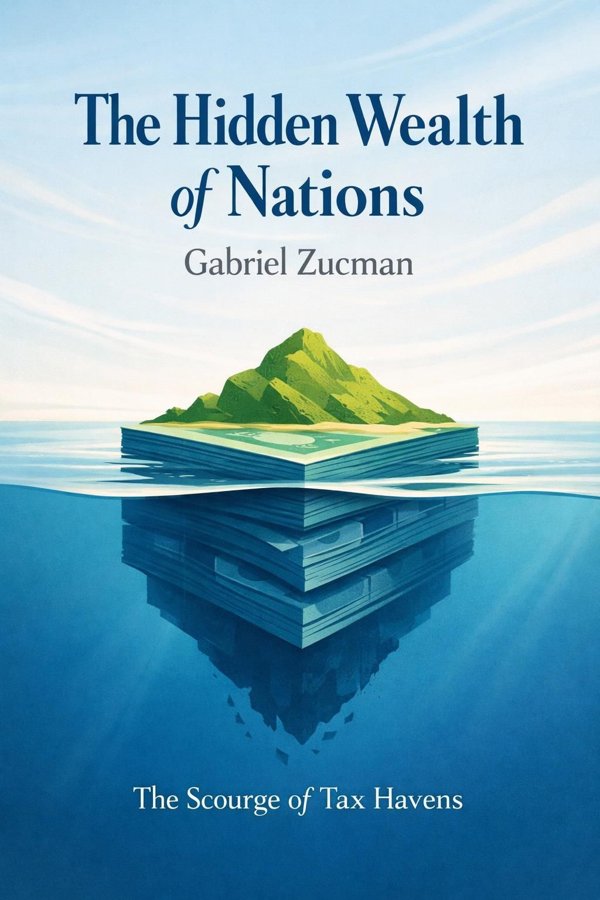
The Hidden Wealth of Nations: The Scourge of Tax Havens: Summary & Key Insights
 10 min8 chaptersAudio available
What Is The Hidden Wealth of Nations: The Scourge of Tax Havens About?
The Hidden Wealth of Nations: The Scourge of Tax Havens by Gabriel Zucman is a economics book spanning 8 pages. In this concise and powerful book, economist Gabriel Zucman investigates the global system of tax havens and the trillions of dollars hidden offshore. Drawing on original research, he reveals how individuals and corporations evade taxes, the impact on global inequality, and the policy measures that could restore fairness to the international tax system.
This FizzRead summary covers all 8 key chapters of The Hidden Wealth of Nations: The Scourge of Tax Havens in approximately 10 minutes, distilling the most important ideas, arguments, and takeaways from Gabriel Zucman's work. Also available as an audio summary and Key Quotes Podcast.
The Hidden Wealth of Nations: The Scourge of Tax Havens
In this concise and powerful book, economist Gabriel Zucman investigates the global system of tax havens and the trillions of dollars hidden offshore. Drawing on original research, he reveals how individuals and corporations evade taxes, the impact on global inequality, and the policy measures that could restore fairness to the international tax system.
Who Should Read The Hidden Wealth of Nations: The Scourge of Tax Havens?
This book is perfect for anyone interested in economics and looking to gain actionable insights in a short read. Whether you're a student, professional, or lifelong learner, the key ideas from The Hidden Wealth of Nations: The Scourge of Tax Havens by Gabriel Zucman will help you think differently.
- ✓Readers who enjoy economics and want practical takeaways
- ✓Professionals looking to apply new ideas to their work and life
- ✓Anyone who wants the core insights of The Hidden Wealth of Nations: The Scourge of Tax Havens in just 10 minutes
Want the full summary?
Get instant access to this book summary and 100K+ more with Fizz Moment.
Get Free SummaryAvailable on App Store • Free to download
Key Chapters
When economists first tried to measure global wealth, they assumed that national accounts and international balance sheets told a coherent story. Yet when I began comparing these records, a striking asymmetry emerged: the world’s assets exceeded the world’s liabilities by several trillion dollars. This was statistically impossible—unless vast reserves of wealth were simply missing from the record. That discrepancy became the starting point for my investigation.
To locate the missing wealth, I analyzed international investment data compiled by the IMF and national central banks. The results revealed a consistent pattern. Countries with well-developed financial industries—Switzerland, Luxembourg, the Cayman Islands, Singapore—reported enormous liabilities to foreigners that did not appear as assets in the countries where those foreigners resided. The missing side of these transactions was, simply put, the hidden wealth of nations.
Estimating the total required cross-referencing official statistics, adjusting for valuation effects, and accounting for underreporting by banks themselves. Through this reconstruction, I found that approximately $7.6 trillion, or about eight percent of global household financial wealth, was held offshore around 2014. Most of it was concentrated among the world’s richest citizens—the top 0.1 percent—whose ability to exploit these havens transformed tax evasion into a normalized global business model.
This isn’t just an abstract number; it represents the erosion of states’ capacity to finance their missions. Wealth hidden abroad deprives governments of hundreds of billions in tax revenue annually. The accuracy of these measurements matters because, without quantification, the issue remains rhetorical—a moral complaint rather than a measurable global failure. By putting numbers to secrecy, we reclaim the power to confront it.
To understand the functioning of tax havens, one must move beyond stereotypes of palm trees and numbered accounts. These jurisdictions are the infrastructure of global financial secrecy, their operations supported by legal engineering and international tolerance. At their core lie two mechanisms: the concealment of ownership and the facilitation of profit shifting.
A tax haven typically offers three services: low or zero taxation, minimal regulatory oversight, and, most crucially, confidentiality. Banks and law firms in these jurisdictions create shell companies and trusts that obscure the true owners of assets. A French billionaire can hold shares in a Swiss account under a Panamanian company; the paper trail is so complex that tax authorities tracing it find only a ghost.
But tax havens do not operate in isolation. They depend on the cooperation—often tacit, sometimes explicit—of major financial centers. London, New York, and Zurich play indispensable roles, providing access to global markets and legitimacy to offshore capital. The result is an ecosystem of secrecy whose borders are porous to money but sealed to transparency.
Banks are central actors here. For decades, institutions like UBS or Credit Suisse actively courted foreign depositors, promising anonymity in return for discreet profits. These practices allowed elites to move wealth invisibly across frontiers. Over time, offshore intermediation became integral to global finance, blurring the line between legal tax avoidance and criminal evasion.
The system thrives because of its complexity. Each layer of trust, subsidiary, and fund distances the owner from the asset, undermining the ability of any single authority to hold them accountable. The mechanics of tax havens, therefore, are not merely technical—they reflect a profound political choice to privilege mobility of capital over the sovereignty of nations.
+ 6 more chapters — available in the FizzRead app
All Chapters in The Hidden Wealth of Nations: The Scourge of Tax Havens
About the Author
Gabriel Zucman is a French economist and professor at the University of California, Berkeley. His research focuses on wealth inequality, tax havens, and public economics. He is recognized for his influential work on global tax evasion and the distribution of wealth.
Get This Summary in Your Preferred Format
Read or listen to the The Hidden Wealth of Nations: The Scourge of Tax Havens summary by Gabriel Zucman anytime, anywhere. FizzRead offers multiple formats so you can learn on your terms — all free.
Available formats: App · Audio · PDF · EPUB — All included free with FizzRead
Download The Hidden Wealth of Nations: The Scourge of Tax Havens PDF and EPUB Summary
Key Quotes from The Hidden Wealth of Nations: The Scourge of Tax Havens
“When economists first tried to measure global wealth, they assumed that national accounts and international balance sheets told a coherent story.”
“To understand the functioning of tax havens, one must move beyond stereotypes of palm trees and numbered accounts.”
Frequently Asked Questions about The Hidden Wealth of Nations: The Scourge of Tax Havens
The Hidden Wealth of Nations: The Scourge of Tax Havens by Gabriel Zucman is a economics book that explores key ideas across 8 chapters. In this concise and powerful book, economist Gabriel Zucman investigates the global system of tax havens and the trillions of dollars hidden offshore. Drawing on original research, he reveals how individuals and corporations evade taxes, the impact on global inequality, and the policy measures that could restore fairness to the international tax system.
You Might Also Like

Business Adventures
John Brooks
10 min
Nudge
Richard H. Thaler, Cass R. Sunstein
10 min
The Hitchhiker"s Guide to the Galaxy
Douglas Adams
10 minThe Muqaddimah
Ibn Khaldun
10 minThe Outsiders
William N. Thorndike
10 min
A Little History of Economics
Niall Kishtainy
10 minBrowse by Category
Ready to read The Hidden Wealth of Nations: The Scourge of Tax Havens?
Get the full summary and 100K+ more books with Fizz Moment.