
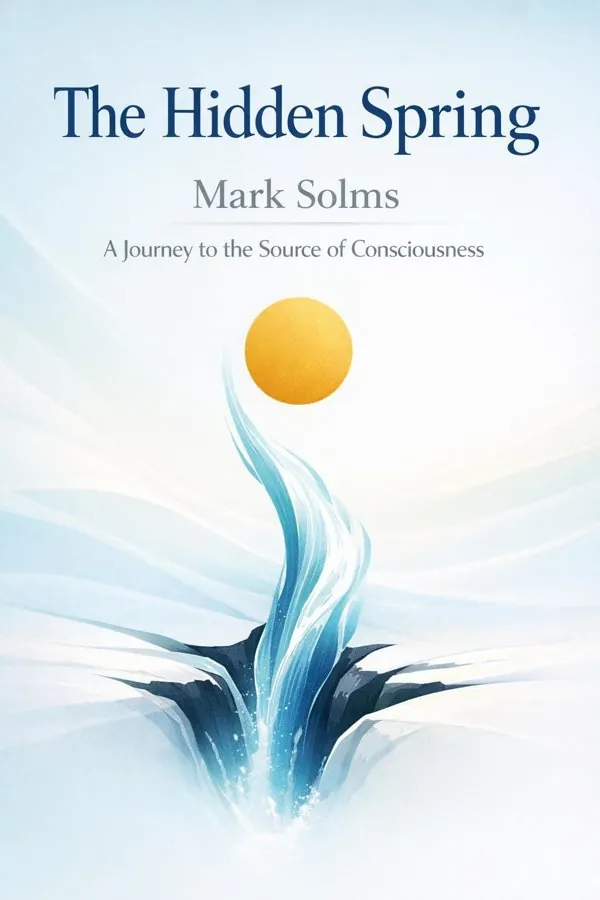
The Hidden Spring: A Journey to the Source of Consciousness: Summary & Key Insights
by Mark Solms
 10 min9 chaptersAudio available
What Is The Hidden Spring: A Journey to the Source of Consciousness About?
The Hidden Spring: A Journey to the Source of Consciousness by Mark Solms is a neuroscience book spanning 9 pages. In this groundbreaking work, neuropsychologist Mark Solms explores the origins of consciousness through the lens of neuroscience and psychoanalysis. He argues that consciousness arises from feelings rather than cognition, challenging long-held assumptions about the mind. Drawing on decades of research, Solms integrates brain science, philosophy, and clinical insight to propose a new model of how subjective experience emerges from the physical brain.
This FizzRead summary covers all 9 key chapters of The Hidden Spring: A Journey to the Source of Consciousness in approximately 10 minutes, distilling the most important ideas, arguments, and takeaways from Mark Solms's work. Also available as an audio summary and Key Quotes Podcast.
The Hidden Spring: A Journey to the Source of Consciousness
In this groundbreaking work, neuropsychologist Mark Solms explores the origins of consciousness through the lens of neuroscience and psychoanalysis. He argues that consciousness arises from feelings rather than cognition, challenging long-held assumptions about the mind. Drawing on decades of research, Solms integrates brain science, philosophy, and clinical insight to propose a new model of how subjective experience emerges from the physical brain.
Who Should Read The Hidden Spring: A Journey to the Source of Consciousness?
This book is perfect for anyone interested in neuroscience and looking to gain actionable insights in a short read. Whether you're a student, professional, or lifelong learner, the key ideas from The Hidden Spring: A Journey to the Source of Consciousness by Mark Solms will help you think differently.
- ✓Readers who enjoy neuroscience and want practical takeaways
- ✓Professionals looking to apply new ideas to their work and life
- ✓Anyone who wants the core insights of The Hidden Spring: A Journey to the Source of Consciousness in just 10 minutes
Want the full summary?
Get instant access to this book summary and 100K+ more with Fizz Moment.
Get Free SummaryAvailable on App Store • Free to download
Key Chapters
The story of consciousness begins with a philosophical division—a split introduced by René Descartes in the seventeenth century between mind and body, res cogitans and res extensa. That dualism haunted science for centuries, creating the illusion that consciousness was a mystery separate from matter. When psychology eventually turned empirical, it was still constrained by Cartesian habits: investigating perception, cognition, and behavior but treating subjective experience as a slippery residue.
In the twentieth century, the behaviorists nearly erased consciousness from scientific discourse altogether. They studied stimuli and responses, measurable actions, not feelings or intentions. When cognitive science finally dethroned behaviorism in the 1950s and 60s, it did so by replacing the human with the model of a computer. The mind became a device for processing information, the brain a complex machine running programs. Consciousness, in this frame, was an emergent function of computation—an illusion created by complexity.
But patients with neurological damage told a different story. In my own clinical work and that of my colleagues, we encountered individuals who had lost the ability to perceive or reason clearly yet remained distinctly alive to their feelings. Some were despairing, others serene, some vehemently angry, though their cognitive capacities were diminished. Conversely, certain forms of brain damage in the deeper structures rendered a person unresponsive—unconscious—despite an intact cortex. The evidence was unmistakable: the seat of consciousness lay not where thoughts occur but where feelings arise.
This historical survey is not an indictment of science but a diagnosis of its blind spot. Consciousness has always been seen through a mirror of intellect. The approach that treated the brain as a computer gave us splendid tools for mapping cognition, yet it ignored the visceral reality of experience. To understand awareness, we must re-enter the body. Cartesian dualism was not an error of logic—it was an error of empathy, forgetting that all knowledge begins in feeling.
Let me state the claim plainly: consciousness arises from affect, not from cognition. To be conscious is to feel oneself existing—to feel pleasure, pain, yearning, satisfaction, fear, curiosity, or calm. Thinking, perceiving, and reasoning are valuable elaborations of this core; they emerge atop the affective foundation but do not generate awareness themselves.
This realization crystallized for me through decades of neuropsychological research, especially examination of cases involving the brainstem. Patients whose cortical regions were destroyed yet retained functioning in the periaqueductal gray and reticular activating system could still wake, sleep, and express basic emotional responses. The opposite—an intact cortex without brainstem activity—led only to unconsciousness. The simplest living organisms, from mammals to fish, exhibit affect-like behaviors that preserve homeostasis, suggesting that consciousness is bound up with survival value.
The feeling-based model thus proposes that consciousness serves the organism’s need to regulate itself. Feelings are internal signals of bodily need: hunger tells of nutrient deficit, pain warns of harm, curiosity drives exploration. Affective consciousness enables flexible, goal-directed responses beyond reflex. It is the origin of volition.
Cognitive consciousness—the knowing that we know—is secondary. You can think without feeling, but those thoughts will lack the warmth of experience. In clinical terms, patients who suffer from affective blunting or damage to subcortical structures lose not intelligence but aliveness. They exist like computers processing data but not caring about outcomes. Hence, cognition alone cannot explain the subjective spark. The hidden spring of awareness lies in emotion—the primal form of knowing that something matters.
+ 7 more chapters — available in the FizzRead app
All Chapters in The Hidden Spring: A Journey to the Source of Consciousness
About the Author
Mark Solms is a South African neuropsychologist and psychoanalyst known for his pioneering work in neuropsychoanalysis. He is a professor at the University of Cape Town and has published extensively on the relationship between brain mechanisms and the mind. His research bridges neuroscience and psychoanalysis, offering new perspectives on consciousness and emotion.
Get This Summary in Your Preferred Format
Read or listen to the The Hidden Spring: A Journey to the Source of Consciousness summary by Mark Solms anytime, anywhere. FizzRead offers multiple formats so you can learn on your terms — all free.
Available formats: App · Audio · PDF · EPUB — All included free with FizzRead
Download The Hidden Spring: A Journey to the Source of Consciousness PDF and EPUB Summary
Key Quotes from The Hidden Spring: A Journey to the Source of Consciousness
“The story of consciousness begins with a philosophical division—a split introduced by René Descartes in the seventeenth century between mind and body, res cogitans and res extensa.”
“Let me state the claim plainly: consciousness arises from affect, not from cognition.”
Frequently Asked Questions about The Hidden Spring: A Journey to the Source of Consciousness
The Hidden Spring: A Journey to the Source of Consciousness by Mark Solms is a neuroscience book that explores key ideas across 9 chapters. In this groundbreaking work, neuropsychologist Mark Solms explores the origins of consciousness through the lens of neuroscience and psychoanalysis. He argues that consciousness arises from feelings rather than cognition, challenging long-held assumptions about the mind. Drawing on decades of research, Solms integrates brain science, philosophy, and clinical insight to propose a new model of how subjective experience emerges from the physical brain.
You Might Also Like
Anxious
Joseph LeDoux
10 min
Hallucinations
Oliver Sacks
10 min
The Biological Mind: How Brain, Body, and Environment Collaborate to Make Us Who We Are
Alan Jasanoff
10 min
The Feeling of Life Itself: Why Consciousness Is Widespread but Can't Be Computed
Christof Koch
10 min
The No-Nonsense Meditation Book
Steven Laureys
10 min
A General Theory of Love
Thomas Lewis, Fari Amini, Richard Lannon
10 minBrowse by Category
Ready to read The Hidden Spring: A Journey to the Source of Consciousness?
Get the full summary and 100K+ more books with Fizz Moment.