
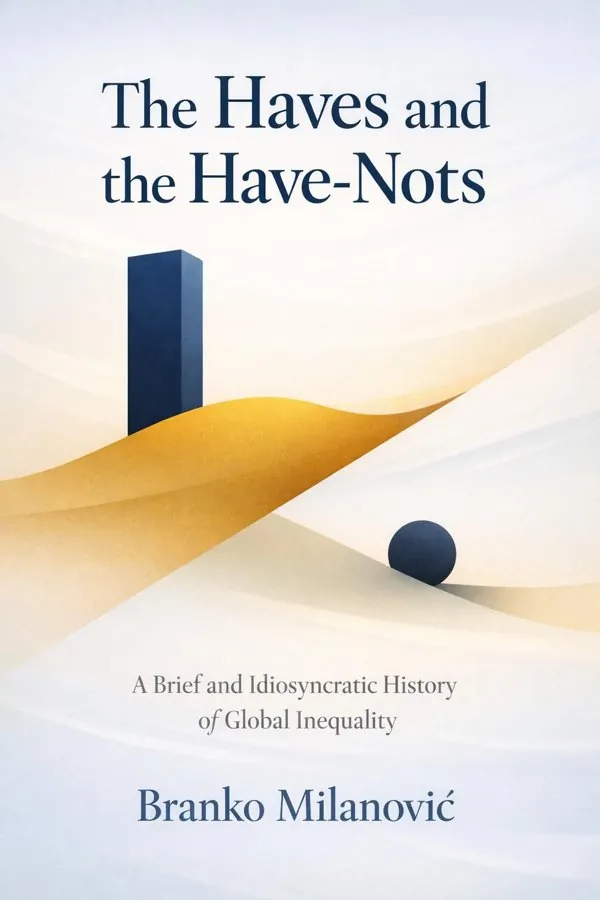
The Haves and the Have-Nots: A Brief and Idiosyncratic History of Global Inequality: Summary & Key Insights
 10 min11 chaptersAudio available
What Is The Haves and the Have-Nots: A Brief and Idiosyncratic History of Global Inequality About?
The Haves and the Have-Nots: A Brief and Idiosyncratic History of Global Inequality by Branko Milanović is a economics book spanning 11 pages. In this engaging and accessible work, economist Branko Milanović explores the history and dynamics of global inequality. Drawing on data and economic theory, he examines how income disparities have evolved across nations and within societies, offering insights into the forces that shape wealth distribution and the prospects for a more equitable world.
This FizzRead summary covers all 11 key chapters of The Haves and the Have-Nots: A Brief and Idiosyncratic History of Global Inequality in approximately 10 minutes, distilling the most important ideas, arguments, and takeaways from Branko Milanović's work. Also available as an audio summary and Key Quotes Podcast.
The Haves and the Have-Nots: A Brief and Idiosyncratic History of Global Inequality
In this engaging and accessible work, economist Branko Milanović explores the history and dynamics of global inequality. Drawing on data and economic theory, he examines how income disparities have evolved across nations and within societies, offering insights into the forces that shape wealth distribution and the prospects for a more equitable world.
Who Should Read The Haves and the Have-Nots: A Brief and Idiosyncratic History of Global Inequality?
This book is perfect for anyone interested in economics and looking to gain actionable insights in a short read. Whether you're a student, professional, or lifelong learner, the key ideas from The Haves and the Have-Nots: A Brief and Idiosyncratic History of Global Inequality by Branko Milanović will help you think differently.
- ✓Readers who enjoy economics and want practical takeaways
- ✓Professionals looking to apply new ideas to their work and life
- ✓Anyone who wants the core insights of The Haves and the Have-Nots: A Brief and Idiosyncratic History of Global Inequality in just 10 minutes
Want the full summary?
Get instant access to this book summary and 100K+ more with Fizz Moment.
Get Free SummaryAvailable on App Store • Free to download
Key Chapters
To understand the present, we must retrace the arc of inequality through time. In pre-industrial societies, disparities were rooted mainly in land ownership and social status. A small aristocracy controlled land and resources, while peasants lived at subsistence levels. Income inequality was stark but stationary; mobility was limited and largely dependent on birth.
The Industrial Revolution transformed this static arrangement. As technology and production surged, new forms of wealth emerged, but so too did new concentrations of power. Industrial capitalism initially widened inequality within nations—entrepreneurs and capital owners amassed large fortunes while the urban poor struggled to adapt. Yet it also created possibilities for broader prosperity: economic growth lifted average incomes, even if unevenly.
Colonialism added an international dimension. The exploitation of colonies for raw materials and labor deepened the gap between European powers and the rest of the world. The wealth accumulated in London or Paris was mirrored by poverty in Bengal or the Congo. This uneven development laid the foundations of modern global inequality.
In the twentieth century, wars, revolutions, and welfare policies reshaped the distribution map. The mid-century brought temporary equality in advanced capitalist countries, aided by social safety nets, strong unions, and progressive taxation. But the last decades of the century, driven by globalization and technological shifts, reversed many of these gains. Emerging economies such as China narrowed the gap with richer nations, but within many countries—including the United States—inequality soared once more.
This historical overview shows that inequality is never fixed; it evolves through the interplay of political and economic forces. My goal here is not nostalgia for a simpler era, but to make clear that our present inequalities are historically constructed—born of decisions, not destiny.
One cannot discuss inequality without measuring it. As an economist, I rely on rigorous tools that translate moral intuitions into numerical clarity. The most famous of these is the Gini coefficient, a single number between zero and one that expresses how income is distributed among people. A Gini of zero represents perfect equality; one represents perfect inequality. But no society has or ever will reach either extreme.
Measurements, however, are more than technical abstractions. They tell stories. Income distribution curves, Lorenz curves, and percentile comparisons all help visualize how far apart the richest and poorest stand. For instance, the top one percent of global earners—those who make hundreds of thousands of dollars per year—possess orders of magnitude more wealth than the bottom half of humanity combined. These figures are stark, but they enable understanding.
Quantifying inequality also reveals its multidimensional nature. National averages can mask local suffering. A country with moderate inequality may still harbor deep regional, ethnic, or gender disparities. Measurement thus becomes not only a diagnostic but a moral instrument, allowing us to see where our systems fail to deliver fairness or opportunity.
In designing these statistical approaches, I want readers to appreciate their purpose. Numbers are not cold; they are mirrors. They show society to itself—as it is, not as it imagines itself to be.
+ 9 more chapters — available in the FizzRead app
All Chapters in The Haves and the Have-Nots: A Brief and Idiosyncratic History of Global Inequality
About the Author
Branko Milanović is a Serbian-American economist specializing in income inequality and development. He served as lead economist in the World Bank’s research department and is a visiting presidential professor at the City University of New York. His research focuses on global income distribution and the economics of inequality.
Get This Summary in Your Preferred Format
Read or listen to the The Haves and the Have-Nots: A Brief and Idiosyncratic History of Global Inequality summary by Branko Milanović anytime, anywhere. FizzRead offers multiple formats so you can learn on your terms — all free.
Available formats: App · Audio · PDF · EPUB — All included free with FizzRead
Download The Haves and the Have-Nots: A Brief and Idiosyncratic History of Global Inequality PDF and EPUB Summary
Key Quotes from The Haves and the Have-Nots: A Brief and Idiosyncratic History of Global Inequality
“To understand the present, we must retrace the arc of inequality through time.”
“One cannot discuss inequality without measuring it.”
Frequently Asked Questions about The Haves and the Have-Nots: A Brief and Idiosyncratic History of Global Inequality
The Haves and the Have-Nots: A Brief and Idiosyncratic History of Global Inequality by Branko Milanović is a economics book that explores key ideas across 11 chapters. In this engaging and accessible work, economist Branko Milanović explores the history and dynamics of global inequality. Drawing on data and economic theory, he examines how income disparities have evolved across nations and within societies, offering insights into the forces that shape wealth distribution and the prospects for a more equitable world.
You Might Also Like

Business Adventures
John Brooks
10 min
Nudge
Richard H. Thaler, Cass R. Sunstein
10 min
The Hitchhiker"s Guide to the Galaxy
Douglas Adams
10 minThe Muqaddimah
Ibn Khaldun
10 minThe Outsiders
William N. Thorndike
10 min
A Little History of Economics
Niall Kishtainy
10 minBrowse by Category
Ready to read The Haves and the Have-Nots: A Brief and Idiosyncratic History of Global Inequality?
Get the full summary and 100K+ more books with Fizz Moment.