
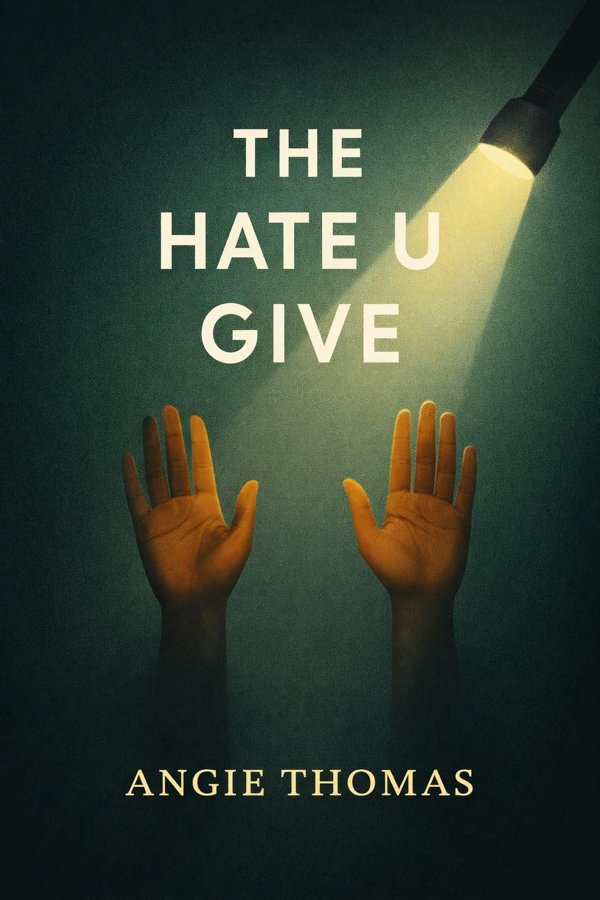
The Hate U Give: Summary & Key Insights
by Angie Thomas
 10 min8 chaptersAudio available
Key Takeaways from The Hate U Give
One of the novel’s deepest insights is that survival can require performance.
The novel’s central tragedy begins with something terrifyingly ordinary: a traffic stop.
A haunting truth runs through The Hate U Give: silence is rarely neutral.
Anger in The Hate U Give is not portrayed as reckless emotion; it is shown as a rational response to repeated harm.
After Khalil is killed, the battle over his reputation becomes almost as important as the battle over the facts.
What Is The Hate U Give About?
The Hate U Give by Angie Thomas is a bestsellers book spanning 4 pages. Angie Thomas’s The Hate U Give is a powerful young adult novel that became an instant modern classic for its unflinching portrayal of race, identity, and police violence in America. Published in 2017, the book follows sixteen-year-old Starr Carter, who moves between two worlds: her predominantly Black, working-class neighborhood of Garden Heights and the wealthy, mostly white private school she attends. That fragile balance shatters when Starr witnesses a police officer kill her unarmed childhood friend, Khalil, during a traffic stop. Suddenly, she is not just grieving—she is the key witness in a case that exposes deep injustices in her community and the broader culture. What makes the novel so resonant is its combination of emotional intimacy and political urgency. Thomas draws on the language, pressures, humor, and pain of real communities, making Starr’s journey feel immediate and authentic. More than a story about a single tragedy, The Hate U Give examines how silence is enforced, how stereotypes distort truth, and how ordinary people find the courage to speak. It matters because it gives voice to experiences too often dismissed—and reminds readers that testimony can be a form of resistance.
This FizzRead summary covers all 8 key chapters of The Hate U Give in approximately 10 minutes, distilling the most important ideas, arguments, and takeaways from Angie Thomas's work. Also available as an audio summary and Key Quotes Podcast.
The Hate U Give
Angie Thomas’s The Hate U Give is a powerful young adult novel that became an instant modern classic for its unflinching portrayal of race, identity, and police violence in America. Published in 2017, the book follows sixteen-year-old Starr Carter, who moves between two worlds: her predominantly Black, working-class neighborhood of Garden Heights and the wealthy, mostly white private school she attends. That fragile balance shatters when Starr witnesses a police officer kill her unarmed childhood friend, Khalil, during a traffic stop. Suddenly, she is not just grieving—she is the key witness in a case that exposes deep injustices in her community and the broader culture.
What makes the novel so resonant is its combination of emotional intimacy and political urgency. Thomas draws on the language, pressures, humor, and pain of real communities, making Starr’s journey feel immediate and authentic. More than a story about a single tragedy, The Hate U Give examines how silence is enforced, how stereotypes distort truth, and how ordinary people find the courage to speak. It matters because it gives voice to experiences too often dismissed—and reminds readers that testimony can be a form of resistance.
Who Should Read The Hate U Give?
This book is perfect for anyone interested in bestsellers and looking to gain actionable insights in a short read. Whether you're a student, professional, or lifelong learner, the key ideas from The Hate U Give by Angie Thomas will help you think differently.
- ✓Readers who enjoy bestsellers and want practical takeaways
- ✓Professionals looking to apply new ideas to their work and life
- ✓Anyone who wants the core insights of The Hate U Give in just 10 minutes
Want the full summary?
Get instant access to this book summary and 100K+ more with Fizz Moment.
Get Free SummaryAvailable on App Store • Free to download
Key Chapters
One of the novel’s deepest insights is that survival can require performance. Starr Carter is not simply living in two places; she is constantly editing herself to fit each one. In Garden Heights, she belongs to a Black community shaped by loyalty, struggle, humor, and danger. At Williamson Prep, she monitors her speech, avoids slang, and suppresses parts of her personality so she will not be judged by her mostly white classmates. This split is exhausting because it is not just social code-switching—it is emotional compartmentalization.
Thomas uses Starr’s double life to show how identity becomes pressured by class, race, and expectations. At school, Starr fears being reduced to stereotypes. At home, she fears drifting too far from the people and culture that made her. Many readers will recognize this tension even outside the novel. Anyone who has changed their language at work, hidden family realities, or softened their opinions to fit an environment understands the cost of belonging on unequal terms.
The book makes clear that code-switching can be strategic, but it also reveals its psychological toll. Starr begins the story believing she must keep her worlds separate to stay safe. As the novel unfolds, she learns that wholeness requires refusing shame. Her growth comes not from choosing one world over the other, but from claiming all of herself in both.
A practical way to apply this idea is to notice where you routinely shrink your identity to make others comfortable. Ask what would change if you brought a little more honesty into those spaces. The takeaway: adaptation may help you navigate the world, but self-respect begins when you stop treating parts of yourself as unacceptable.
The novel’s central tragedy begins with something terrifyingly ordinary: a traffic stop. Starr and Khalil are leaving a party when they are pulled over by a police officer later identified as One-Fifteen. The scene unfolds with unbearable familiarity—commands, suspicion, fear, and then sudden violence. Khalil, unarmed, is shot and killed. Thomas writes this moment not as an abstraction or headline but as lived trauma. The power of the scene lies in how quickly normality becomes catastrophe.
This event is the crucible of the novel because it destroys innocence on multiple levels. Starr loses her childhood friend, but she also loses the illusion that truth automatically leads to justice. Khalil is gone, and within hours the public narrative begins to shift away from his humanity and toward insinuations about his behavior. Thomas shows how institutional violence does not end with the bullet; it continues through doubt, distortion, and delay.
In practical terms, the scene asks readers to think critically about how they consume stories of public violence. Do we focus first on the victim’s life, or do we immediately search for details that make the death easier to excuse? The novel insists that the framing of an event matters as much as the event itself.
For readers, the lesson extends beyond policing. Moments of crisis often reveal the systems already operating beneath everyday life. Seemingly routine interactions can be shaped by bias, power, and fear. The takeaway: do not mistake familiar institutions for neutral ones—pay attention to how ordinary procedures can become sites of injustice.
A haunting truth runs through The Hate U Give: silence is rarely neutral. After Khalil’s death, Starr is overwhelmed by grief, fear, and pressure. She knows what she saw, yet speaking publicly could endanger her family, expose her to scrutiny, and bring retaliation from both the police and local gangs. Thomas captures the cruel burden placed on witnesses from marginalized communities: tell the truth, but be prepared to pay for it.
The novel carefully explores why people remain silent. Silence can be self-protection. It can be trauma. It can be the learned response of those who have seen systems fail before. But the book also shows how silence serves power. When witnesses say nothing, official narratives harden. Stereotypes go unchallenged. The dead become symbols instead of people.
Starr’s journey toward speaking out is not framed as easy heroism. It is a gradual process of realizing that her voice matters precisely because others want it contained. She learns that testimony is not only about legal evidence—it is also about reclaiming human dignity. Her words become a way of honoring Khalil and resisting the machinery that would erase him.
Readers can apply this lesson in everyday contexts. Speaking up may mean challenging a false rumor at school, addressing bias at work, or refusing to let someone be misrepresented in a group setting. Not every act of truth-telling is public or dramatic, but each one disrupts the comfort of silence.
The takeaway: use your voice where you can, especially when silence would make injustice easier to ignore.
Anger in The Hate U Give is not portrayed as reckless emotion; it is shown as a rational response to repeated harm. After Khalil’s death, Garden Heights becomes a site of mourning, frustration, and protest. Thomas presents community unrest not as senseless chaos but as the accumulated result of neglect, surveillance, poverty, and public devaluation. When institutions fail to deliver justice, grief spills into the streets.
This is one of the novel’s most important political ideas: resistance does not emerge in a vacuum. It grows from lived experience. People protest because they are tired of being unheard. They riot because they believe no peaceful route has protected them. Thomas does not romanticize destruction, but she demands that readers ask the harder question: what conditions made this explosion feel inevitable?
Garden Heights also shows that resistance takes many forms. Some characters march. Some organize. Some speak to the media. Some protect local businesses or care for neighbors in crisis. Thomas broadens the meaning of activism by showing that communities survive through mutual support as much as public confrontation.
A practical application of this idea is to look beyond surface judgments when communities express rage. Instead of asking only whether a reaction is acceptable, ask what pain or injustice gave rise to it. In personal life, this can mean responding to conflict with curiosity about underlying hurt rather than immediate condemnation.
The takeaway: when people erupt in anger, do not focus only on the flames—examine the conditions that kept fueling the fire.
After Khalil is killed, the battle over his reputation becomes almost as important as the battle over the facts. Rumors about drugs, gang ties, and bad choices circulate quickly, suggesting that if Khalil was imperfect, his death is somehow less tragic or less unjust. Thomas exposes a devastating social reflex: when a marginalized person is harmed, people often search for flaws that make the violence easier to rationalize.
The novel makes clear that stereotypes are not harmless misunderstandings. They function as tools that strip people of complexity and empathy. Khalil is a teenager, a son, a friend, and a person with dreams and limitations. But public discourse tries to flatten him into a category. Once that happens, accountability becomes harder to demand because the victim has already been symbolically dehumanized.
This idea reaches beyond the book’s central incident. Starr’s classmates reveal casual assumptions about Black neighborhoods, Black anger, and Black speech. These moments show how stereotypes shape daily interactions, not just dramatic public cases. Thomas invites readers to recognize how often labels replace listening.
In practical terms, this means interrogating the stories we accept about individuals or communities. If your first understanding of someone comes from rumor, media shorthand, or social bias, it is probably incomplete. Ask what details are missing. Ask whose perspective is absent.
The takeaway: whenever a person is reduced to a stereotype, slow down and insist on their full humanity before forming your judgment.
While The Hate U Give deals with public injustice, much of its emotional strength comes from private relationships. Starr’s family is not perfect, but it is fiercely protective, honest, and deeply loving. Her parents, Maverick and Lisa, serve as moral anchors in a chaotic world. They offer different forms of guidance—discipline, tenderness, political awareness, and practical caution. Through them, Thomas shows that family is not only a source of comfort; it is where values are taught, tested, and passed on.
Maverick, in particular, embodies the complexity of growth. He has a difficult past, yet he is committed to fatherhood, community, and accountability. Lisa balances fear for her children’s safety with determination to help them thrive. Their parenting reveals that raising children in an unjust society requires more than affection. It requires preparing them for bias while preserving their dignity.
The novel also presents siblings and extended community as part of this support system. In moments of crisis, Starr is held up by people who remind her she does not have to face trauma alone. This matters because one of injustice’s goals is isolation. Family, in Thomas’s telling, becomes a counterforce to that isolation.
Readers can apply this idea by thinking of family broadly: biological relatives, chosen family, mentors, and trusted friends. In difficult seasons, resilience often depends on relationships that tell the truth and offer protection.
The takeaway: build and value circles of care that do more than comfort you—they should help you become braver, clearer, and more grounded.
Courage in The Hate U Give is not the absence of fear; it is action taken while fear remains. Starr is frightened throughout the novel—of public exposure, of retaliation, of losing friends, of making things worse for her family. Thomas avoids the simplistic idea that bravery arrives as sudden confidence. Instead, she shows courage as incremental, messy, and deeply personal.
What makes Starr’s transformation compelling is that every step forward costs her something. Speaking out threatens her carefully managed identity. It strains relationships. It forces her to stop hiding behind the version of herself she curated for safety. Courage, then, is not just about confronting external power; it is about surrendering the false stability of silence.
This insight applies far beyond activism. Many people delay necessary action because they are waiting to feel fully ready. But the novel argues that readiness often comes after the decision, not before it. Whether the issue is reporting harm, setting a boundary, changing careers, or naming a painful truth, courage usually begins in uncertainty.
Thomas also shows that courage is contagious. When one person speaks, others often find strength to do the same. Starr’s voice matters not only because of what she says, but because it models possibility for those around her.
The takeaway: do not wait for fear to disappear before you act. Often, the only path to a stronger self is through the discomfort you have been trying to avoid.
All Chapters in The Hate U Give
About the Author
Angie Thomas is an American author born and raised in Jackson, Mississippi. Before becoming a novelist, she was a teenage rapper, an experience that helped shape her ear for voice, rhythm, and authentic dialogue. She later studied creative writing at Belhaven University and emerged as a major literary voice with her debut novel, The Hate U Give. The book became an international bestseller, earned critical acclaim, and was adapted into a feature film. Thomas is celebrated for writing stories centered on Black youth with honesty, humor, and emotional depth. Her work often explores race, identity, family, and systemic injustice while remaining accessible to a wide readership. She has played a major role in expanding representation in contemporary young adult fiction.
Get This Summary in Your Preferred Format
Read or listen to the The Hate U Give summary by Angie Thomas anytime, anywhere. FizzRead offers multiple formats so you can learn on your terms — all free.
Available formats: App · Audio · PDF · EPUB — All included free with FizzRead
Download The Hate U Give PDF and EPUB Summary
Key Quotes from The Hate U Give
“One of the novel’s deepest insights is that survival can require performance.”
“The novel’s central tragedy begins with something terrifyingly ordinary: a traffic stop.”
“A haunting truth runs through The Hate U Give: silence is rarely neutral.”
“Anger in The Hate U Give is not portrayed as reckless emotion; it is shown as a rational response to repeated harm.”
“After Khalil is killed, the battle over his reputation becomes almost as important as the battle over the facts.”
Frequently Asked Questions about The Hate U Give
The Hate U Give by Angie Thomas is a bestsellers book that explores key ideas across 8 chapters. Angie Thomas’s The Hate U Give is a powerful young adult novel that became an instant modern classic for its unflinching portrayal of race, identity, and police violence in America. Published in 2017, the book follows sixteen-year-old Starr Carter, who moves between two worlds: her predominantly Black, working-class neighborhood of Garden Heights and the wealthy, mostly white private school she attends. That fragile balance shatters when Starr witnesses a police officer kill her unarmed childhood friend, Khalil, during a traffic stop. Suddenly, she is not just grieving—she is the key witness in a case that exposes deep injustices in her community and the broader culture. What makes the novel so resonant is its combination of emotional intimacy and political urgency. Thomas draws on the language, pressures, humor, and pain of real communities, making Starr’s journey feel immediate and authentic. More than a story about a single tragedy, The Hate U Give examines how silence is enforced, how stereotypes distort truth, and how ordinary people find the courage to speak. It matters because it gives voice to experiences too often dismissed—and reminds readers that testimony can be a form of resistance.
More by Angie Thomas

You Might Also Like

The Godfather
Mario Puzo
10 min
The Handmaid's Tale
Margaret Atwood
10 min
The Hunger Games
Suzanne Collins
10 min
The Nightingale
Kristin Hannah
10 min
The Seven Husbands of Evelyn Hugo
Taylor Jenkins Reid
10 min
Backwater Justice
Fern Michaels
10 minBrowse by Category
Ready to read The Hate U Give?
Get the full summary and 100K+ more books with Fizz Moment.