
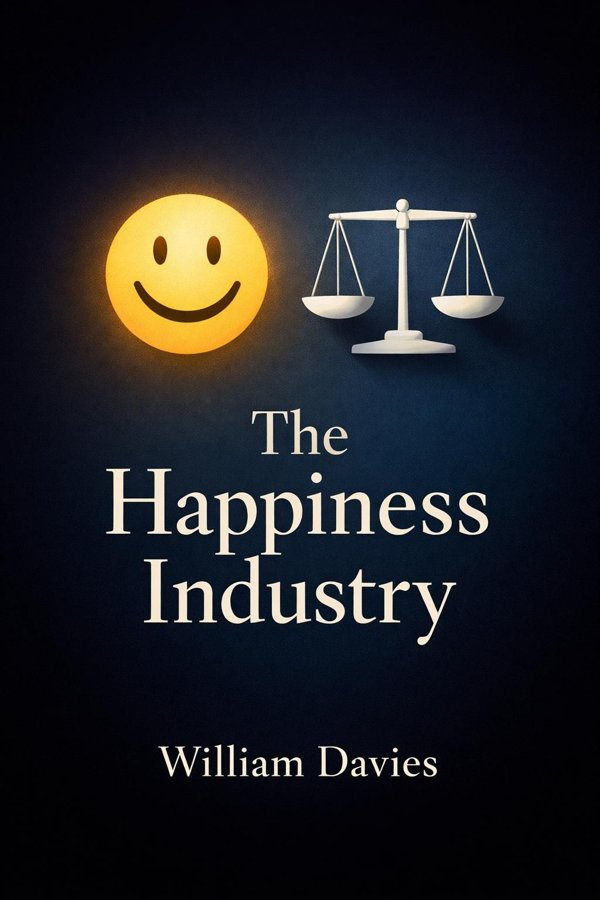
The Happiness Industry: How the Government and Big Business Sold Us Well-Being: Summary & Key Insights
 10 min10 chaptersAudio available
What Is The Happiness Industry: How the Government and Big Business Sold Us Well-Being About?
The Happiness Industry: How the Government and Big Business Sold Us Well-Being by William Davies is a economics book spanning 10 pages. In this incisive work, political economist William Davies explores how the modern pursuit of happiness has been transformed into an instrument of social control and economic management. He traces the history of the 'science of happiness' from Jeremy Bentham’s utilitarian philosophy to contemporary corporate and governmental practices that commodify well-being. The book critically examines how psychological metrics and behavioral economics have been used to shape public policy and workplace culture, revealing the political and ethical implications of treating happiness as a measurable product.
This FizzRead summary covers all 10 key chapters of The Happiness Industry: How the Government and Big Business Sold Us Well-Being in approximately 10 minutes, distilling the most important ideas, arguments, and takeaways from William Davies's work. Also available as an audio summary and Key Quotes Podcast.
The Happiness Industry: How the Government and Big Business Sold Us Well-Being
In this incisive work, political economist William Davies explores how the modern pursuit of happiness has been transformed into an instrument of social control and economic management. He traces the history of the 'science of happiness' from Jeremy Bentham’s utilitarian philosophy to contemporary corporate and governmental practices that commodify well-being. The book critically examines how psychological metrics and behavioral economics have been used to shape public policy and workplace culture, revealing the political and ethical implications of treating happiness as a measurable product.
Who Should Read The Happiness Industry: How the Government and Big Business Sold Us Well-Being?
This book is perfect for anyone interested in economics and looking to gain actionable insights in a short read. Whether you're a student, professional, or lifelong learner, the key ideas from The Happiness Industry: How the Government and Big Business Sold Us Well-Being by William Davies will help you think differently.
- ✓Readers who enjoy economics and want practical takeaways
- ✓Professionals looking to apply new ideas to their work and life
- ✓Anyone who wants the core insights of The Happiness Industry: How the Government and Big Business Sold Us Well-Being in just 10 minutes
Want the full summary?
Get instant access to this book summary and 100K+ more with Fizz Moment.
Get Free SummaryAvailable on App Store • Free to download
Key Chapters
To comprehend the current obsession with measuring happiness, one must start with utilitarianism. Jeremy Bentham, writing in the late eighteenth century, proposed that the goal of society should be the greatest happiness of the greatest number. His innovation lay in thinking that pleasure and pain could be calculated—that policy could, quite literally, be guided by arithmetic. Though Bentham lacked the means to operationalize his idea, the philosophical seed was sown: feelings could be treated as quantities susceptible to bureaucratic management.
This conception dovetailed perfectly with the emerging logic of industrial capitalism and the modern state. As population statistics, census data, and early economic indicators arose, Bentham’s dreams of a measurable moral order found material support. The very notion of efficiency—that inputs should yield maximal outputs—has its psychological cousin in the calculus of pleasure versus pain. And so, from the beginning, the politics of measurement were bound to the governance of emotion.
By tracing this lineage, I wanted to show that the instrumentation of happiness is no historical accident. It is embedded within modern rationalism itself: the belief that what matters can be counted, and what cannot be counted should, somehow, be made to fit the calculus. The moral aspiration to increase collective happiness was transformed into the technical project of managing affective life.
The nineteenth and early twentieth centuries saw psychology and economics draw ever closer, each seeking to render human behavior predictable and controllable. Psychologists such as Wilhelm Wundt and later the behaviorists viewed emotions not as inner mysteries but as observable reactions, measurable in laboratory settings. Economists, meanwhile, refined Bentham’s felicific calculus into utility theory, presuming that individuals make choices to maximize subjective satisfaction.
This convergence generated a new kind of science—one obsessed with quantification, data collection, and the promise of prediction. Industrialists and policy-makers quickly recognized the potential. If emotions could be monitored and shaped, then motivation, compliance, and even social order could be achieved more efficiently. Thus was born an era of behavioral measurement, in which emotions became key variables in the machinery of control.
Throughout the twentieth century, developments like psychometric testing, time-and-motion studies, and later, marketing research built an infrastructure for what I describe as the management of feeling. Happiness was no longer a moral or philosophical question; it became a technical object—a resource to be optimized within institutions.
+ 8 more chapters — available in the FizzRead app
All Chapters in The Happiness Industry: How the Government and Big Business Sold Us Well-Being
About the Author
William Davies is a British sociologist, political economist, and writer. He is a professor at Goldsmiths, University of London, and his research focuses on the intersection of economics, psychology, and politics. Davies is known for his critical analyses of neoliberalism and the influence of behavioral science on governance and business.
Get This Summary in Your Preferred Format
Read or listen to the The Happiness Industry: How the Government and Big Business Sold Us Well-Being summary by William Davies anytime, anywhere. FizzRead offers multiple formats so you can learn on your terms — all free.
Available formats: App · Audio · PDF · EPUB — All included free with FizzRead
Download The Happiness Industry: How the Government and Big Business Sold Us Well-Being PDF and EPUB Summary
Key Quotes from The Happiness Industry: How the Government and Big Business Sold Us Well-Being
“To comprehend the current obsession with measuring happiness, one must start with utilitarianism.”
“The nineteenth and early twentieth centuries saw psychology and economics draw ever closer, each seeking to render human behavior predictable and controllable.”
Frequently Asked Questions about The Happiness Industry: How the Government and Big Business Sold Us Well-Being
The Happiness Industry: How the Government and Big Business Sold Us Well-Being by William Davies is a economics book that explores key ideas across 10 chapters. In this incisive work, political economist William Davies explores how the modern pursuit of happiness has been transformed into an instrument of social control and economic management. He traces the history of the 'science of happiness' from Jeremy Bentham’s utilitarian philosophy to contemporary corporate and governmental practices that commodify well-being. The book critically examines how psychological metrics and behavioral economics have been used to shape public policy and workplace culture, revealing the political and ethical implications of treating happiness as a measurable product.
You Might Also Like
Business Adventures
John Brooks
10 min
Nudge
Richard H. Thaler, Cass R. Sunstein
10 min
The Hitchhiker"s Guide to the Galaxy
Douglas Adams
10 minThe Muqaddimah
Ibn Khaldun
10 minThe Outsiders
William N. Thorndike
10 min
A Little History of Economics
Niall Kishtainy
10 minBrowse by Category
Ready to read The Happiness Industry: How the Government and Big Business Sold Us Well-Being?
Get the full summary and 100K+ more books with Fizz Moment.