
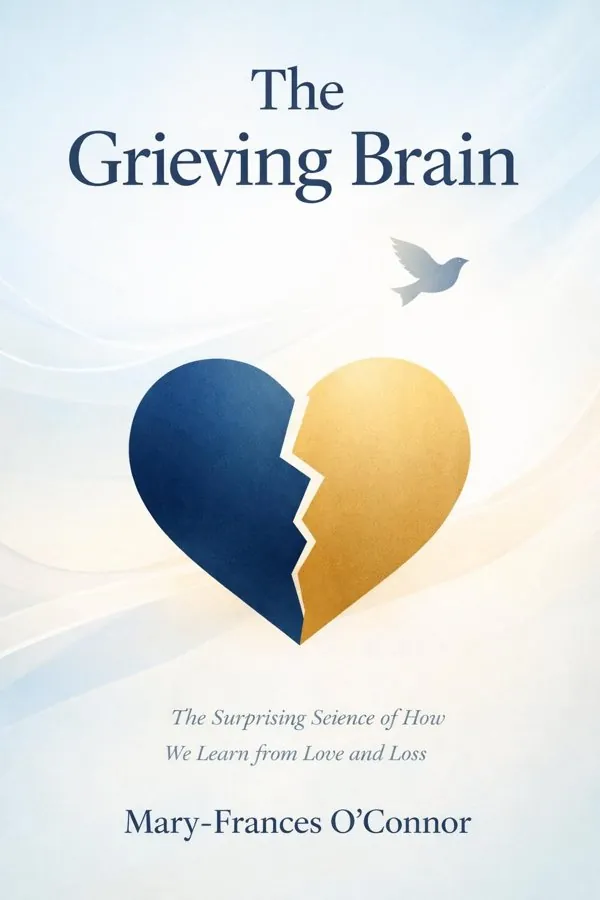
The Grieving Brain: The Surprising Science of How We Learn from Love and Loss: Summary & Key Insights
 10 min7 chaptersAudio available
What Is The Grieving Brain: The Surprising Science of How We Learn from Love and Loss About?
The Grieving Brain: The Surprising Science of How We Learn from Love and Loss by Mary-Frances O'Connor is a neuroscience book spanning 7 pages. In this groundbreaking work, neuroscientist Mary-Frances O’Connor explores the science behind grief and the human brain’s response to loss. Drawing on decades of research, she explains how our neural systems for attachment and learning are deeply intertwined with the experience of bereavement, offering a compassionate and evidence-based understanding of how we adapt to the death of loved ones.
This FizzRead summary covers all 7 key chapters of The Grieving Brain: The Surprising Science of How We Learn from Love and Loss in approximately 10 minutes, distilling the most important ideas, arguments, and takeaways from Mary-Frances O'Connor's work. Also available as an audio summary and Key Quotes Podcast.
The Grieving Brain: The Surprising Science of How We Learn from Love and Loss
In this groundbreaking work, neuroscientist Mary-Frances O’Connor explores the science behind grief and the human brain’s response to loss. Drawing on decades of research, she explains how our neural systems for attachment and learning are deeply intertwined with the experience of bereavement, offering a compassionate and evidence-based understanding of how we adapt to the death of loved ones.
Who Should Read The Grieving Brain: The Surprising Science of How We Learn from Love and Loss?
This book is perfect for anyone interested in neuroscience and looking to gain actionable insights in a short read. Whether you're a student, professional, or lifelong learner, the key ideas from The Grieving Brain: The Surprising Science of How We Learn from Love and Loss by Mary-Frances O'Connor will help you think differently.
- ✓Readers who enjoy neuroscience and want practical takeaways
- ✓Professionals looking to apply new ideas to their work and life
- ✓Anyone who wants the core insights of The Grieving Brain: The Surprising Science of How We Learn from Love and Loss in just 10 minutes
Want the full summary?
Get instant access to this book summary and 100K+ more with Fizz Moment.
Get Free SummaryAvailable on App Store • Free to download
Key Chapters
Attachment is one of the brain’s most fundamental operations. From infancy onward, our survival depends on bonding with others. What fascinates me as a neuroscientist is that these bonds are not abstract emotions; they are encoded in specific neural systems that track proximity, care, and emotional attunement. When you think of someone you love, regions in your brain’s ventral striatum and prefrontal cortex light up with familiarity. These structures form what I call a 'neural map of connection' — a system that teaches the brain, ‘This person is safe, this person means survival.’
Our brain doesn’t just recognize loved ones; it anticipates them. It predicts their daily patterns, the sound of their voice, their presence in a shared home. This predictive coding is what makes attachment feel effortless. But it also makes loss devastating. When someone dies, those predictions continue to fire — expecting a hug that will never come, a text that will never arrive. The brain’s attachment circuitry doesn’t immediately shut down because biologically, it was designed never to lose track of those who matter most. Grief, therefore, begins as an error signal in these systems — a painful awareness that what the brain expects no longer matches reality.
Understanding this helps us reframe grief from chaos into meaning. Our pain is the result of an exquisitely tuned human mechanism, one that evolved to keep relationships alive. In other words, we grieve because we are wired for love.
One of the central ideas in this book is that grieving is not about forgetting, but learning. The brain’s predictive machinery — the same processes that allow us to navigate the world with ease — has learned patterns from our loved one’s existence. For instance, you might unconsciously expect the sound of your partner’s keys in the door every evening. When that sound never comes, the brain experiences a prediction error. It must relearn the world without that cue.
This relearning process is fundamentally the same as other types of learning the brain performs, but with deeply emotional consequences. The hippocampus and prefrontal cortex collaborate to update old expectations and form new models of reality. Early in grief, this system cannot keep up — the old models persist, causing moments of disbelief or confusion. It’s why you might still think, just for a split second, that the deceased person is about to walk into the room. Over time, as the brain’s learning mechanisms adapt, these misfires diminish, and what once felt like raw disbelief becomes a gentler memory.
Through this lens, grief becomes an act of cognitive as well as emotional transformation. It is the slow, painstaking education of the self in a world now redefined by absence. This insight offers compassion — what we often call ‘moving on’ is really the completion of a deep learning process that the brain performs to ensure we can go on living meaningfully.
+ 5 more chapters — available in the FizzRead app
All Chapters in The Grieving Brain: The Surprising Science of How We Learn from Love and Loss
About the Author
Mary-Frances O’Connor is an associate professor of psychology at the University of Arizona, where she directs the Grief, Loss and Social Stress (GLASS) Lab. Her research focuses on the neurobiological and psychological processes of grief and bereavement.
Get This Summary in Your Preferred Format
Read or listen to the The Grieving Brain: The Surprising Science of How We Learn from Love and Loss summary by Mary-Frances O'Connor anytime, anywhere. FizzRead offers multiple formats so you can learn on your terms — all free.
Available formats: App · Audio · PDF · EPUB — All included free with FizzRead
Download The Grieving Brain: The Surprising Science of How We Learn from Love and Loss PDF and EPUB Summary
Key Quotes from The Grieving Brain: The Surprising Science of How We Learn from Love and Loss
“Attachment is one of the brain’s most fundamental operations.”
“One of the central ideas in this book is that grieving is not about forgetting, but learning.”
Frequently Asked Questions about The Grieving Brain: The Surprising Science of How We Learn from Love and Loss
The Grieving Brain: The Surprising Science of How We Learn from Love and Loss by Mary-Frances O'Connor is a neuroscience book that explores key ideas across 7 chapters. In this groundbreaking work, neuroscientist Mary-Frances O’Connor explores the science behind grief and the human brain’s response to loss. Drawing on decades of research, she explains how our neural systems for attachment and learning are deeply intertwined with the experience of bereavement, offering a compassionate and evidence-based understanding of how we adapt to the death of loved ones.
You Might Also Like
Anxious
Joseph LeDoux
10 min
Hallucinations
Oliver Sacks
10 min
The Biological Mind: How Brain, Body, and Environment Collaborate to Make Us Who We Are
Alan Jasanoff
10 min
The Feeling of Life Itself: Why Consciousness Is Widespread but Can't Be Computed
Christof Koch
10 min
The No-Nonsense Meditation Book
Steven Laureys
10 min
A General Theory of Love
Thomas Lewis, Fari Amini, Richard Lannon
10 minBrowse by Category
Ready to read The Grieving Brain: The Surprising Science of How We Learn from Love and Loss?
Get the full summary and 100K+ more books with Fizz Moment.