
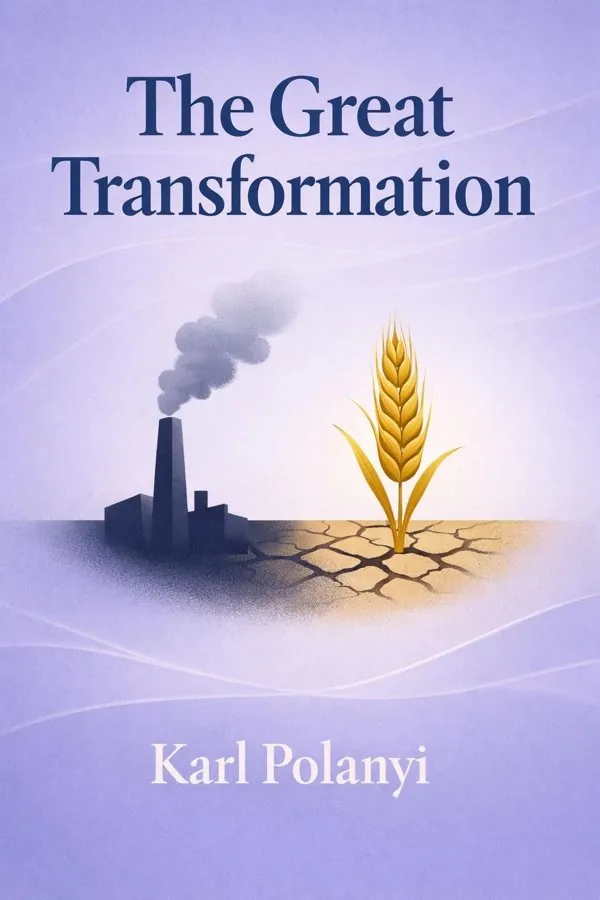
The Great Transformation: The Political and Economic Origins of Our Time: Summary & Key Insights
by Karl Polanyi
 10 min10 chaptersAudio available
What Is The Great Transformation: The Political and Economic Origins of Our Time About?
The Great Transformation: The Political and Economic Origins of Our Time by Karl Polanyi is a economics book spanning 10 pages. Karl Polanyi’s seminal 1944 work examines the rise of the modern market economy and its profound social consequences. He argues that the self-regulating market, far from being a natural development, was a deliberate political project that disrupted traditional social relations and led to economic instability and social dislocation. Polanyi traces the historical transformation from pre-industrial societies to industrial capitalism, emphasizing the tension between market expansion and social protection.
This FizzRead summary covers all 10 key chapters of The Great Transformation: The Political and Economic Origins of Our Time in approximately 10 minutes, distilling the most important ideas, arguments, and takeaways from Karl Polanyi's work. Also available as an audio summary and Key Quotes Podcast.
The Great Transformation: The Political and Economic Origins of Our Time
Karl Polanyi’s seminal 1944 work examines the rise of the modern market economy and its profound social consequences. He argues that the self-regulating market, far from being a natural development, was a deliberate political project that disrupted traditional social relations and led to economic instability and social dislocation. Polanyi traces the historical transformation from pre-industrial societies to industrial capitalism, emphasizing the tension between market expansion and social protection.
Who Should Read The Great Transformation: The Political and Economic Origins of Our Time?
This book is perfect for anyone interested in economics and looking to gain actionable insights in a short read. Whether you're a student, professional, or lifelong learner, the key ideas from The Great Transformation: The Political and Economic Origins of Our Time by Karl Polanyi will help you think differently.
- ✓Readers who enjoy economics and want practical takeaways
- ✓Professionals looking to apply new ideas to their work and life
- ✓Anyone who wants the core insights of The Great Transformation: The Political and Economic Origins of Our Time in just 10 minutes
Want the full summary?
Get instant access to this book summary and 100K+ more with Fizz Moment.
Get Free SummaryAvailable on App Store • Free to download
Key Chapters
Long before industrial chimneys darkened the skies of England, before economists spoke of supply and demand, human societies thrived through systems that bore little resemblance to market capitalism. Economic life was not an autonomous sphere governed by prices but was deeply enmeshed in social institutions—kinship, religion, and community. I describe this as an 'embedded economy.' In such societies, to act economically was to act socially; one could not separate material concerns from moral and cultural obligations.
In ancient and tribal societies, three principles organized economic behavior: reciprocity, redistribution, and householding. Reciprocity bound people in webs of give and take—the hunter sharing his catch, the farmer exchanging surpluses, the neighbor lending tools. Redistribution ensured that the surplus passed through a central authority, whether a chief or temple, who then reallocated it in keeping with social norms. Householding meant production for direct use within the family or community, not for profit. None of these depended on markets in the modern sense.
This embeddedness meant that economic relations were governed by values of honor, religion, and social stability. Prices, if they existed, were administered rather than competitive; labor was a social duty; and land, often held communally, was inalienable. The idea of land as 'property' or labor as a 'commodity' would have seemed absurd. In these societies, economy followed society, not the other way around. It was only with the disintegration of traditional bonds—when markets ceased to be instruments and began to organize life itself—that a unique and perilous transformation began.
The decisive break came with the Industrial Revolution in England. It was not a matter of gradual evolution but a true revolution in the organization of society. The enclosure movement—those vast acts of privatization of common lands—transformed the material and moral fabric of rural life. Peasants who once had access to land and resources essential for subsistence were stripped of these rights, forced into the labor market as wage earners. Here, for the first time, labor became a commodity—workers had to sell their capacity to work simply to survive.
Yet the rise of a market society required more than dispossession. It demanded the creation of entirely new institutions designed to disembed the economy from traditional control. Parliament, influenced by utilitarian doctrine and classical economics, began to legislate according to the principle that markets, if left alone, would harmonize human affairs more effectively than any moral or communal constraint. Laws protecting workers, guaranteeing subsistence, or stabilizing prices were dismantled. Market freedom was elevated to a secular faith.
This transformation was not spontaneous; it was imposed. Policies of laissez-faire were, paradoxically, the most interventionist measures of all. It took the power of the state to create the conditions for 'free' markets—to enforce contracts, suppress subsistence rights, and treat land, labor, and money as tradable resources. What we call 'economic liberty' emerged from the coercion of society into market dependence. The Industrial Revolution, then, was not merely a technological achievement but a social transformation: the subordination of human life to the imperatives of capital accumulation and price mechanism.
+ 8 more chapters — available in the FizzRead app
All Chapters in The Great Transformation: The Political and Economic Origins of Our Time
About the Author
Karl Polanyi (1886–1964) was a Hungarian economic historian, anthropologist, and social theorist. His interdisciplinary work bridged economics, sociology, and history, and he is best known for his critique of market liberalism and his analysis of the social foundations of economic systems.
Get This Summary in Your Preferred Format
Read or listen to the The Great Transformation: The Political and Economic Origins of Our Time summary by Karl Polanyi anytime, anywhere. FizzRead offers multiple formats so you can learn on your terms — all free.
Available formats: App · Audio · PDF · EPUB — All included free with FizzRead
Download The Great Transformation: The Political and Economic Origins of Our Time PDF and EPUB Summary
Key Quotes from The Great Transformation: The Political and Economic Origins of Our Time
“Long before industrial chimneys darkened the skies of England, before economists spoke of supply and demand, human societies thrived through systems that bore little resemblance to market capitalism.”
“The decisive break came with the Industrial Revolution in England.”
Frequently Asked Questions about The Great Transformation: The Political and Economic Origins of Our Time
The Great Transformation: The Political and Economic Origins of Our Time by Karl Polanyi is a economics book that explores key ideas across 10 chapters. Karl Polanyi’s seminal 1944 work examines the rise of the modern market economy and its profound social consequences. He argues that the self-regulating market, far from being a natural development, was a deliberate political project that disrupted traditional social relations and led to economic instability and social dislocation. Polanyi traces the historical transformation from pre-industrial societies to industrial capitalism, emphasizing the tension between market expansion and social protection.
You Might Also Like
Business Adventures
John Brooks
10 min
Nudge
Richard H. Thaler, Cass R. Sunstein
10 min
The Hitchhiker"s Guide to the Galaxy
Douglas Adams
10 minThe Muqaddimah
Ibn Khaldun
10 minThe Outsiders
William N. Thorndike
10 min
A Little History of Economics
Niall Kishtainy
10 minBrowse by Category
Ready to read The Great Transformation: The Political and Economic Origins of Our Time?
Get the full summary and 100K+ more books with Fizz Moment.