
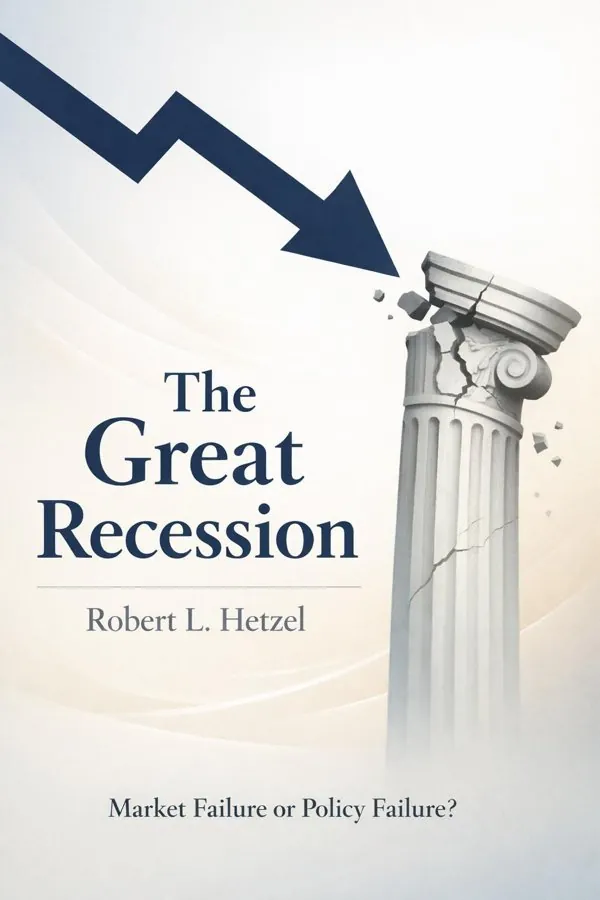
The Great Recession: Market Failure or Policy Failure?: Summary & Key Insights
 10 min11 chaptersAudio available
What Is The Great Recession: Market Failure or Policy Failure? About?
The Great Recession: Market Failure or Policy Failure? by Robert L. Hetzel is a economics book spanning 11 pages. This book analyzes the causes and consequences of the 2007–2009 financial crisis, arguing that the Great Recession was primarily the result of policy mistakes rather than inherent market instability. Hetzel, an economist at the Federal Reserve Bank of Richmond, examines monetary policy decisions, the role of the Federal Reserve, and the broader macroeconomic environment that led to the downturn.
This FizzRead summary covers all 11 key chapters of The Great Recession: Market Failure or Policy Failure? in approximately 10 minutes, distilling the most important ideas, arguments, and takeaways from Robert L. Hetzel's work. Also available as an audio summary and Key Quotes Podcast.
The Great Recession: Market Failure or Policy Failure?
This book analyzes the causes and consequences of the 2007–2009 financial crisis, arguing that the Great Recession was primarily the result of policy mistakes rather than inherent market instability. Hetzel, an economist at the Federal Reserve Bank of Richmond, examines monetary policy decisions, the role of the Federal Reserve, and the broader macroeconomic environment that led to the downturn.
Who Should Read The Great Recession: Market Failure or Policy Failure??
This book is perfect for anyone interested in economics and looking to gain actionable insights in a short read. Whether you're a student, professional, or lifelong learner, the key ideas from The Great Recession: Market Failure or Policy Failure? by Robert L. Hetzel will help you think differently.
- ✓Readers who enjoy economics and want practical takeaways
- ✓Professionals looking to apply new ideas to their work and life
- ✓Anyone who wants the core insights of The Great Recession: Market Failure or Policy Failure? in just 10 minutes
Want the full summary?
Get instant access to this book summary and 100K+ more with Fizz Moment.
Get Free SummaryAvailable on App Store • Free to download
Key Chapters
Economic stability has always been tied to the character of monetary policy. After World War II, the United States emerged with an ambitious commitment to full employment and stable growth. Yet the Federal Reserve struggled to define its mandate clearly. Through the 1950s and 1960s, policy was dominated by the Keynesian belief that controlling short-term interest rates and managing aggregate demand could smooth cycles.
My analysis starts here because it’s impossible to understand the Great Recession without appreciating the intellectual legacy that shaped the Fed’s instincts. The postwar era saw repeated tensions between price stability and employment goals. Whenever inflation seemed subdued, policymakers relaxed, using low interest rates to sustain expansions, without realizing that such moves destabilized expectations over the long term. By the 1970s, a credibility crisis in monetary policy—manifested in runaway inflation—forced a historic reset under Chairman Paul Volcker. Out of that painful disinflation birthed a new consensus: monetary policy should focus on stable nominal anchors.
This transformation—what I call the monetarist turn—was essential to what followed. The Fed slowly internalized the lesson that erratic control of money supply and discretionary management of rates undermine both price stability and output. Through the 1980s and 1990s, a rule-like discipline emerged, guided by the understanding that monetary policy should aim for credibility and low inflation, even at the cost of short-term output fluctuations. This background sets the stage for the paradox that followed: success bred complacency.
From about 1983 until the mid-2000s, the U.S. economy enjoyed two decades of steady growth and subdued inflation. Economists labeled this era the Great Moderation. It was, to many, definitive proof of the victory of sophisticated monetary management. But I argue in this book that the Great Moderation created an illusion—a false sense of permanence in stability that masked the need for discipline.
What stabilized the economy during those years was not the innate genius of markets nor new financial instruments. It was a credible expectation that the central bank would maintain low and predictable inflation. That credibility meant that households, firms, and financial markets could plan long-term contracts confidently, assuming nominal values would not suddenly depreciate.
However, the success of the Great Moderation induced a quiet drift toward discretion. Policymakers began to believe they could fine-tune outcomes. Short-term interest-rate targeting replaced monetary aggregates, and the Fed allowed itself increasing latitude to manage temporary imbalances. When recessions or shocks appeared mild, many concluded the lesson of history had been reversed: markets could self-correct as long as the Fed responded pragmatically. In reality, the moderation owed itself to adherence to predictable rules, not flexibility.
+ 9 more chapters — available in the FizzRead app
All Chapters in The Great Recession: Market Failure or Policy Failure?
About the Author
Robert L. Hetzel is a senior economist and research advisor at the Federal Reserve Bank of Richmond. He has written extensively on monetary policy, central banking, and the history of economic thought, with a focus on the Federal Reserve’s role in shaping economic cycles.
Get This Summary in Your Preferred Format
Read or listen to the The Great Recession: Market Failure or Policy Failure? summary by Robert L. Hetzel anytime, anywhere. FizzRead offers multiple formats so you can learn on your terms — all free.
Available formats: App · Audio · PDF · EPUB — All included free with FizzRead
Download The Great Recession: Market Failure or Policy Failure? PDF and EPUB Summary
Key Quotes from The Great Recession: Market Failure or Policy Failure?
“Economic stability has always been tied to the character of monetary policy.”
“From about 1983 until the mid-2000s, the U.”
Frequently Asked Questions about The Great Recession: Market Failure or Policy Failure?
The Great Recession: Market Failure or Policy Failure? by Robert L. Hetzel is a economics book that explores key ideas across 11 chapters. This book analyzes the causes and consequences of the 2007–2009 financial crisis, arguing that the Great Recession was primarily the result of policy mistakes rather than inherent market instability. Hetzel, an economist at the Federal Reserve Bank of Richmond, examines monetary policy decisions, the role of the Federal Reserve, and the broader macroeconomic environment that led to the downturn.
You Might Also Like

Business Adventures
John Brooks
10 min
Nudge
Richard H. Thaler, Cass R. Sunstein
10 min
The Hitchhiker"s Guide to the Galaxy
Douglas Adams
10 minThe Muqaddimah
Ibn Khaldun
10 minThe Outsiders
William N. Thorndike
10 min
A Little History of Economics
Niall Kishtainy
10 minBrowse by Category
Ready to read The Great Recession: Market Failure or Policy Failure??
Get the full summary and 100K+ more books with Fizz Moment.