
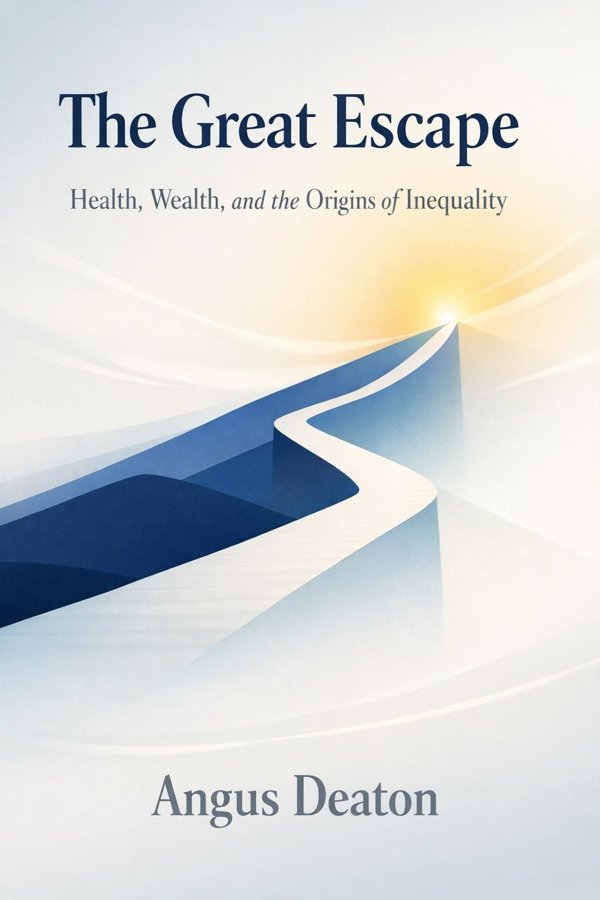
The Great Escape: Health, Wealth, and the Origins of Inequality: Summary & Key Insights
by Angus Deaton
 10 min10 chaptersAudio available
What Is The Great Escape: Health, Wealth, and the Origins of Inequality About?
The Great Escape: Health, Wealth, and the Origins of Inequality by Angus Deaton is a economics book spanning 10 pages. In this influential work, Nobel laureate Angus Deaton explores how modern economic growth has led to both unprecedented prosperity and deep inequality. He traces the historical evolution of health and wealth, showing how advances in science, medicine, and income have allowed many to escape poverty and disease, while others remain trapped. Deaton examines the interplay between development, globalization, and inequality, offering insights into how policy can foster more equitable progress.
This FizzRead summary covers all 10 key chapters of The Great Escape: Health, Wealth, and the Origins of Inequality in approximately 10 minutes, distilling the most important ideas, arguments, and takeaways from Angus Deaton's work. Also available as an audio summary and Key Quotes Podcast.
The Great Escape: Health, Wealth, and the Origins of Inequality
In this influential work, Nobel laureate Angus Deaton explores how modern economic growth has led to both unprecedented prosperity and deep inequality. He traces the historical evolution of health and wealth, showing how advances in science, medicine, and income have allowed many to escape poverty and disease, while others remain trapped. Deaton examines the interplay between development, globalization, and inequality, offering insights into how policy can foster more equitable progress.
Who Should Read The Great Escape: Health, Wealth, and the Origins of Inequality?
This book is perfect for anyone interested in economics and looking to gain actionable insights in a short read. Whether you're a student, professional, or lifelong learner, the key ideas from The Great Escape: Health, Wealth, and the Origins of Inequality by Angus Deaton will help you think differently.
- ✓Readers who enjoy economics and want practical takeaways
- ✓Professionals looking to apply new ideas to their work and life
- ✓Anyone who wants the core insights of The Great Escape: Health, Wealth, and the Origins of Inequality in just 10 minutes
Want the full summary?
Get instant access to this book summary and 100K+ more with Fizz Moment.
Get Free SummaryAvailable on App Store • Free to download
Key Chapters
To understand our escape, we must begin by recognizing how rare it is in the long sweep of human history. For millennia, average life expectancy hovered around 30 years. Epidemics wiped out whole communities, and hunger was a constant companion. The first true escape began in Europe during the eighteenth and nineteenth centuries, not with sudden economic wealth but with the slow triumph of knowledge—scientific and social breakthroughs that redefined how humans dealt with disease and the environment.
Epidemiology, vaccination, and hygiene played central roles. The discovery of smallpox inoculation and the understanding of sanitation transformed survival rates. These innovations were not born of wealth; rather, they paved the way for it. When people began living longer, children survived to adulthood, and societies could invest in education and industry. For example, Britain’s mortality decline preceded its full industrial transformation, suggesting that the first real capital a society must accumulate is not money but health.
I emphasize this point because it challenges the deterministic idea that income growth automatically drives progress. Early escapes came from curiosity, experimentation, and public investment in knowledge. The virtuous circle between learning and living began turning, and some countries—those fortunate enough to foster science and governance—accelerated ahead. Yet from the beginning, this escape was selective. Western Europe and its offshoots benefited first. Colonized peoples often suffered worse health as imperialism integrated their economies without safeguarding their populations. The seeds of global inequality were planted even as humanity’s overall welfare improved.
The story of modern progress is, above all, a story of health transition—the shift from widespread premature death to longevity shaped by human control over environment and disease. In this transformation, three factors loom large: public health measures, medical discoveries, and nutrition.
Public health interventions—clean water, sewage systems, vaccination campaigns—did more to reduce mortality than any medical breakthrough. When cities learned to separate drinking water from waste, child mortality plummeted. Nutrition too played a vital but often overlooked role; better-fed mothers had healthier babies, and growing children gained resistance to disease. Societies that invested in these preventive strategies saw their life expectancy rise decades before they became economically rich.
Yet progress was uneven. The control of infectious diseases in early-industrial societies created a paradox: as fewer people died young, populations soared. This demographic explosion placed new strains on resources and governance, shaping the destinies of countries differently depending on their institutions and levels of education. Where governance was weak, the growth of population outpaced progress; where it was strong, the health transition became a foundation for prosperity.
In countries like India and China, the twentieth century saw dramatic gains driven not by Western medicine imposed from above but by domestic investments in literacy, vaccination, and infrastructure. The global diffusion of health knowledge marked one of the most profound equalizing forces in history. Yet the persistence of unequal health outcomes underscores that knowledge alone is insufficient without political will and economic inclusion.
+ 8 more chapters — available in the FizzRead app
All Chapters in The Great Escape: Health, Wealth, and the Origins of Inequality
About the Author
Angus Deaton is a British-American economist and Nobel laureate recognized for his analysis of consumption, poverty, and welfare. He has taught at Princeton University and contributed extensively to understanding global inequality and development economics.
Get This Summary in Your Preferred Format
Read or listen to the The Great Escape: Health, Wealth, and the Origins of Inequality summary by Angus Deaton anytime, anywhere. FizzRead offers multiple formats so you can learn on your terms — all free.
Available formats: App · Audio · PDF · EPUB — All included free with FizzRead
Download The Great Escape: Health, Wealth, and the Origins of Inequality PDF and EPUB Summary
Key Quotes from The Great Escape: Health, Wealth, and the Origins of Inequality
“To understand our escape, we must begin by recognizing how rare it is in the long sweep of human history.”
“The story of modern progress is, above all, a story of health transition—the shift from widespread premature death to longevity shaped by human control over environment and disease.”
Frequently Asked Questions about The Great Escape: Health, Wealth, and the Origins of Inequality
The Great Escape: Health, Wealth, and the Origins of Inequality by Angus Deaton is a economics book that explores key ideas across 10 chapters. In this influential work, Nobel laureate Angus Deaton explores how modern economic growth has led to both unprecedented prosperity and deep inequality. He traces the historical evolution of health and wealth, showing how advances in science, medicine, and income have allowed many to escape poverty and disease, while others remain trapped. Deaton examines the interplay between development, globalization, and inequality, offering insights into how policy can foster more equitable progress.
You Might Also Like

Business Adventures
John Brooks
10 min
Nudge
Richard H. Thaler, Cass R. Sunstein
10 min
The Hitchhiker"s Guide to the Galaxy
Douglas Adams
10 minThe Muqaddimah
Ibn Khaldun
10 minThe Outsiders
William N. Thorndike
10 min
A Little History of Economics
Niall Kishtainy
10 minBrowse by Category
Ready to read The Great Escape: Health, Wealth, and the Origins of Inequality?
Get the full summary and 100K+ more books with Fizz Moment.