
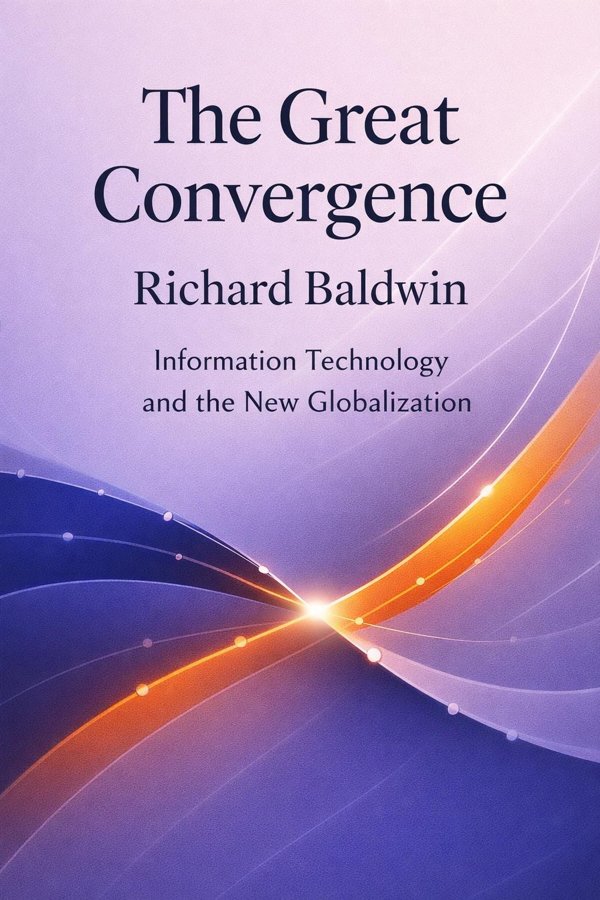
The Great Convergence: Information Technology and the New Globalization: Summary & Key Insights
 10 min8 chaptersAudio available
What Is The Great Convergence: Information Technology and the New Globalization About?
The Great Convergence: Information Technology and the New Globalization by Richard Baldwin is a economics book spanning 8 pages. This book explores how information technology has transformed globalization by drastically reducing the cost of moving ideas. Richard Baldwin argues that this 'new globalization' has shifted industrialization patterns, enabling developing nations to industrialize rapidly while developed nations experience deindustrialization. The work provides a comprehensive analysis of global supply chains, trade policy, and the economic implications of digital connectivity.
This FizzRead summary covers all 8 key chapters of The Great Convergence: Information Technology and the New Globalization in approximately 10 minutes, distilling the most important ideas, arguments, and takeaways from Richard Baldwin's work. Also available as an audio summary and Key Quotes Podcast.
The Great Convergence: Information Technology and the New Globalization
This book explores how information technology has transformed globalization by drastically reducing the cost of moving ideas. Richard Baldwin argues that this 'new globalization' has shifted industrialization patterns, enabling developing nations to industrialize rapidly while developed nations experience deindustrialization. The work provides a comprehensive analysis of global supply chains, trade policy, and the economic implications of digital connectivity.
Who Should Read The Great Convergence: Information Technology and the New Globalization?
This book is perfect for anyone interested in economics and looking to gain actionable insights in a short read. Whether you're a student, professional, or lifelong learner, the key ideas from The Great Convergence: Information Technology and the New Globalization by Richard Baldwin will help you think differently.
- ✓Readers who enjoy economics and want practical takeaways
- ✓Professionals looking to apply new ideas to their work and life
- ✓Anyone who wants the core insights of The Great Convergence: Information Technology and the New Globalization in just 10 minutes
Want the full summary?
Get instant access to this book summary and 100K+ more with Fizz Moment.
Get Free SummaryAvailable on App Store • Free to download
Key Chapters
In the nineteenth century, globalization’s first great leap was born of steam, steel, and a simple economic fact: moving goods became cheap. Before that era, economies were fundamentally local. Production and consumption occurred shoulder to shoulder because transport costs made long-distance trade prohibitive. Steamships and railroads, however, rewrote geography. This epochal transformation—what I call the first unbundling—allowed countries to specialize according to comparative advantage. Britain’s factories could produce textiles more efficiently than India’s handlooms, and cheap transport allowed those goods to reach global markets. Manufacturing and innovation concentrated in industrialized nations, while raw materials and agricultural products flowed from the periphery.
This separation of production and consumption unleashed wealth creation of an unprecedented scale—but also entrenched global inequality. Developing nations remained suppliers of commodities; industrialized nations controlled technology and capital. For nearly a century, no developing country managed to close the gap. Industrial know-how did not travel easily, because knowledge could only be transmitted through human proximity—through engineers, managers, and skilled apprentices. In short, technology was geographically sticky. The first unbundling globalized goods, but not ideas.
By the late twentieth century, a subtler but equally profound force began to rewrite economic geography: information and communication technology. Fiber optics, satellites, personal computing, and the internet steadily reduced the cost of moving ideas and coordinating production activities across borders. Suddenly, it became possible to manage a complex production process scattered across multiple countries in real time. This is what I term the second unbundling.
Whereas the first unbundling separated factories from consumers, the second separated factories from factories. No longer did all production stages have to be in one location. Design could stay in Silicon Valley, component manufacturing could occur in South Korea, assembly in China, and logistics coordination in Singapore—all guided by instantaneous digital communication. The multinational firm became not a monolith, but a network—a web of tasks connected by data and standards.
This unbundling was not only technological but organizational. It fundamentally altered the logic of competitiveness. Geography, once the basis of entire industrial ecosystems, started losing its grip. Capacities could be sliced and recombined. As firms disaggregated production, developing nations found new entry points into global manufacturing. They no longer had to master entire industries; they could specialize in performing a single well-defined task within a value chain. This reshaped not only trade patterns but the entire architecture of global capitalism.
+ 6 more chapters — available in the FizzRead app
All Chapters in The Great Convergence: Information Technology and the New Globalization
About the Author
Richard Baldwin is a British economist and professor of international economics at the Graduate Institute of International and Development Studies in Geneva. He is known for his research on globalization, trade, and economic policy, and has served as editor-in-chief of VoxEU.org, a leading policy portal for economic research.
Get This Summary in Your Preferred Format
Read or listen to the The Great Convergence: Information Technology and the New Globalization summary by Richard Baldwin anytime, anywhere. FizzRead offers multiple formats so you can learn on your terms — all free.
Available formats: App · Audio · PDF · EPUB — All included free with FizzRead
Download The Great Convergence: Information Technology and the New Globalization PDF and EPUB Summary
Key Quotes from The Great Convergence: Information Technology and the New Globalization
“In the nineteenth century, globalization’s first great leap was born of steam, steel, and a simple economic fact: moving goods became cheap.”
“By the late twentieth century, a subtler but equally profound force began to rewrite economic geography: information and communication technology.”
Frequently Asked Questions about The Great Convergence: Information Technology and the New Globalization
The Great Convergence: Information Technology and the New Globalization by Richard Baldwin is a economics book that explores key ideas across 8 chapters. This book explores how information technology has transformed globalization by drastically reducing the cost of moving ideas. Richard Baldwin argues that this 'new globalization' has shifted industrialization patterns, enabling developing nations to industrialize rapidly while developed nations experience deindustrialization. The work provides a comprehensive analysis of global supply chains, trade policy, and the economic implications of digital connectivity.
You Might Also Like

Business Adventures
John Brooks
10 min
Nudge
Richard H. Thaler, Cass R. Sunstein
10 min
The Hitchhiker"s Guide to the Galaxy
Douglas Adams
10 minThe Muqaddimah
Ibn Khaldun
10 minThe Outsiders
William N. Thorndike
10 min
A Little History of Economics
Niall Kishtainy
10 minBrowse by Category
Ready to read The Great Convergence: Information Technology and the New Globalization?
Get the full summary and 100K+ more books with Fizz Moment.