
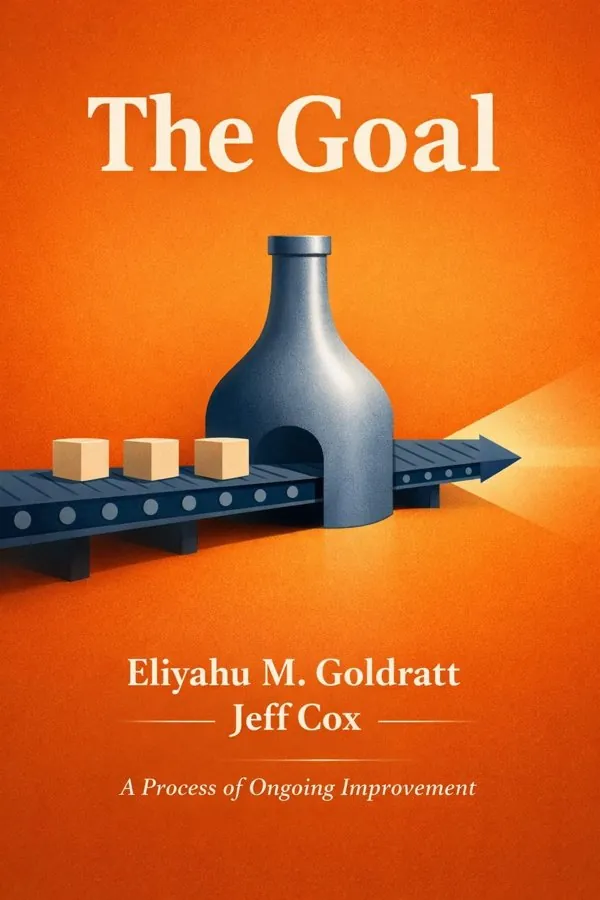
The Goal: A Process of Ongoing Improvement: Summary & Key Insights
by Eliyahu M. Goldratt, Jeff Cox
 10 min4 chaptersAudio available
What Is The Goal: A Process of Ongoing Improvement About?
The Goal: A Process of Ongoing Improvement by Eliyahu M. Goldratt, Jeff Cox is a leadership book spanning 4 pages. The Goal is a management-oriented novel that introduces the Theory of Constraints through a fictional narrative. It follows Alex Rogo, a plant manager who must save his manufacturing plant from closure by improving productivity and efficiency. Through his journey, the book explores how identifying and addressing bottlenecks can lead to continuous improvement in business operations.
This FizzRead summary covers all 4 key chapters of The Goal: A Process of Ongoing Improvement in approximately 10 minutes, distilling the most important ideas, arguments, and takeaways from Eliyahu M. Goldratt, Jeff Cox's work. Also available as an audio summary and Key Quotes Podcast.
The Goal: A Process of Ongoing Improvement
The Goal is a management-oriented novel that introduces the Theory of Constraints through a fictional narrative. It follows Alex Rogo, a plant manager who must save his manufacturing plant from closure by improving productivity and efficiency. Through his journey, the book explores how identifying and addressing bottlenecks can lead to continuous improvement in business operations.
Who Should Read The Goal: A Process of Ongoing Improvement?
This book is perfect for anyone interested in leadership and looking to gain actionable insights in a short read. Whether you're a student, professional, or lifelong learner, the key ideas from The Goal: A Process of Ongoing Improvement by Eliyahu M. Goldratt, Jeff Cox will help you think differently.
- ✓Readers who enjoy leadership and want practical takeaways
- ✓Professionals looking to apply new ideas to their work and life
- ✓Anyone who wants the core insights of The Goal: A Process of Ongoing Improvement in just 10 minutes
Want the full summary?
Get instant access to this book summary and 100K+ more with Fizz Moment.
Get Free SummaryAvailable on App Store • Free to download
Key Chapters
Alex Rogo’s world begins with urgency. His plant at UniCo is in trouble — orders are late, customer complaints are mounting, and headquarters has given him a deadline to turn the plant around or face closure. These opening scenes are not about dramatizing failure for its own sake, but about confronting a truth every leader knows: when things fall apart, we tend to push harder on the very levers that got us stuck in the first place.
Alex initially does what any conventional manager would do. He tightens schedules, pushes his people for longer hours, and tries to increase worker efficiency. Yet, paradoxically, the situation worsens. Finished goods pile up at the warehouse, work‑in‑process clogs the aisles, and delivery times stretch even further. It is here that Alex runs into his former physics professor, Jonah — a man whose questions, rather than answers, begin to unravel the assumptions behind how organizations pursue success.
Jonah asks a deceptively simple question: What is the goal of your company? Alex offers a variety of textbook responses — productivity, efficiency, quality, even customer satisfaction — but Jonah shakes his head. None of these are the true goal. The real goal, Jonah insists, is to make money, now and in the future. Every action, every policy, every reported metric must be judged by whether it moves the organization toward or away from that single objective.
From that point, Alex’s journey becomes a quest to interpret what “making money” means in operational terms. In their discussions, Jonah introduces three key measurements: Throughput (the rate at which the system generates money through sales), Inventory (the money tied up in things the system intends to sell), and Operational Expense (the money that the system spends to turn inventory into throughput). These become Alex’s compass points. Success isn’t about keeping every machine running at maximum speed; it’s about synchronizing the entire chain so that these three measures align toward profitability.
Once Alex understands that his plant’s goal is to make money and learns the meaning of throughput, inventory, and operational expense, he begins to see his world differently. The major revelation comes from Jonah’s next insight: every system has a constraint — a limiting factor that determines the pace of the entire process. Just as a chain is only as strong as its weakest link, a factory’s performance is dictated by its slowest or most overburdened step.
This idea is revolutionary because it overturns the traditional obsession with balancing capacity across the board. Managers usually try to keep every resource working full time, but Jonah argues that maximizing individual efficiency often creates local optima that hurt the overall flow. A non‑bottleneck running at full capacity can flood the system with excess work, producing piles of unfinished inventory that mask the real problem and consume cash.
Back at the plant, Alex and his team — including his energetic supervisors Lou, Stacey, and Bob — begin a systematic search for the constraint. They discover that specific machines, such as the NCX‑10 and the heat‑treating furnace, are genuine bottlenecks. Everything in production waits for these stages to free up, causing delays that ripple down the line. Jonah coaches Alex to make every minute of a bottleneck count: never let it remain idle, ensure that only quality parts reach it, and feed it in order of true priority.
As Alex experiments with these ideas, subtle but profound changes occur. Instead of starting more work at the front of the process, the team learns to release materials only in harmony with what the bottleneck can handle. They reorganize shifts, introduce buffer stocks before the constraint, and even run setups off‑hours to keep the crucial equipment productive. The factory floor begins to breathe again — less chaos, fewer backlogs, more predictability.
Yet Jonah reminds him: improving a bottleneck doesn’t end the journey. The moment one constraint is broken, another takes its place. The process of ongoing improvement, therefore, is endless. It is through this continuous cycle that an organization evolves — always searching for the next limiting factor, always learning to see more clearly where the true leverage lies.
+ 2 more chapters — available in the FizzRead app
All Chapters in The Goal: A Process of Ongoing Improvement
About the Authors
Eliyahu M. Goldratt was an Israeli physicist, management consultant, and business theorist known for developing the Theory of Constraints. Jeff Cox is an American author and business writer who has co-authored several management and business novels.
Get This Summary in Your Preferred Format
Read or listen to the The Goal: A Process of Ongoing Improvement summary by Eliyahu M. Goldratt, Jeff Cox anytime, anywhere. FizzRead offers multiple formats so you can learn on your terms — all free.
Available formats: App · Audio · PDF · EPUB — All included free with FizzRead
Download The Goal: A Process of Ongoing Improvement PDF and EPUB Summary
Key Quotes from The Goal: A Process of Ongoing Improvement
“His plant at UniCo is in trouble — orders are late, customer complaints are mounting, and headquarters has given him a deadline to turn the plant around or face closure.”
“Once Alex understands that his plant’s goal is to make money and learns the meaning of throughput, inventory, and operational expense, he begins to see his world differently.”
Frequently Asked Questions about The Goal: A Process of Ongoing Improvement
The Goal: A Process of Ongoing Improvement by Eliyahu M. Goldratt, Jeff Cox is a leadership book that explores key ideas across 4 chapters. The Goal is a management-oriented novel that introduces the Theory of Constraints through a fictional narrative. It follows Alex Rogo, a plant manager who must save his manufacturing plant from closure by improving productivity and efficiency. Through his journey, the book explores how identifying and addressing bottlenecks can lead to continuous improvement in business operations.
You Might Also Like

Extreme Ownership
Jocko Willink
10 min
Dare to Lead
Brene Brown
10 min
Leaders Eat Last
Simon Sinek
10 min
The 21 Irrefutable Laws of Leadership
John Maxwell
10 min
Start With Why
Simon Sinek
10 min
How to Lead When You're Not in Charge
Clay Scroggins
10 minBrowse by Category
Ready to read The Goal: A Process of Ongoing Improvement?
Get the full summary and 100K+ more books with Fizz Moment.