
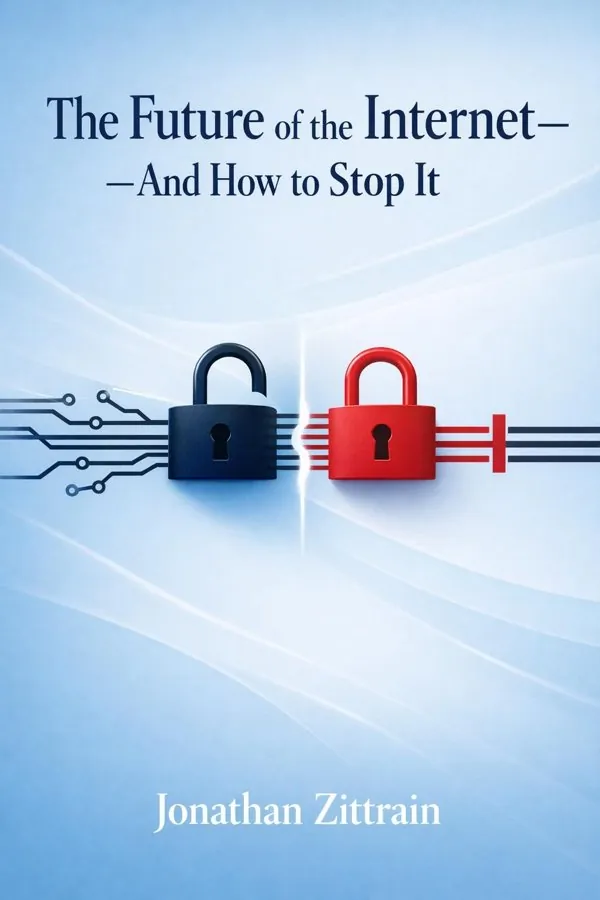
The Future of the Internet—And How to Stop It: Summary & Key Insights
 10 min6 chaptersAudio available
What Is The Future of the Internet—And How to Stop It About?
The Future of the Internet—And How to Stop It by Jonathan Zittrain is a digital_culture book spanning 6 pages. In this influential work, Jonathan Zittrain explores how the open and generative nature of the Internet and personal computing has driven innovation and creativity, but also how this same openness makes the digital ecosystem vulnerable to control, security threats, and loss of freedom. He argues for a balance between innovation and stability, proposing ways to preserve the Internet’s generative potential while mitigating its risks.
This FizzRead summary covers all 6 key chapters of The Future of the Internet—And How to Stop It in approximately 10 minutes, distilling the most important ideas, arguments, and takeaways from Jonathan Zittrain's work. Also available as an audio summary and Key Quotes Podcast.
The Future of the Internet—And How to Stop It
In this influential work, Jonathan Zittrain explores how the open and generative nature of the Internet and personal computing has driven innovation and creativity, but also how this same openness makes the digital ecosystem vulnerable to control, security threats, and loss of freedom. He argues for a balance between innovation and stability, proposing ways to preserve the Internet’s generative potential while mitigating its risks.
Who Should Read The Future of the Internet—And How to Stop It?
This book is perfect for anyone interested in digital_culture and looking to gain actionable insights in a short read. Whether you're a student, professional, or lifelong learner, the key ideas from The Future of the Internet—And How to Stop It by Jonathan Zittrain will help you think differently.
- ✓Readers who enjoy digital_culture and want practical takeaways
- ✓Professionals looking to apply new ideas to their work and life
- ✓Anyone who wants the core insights of The Future of the Internet—And How to Stop It in just 10 minutes
Want the full summary?
Get instant access to this book summary and 100K+ more with Fizz Moment.
Get Free SummaryAvailable on App Store • Free to download
Key Chapters
To understand what’s at stake, we have to step back to the era when computing was personal for the first time. The early personal computers—the Apple II, the IBM PC—were machines that invited tinkering. Their users could open the case, change components, write their own programs, and exchange ideas freely. Paired with the Internet, which was built on a decentralized, end-to-end architecture, these generative machines turned into something revolutionary.
Generativity is the opposite of lock-in. It means that the power to create doesn’t rest in the hands of manufacturers, providers, or platforms—it rests with the users themselves. The Internet’s protocols, its simplicity, and its lack of central control made it a breeding ground for independent innovation. Think of how the web itself came from Tim Berners-Lee’s individual initiative at CERN, with no central committee ordering its birth. Think of e-mail, of blogging, of the early peer-to-peer networks—all were extensions from the edges of the system, by users empowered to invent without permission.
This quality, I argue, is what has given us a historically unprecedented burst of creativity. When systems are generative, they surprise their creators. Yet that same virtue—allowing anyone to add or change what the system can do—also made the Internet vulnerable. With open gates come intruders. Malware and spam thrive in the same ecological niche that allowed the Web and e-commerce to thrive. This paradox sits at the center of everything that follows: the balance between freedom and control, between innovation and safety.
Once the Internet became a global commons, bad actors discovered how easily its powers could be exploited. A single worm, written in a dorm room or by a criminal syndicate, could infect millions of machines that shared the same flexibility which made them capable of running anything. Spam clogged inboxes; spyware recorded keystrokes; and vast botnets turned users’ computers into remote-controlled armies for profit or sabotage.
Each new wave of attacks provoked efforts to tame the Internet—to make it safer by making it less open. Companies began building tethered systems that blocked user modifications, updates were pushed from centralized sources, and devices that once let you experiment began to tell you politely that you were not authorized to install certain files or change certain defaults.
The irony is that the rise of security threats can drive us into the comforting arms of control. We, the users, become willing participants in our own disempowerment. We trade the messy, unpredictable power of generative technologies for the reassuring stability of managed ones. But this trade, I warn, has long-term consequences: a world of appliances where experimentation, independent creation, and even dissent become constrained by design.
+ 4 more chapters — available in the FizzRead app
All Chapters in The Future of the Internet—And How to Stop It
About the Author
Jonathan Zittrain is a professor of Internet governance and law at Harvard University, co-founder of the Berkman Klein Center for Internet & Society, and a leading scholar on digital technology, law, and ethics. His research focuses on the intersection of technology, policy, and human rights in the digital age.
Get This Summary in Your Preferred Format
Read or listen to the The Future of the Internet—And How to Stop It summary by Jonathan Zittrain anytime, anywhere. FizzRead offers multiple formats so you can learn on your terms — all free.
Available formats: App · Audio · PDF · EPUB — All included free with FizzRead
Download The Future of the Internet—And How to Stop It PDF and EPUB Summary
Key Quotes from The Future of the Internet—And How to Stop It
“To understand what’s at stake, we have to step back to the era when computing was personal for the first time.”
“Once the Internet became a global commons, bad actors discovered how easily its powers could be exploited.”
Frequently Asked Questions about The Future of the Internet—And How to Stop It
The Future of the Internet—And How to Stop It by Jonathan Zittrain is a digital_culture book that explores key ideas across 6 chapters. In this influential work, Jonathan Zittrain explores how the open and generative nature of the Internet and personal computing has driven innovation and creativity, but also how this same openness makes the digital ecosystem vulnerable to control, security threats, and loss of freedom. He argues for a balance between innovation and stability, proposing ways to preserve the Internet’s generative potential while mitigating its risks.
You Might Also Like
An Ugly Truth: Inside Facebook’s Battle for Domination
Sheera Frenkel, Cecilia Kang
10 min
Cyber Citizens
Ian Goodfellow
10 min
Digital Minimalism: Choosing a Focused Life in a Noisy World
Cal Newport
10 min
E‑Books & Beyond
Various Authors
10 min
The Future of Media
Various Authors
10 min
This Is Why We Can't Have Nice Things
Whitney Phillips
10 minBrowse by Category
Ready to read The Future of the Internet—And How to Stop It?
Get the full summary and 100K+ more books with Fizz Moment.