
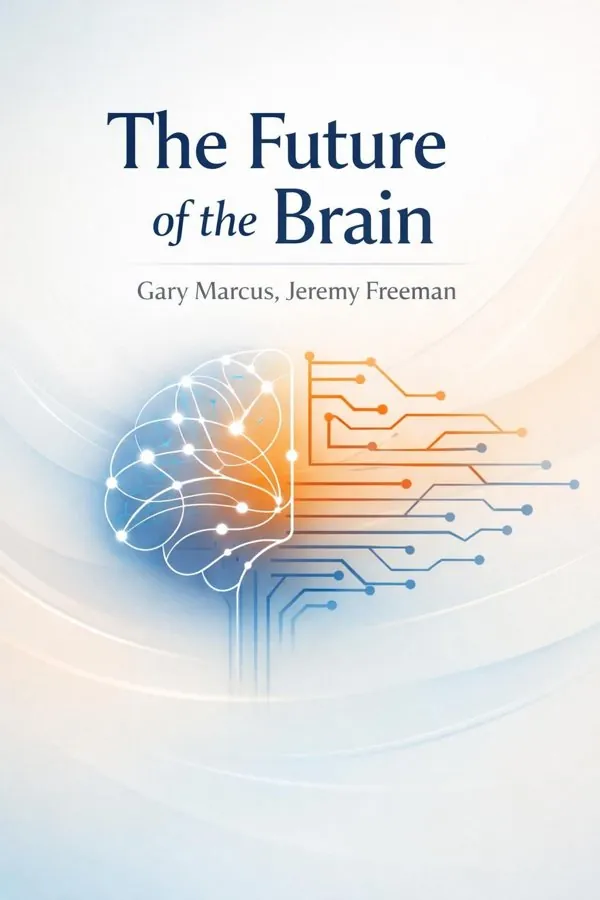
The Future of the Brain: Essays by the World's Leading Neuroscientists: Summary & Key Insights
by Gary Marcus, Jeremy Freeman
 10 min11 chaptersAudio available
What Is The Future of the Brain: Essays by the World's Leading Neuroscientists About?
The Future of the Brain: Essays by the World's Leading Neuroscientists by Gary Marcus, Jeremy Freeman is a neuroscience book spanning 11 pages. This collection of essays brings together leading neuroscientists to explore the future directions of brain research. The contributors discuss advances in brain mapping, neural computation, consciousness, and artificial intelligence, offering insights into how emerging technologies may transform our understanding of the human mind.
This FizzRead summary covers all 11 key chapters of The Future of the Brain: Essays by the World's Leading Neuroscientists in approximately 10 minutes, distilling the most important ideas, arguments, and takeaways from Gary Marcus, Jeremy Freeman's work. Also available as an audio summary and Key Quotes Podcast.
The Future of the Brain: Essays by the World's Leading Neuroscientists
This collection of essays brings together leading neuroscientists to explore the future directions of brain research. The contributors discuss advances in brain mapping, neural computation, consciousness, and artificial intelligence, offering insights into how emerging technologies may transform our understanding of the human mind.
Who Should Read The Future of the Brain: Essays by the World's Leading Neuroscientists?
This book is perfect for anyone interested in neuroscience and looking to gain actionable insights in a short read. Whether you're a student, professional, or lifelong learner, the key ideas from The Future of the Brain: Essays by the World's Leading Neuroscientists by Gary Marcus, Jeremy Freeman will help you think differently.
- ✓Readers who enjoy neuroscience and want practical takeaways
- ✓Professionals looking to apply new ideas to their work and life
- ✓Anyone who wants the core insights of The Future of the Brain: Essays by the World's Leading Neuroscientists in just 10 minutes
Want the full summary?
Get instant access to this book summary and 100K+ more with Fizz Moment.
Get Free SummaryAvailable on App Store • Free to download
Key Chapters
The story of neuroscience is one of extraordinary persistence. When Santiago Ramón y Cajal peered through his microscope in the late nineteenth century, he could not have predicted the dazzling imaging tools that would appear a century later. Yet his hand-drawn depictions of neurons were the first glimpse of the intricate networks that underlie thought and behavior. For decades, progress was slow—limited by our inability to see or measure the living brain without harm. Then came electroencephalography, single-unit recordings, and eventually the explosion of neuroimaging techniques that allowed us to visualize brain activity in real time.
As computational power grew, so did our imagination. Neuroscience merged with computer science, producing the first realistic models of neural networks. Where earlier generations described the brain as a telephone switchboard, we now speak of dynamic systems, plastic connections, and emergent computation. Modern tools—two-photon microscopy, optogenetics, functional MRI—allow us to observe the brain at micro and macro scales simultaneously. Yet despite all our measurements, a central challenge remains: making sense of an organ that continually changes as it learns and remembers.
In this historical arc, one truth becomes clear: each leap in technology reveals not simplicity but greater complexity. Every new layer of understanding opens another frontier. The essays that follow emerge from this lineage of ambition, aiming to decode how billions of neurons give rise to our every sensation, emotion, and idea.
Among all the mysteries of neuroscience, consciousness is perhaps the most profound. To speak as the editors often do, it is not the brain’s capacity to process information that astonishes us—it is the subjective experience, the felt quality of being. The contributors in this section grapple with fundamental questions: Is consciousness a byproduct of neural complexity, or an emergent property that requires new scientific paradigms?
Giulio Tononi’s integrated information theory offers one approach, suggesting that consciousness corresponds to the amount of integrated information generated by a system. Others, drawing from advances in neuroimaging and computational modeling, attempt to identify neural correlates of conscious perception—the particular networks that light up when awareness is present. Yet all agree that defining consciousness cannot rely on measurement alone. The subjective must somehow be integrated with the objective, and doing so may mean rethinking what counts as scientific explanation.
These explorations are not purely theoretical. Understanding consciousness carries implications for AI, medicine, and ethics. Can a patient in a vegetative state retain hidden awareness? Could an artificial system ever truly experience? To ask these questions is to confront the limits of current neuroscience. But limits are precisely what this book invites us to test.
+ 9 more chapters — available in the FizzRead app
All Chapters in The Future of the Brain: Essays by the World's Leading Neuroscientists
About the Authors
Gary Marcus is a cognitive scientist, author, and professor known for his work on the intersection of psychology, linguistics, and artificial intelligence. Jeremy Freeman is a neuroscientist and computational biologist focused on large-scale brain data analysis and open science initiatives.
Get This Summary in Your Preferred Format
Read or listen to the The Future of the Brain: Essays by the World's Leading Neuroscientists summary by Gary Marcus, Jeremy Freeman anytime, anywhere. FizzRead offers multiple formats so you can learn on your terms — all free.
Available formats: App · Audio · PDF · EPUB — All included free with FizzRead
Download The Future of the Brain: Essays by the World's Leading Neuroscientists PDF and EPUB Summary
Key Quotes from The Future of the Brain: Essays by the World's Leading Neuroscientists
“The story of neuroscience is one of extraordinary persistence.”
“Among all the mysteries of neuroscience, consciousness is perhaps the most profound.”
Frequently Asked Questions about The Future of the Brain: Essays by the World's Leading Neuroscientists
The Future of the Brain: Essays by the World's Leading Neuroscientists by Gary Marcus, Jeremy Freeman is a neuroscience book that explores key ideas across 11 chapters. This collection of essays brings together leading neuroscientists to explore the future directions of brain research. The contributors discuss advances in brain mapping, neural computation, consciousness, and artificial intelligence, offering insights into how emerging technologies may transform our understanding of the human mind.
You Might Also Like
Anxious
Joseph LeDoux
10 min
Hallucinations
Oliver Sacks
10 min
The Biological Mind: How Brain, Body, and Environment Collaborate to Make Us Who We Are
Alan Jasanoff
10 min
The Feeling of Life Itself: Why Consciousness Is Widespread but Can't Be Computed
Christof Koch
10 min
The No-Nonsense Meditation Book
Steven Laureys
10 min
A General Theory of Love
Thomas Lewis, Fari Amini, Richard Lannon
10 minBrowse by Category
Ready to read The Future of the Brain: Essays by the World's Leading Neuroscientists?
Get the full summary and 100K+ more books with Fizz Moment.