
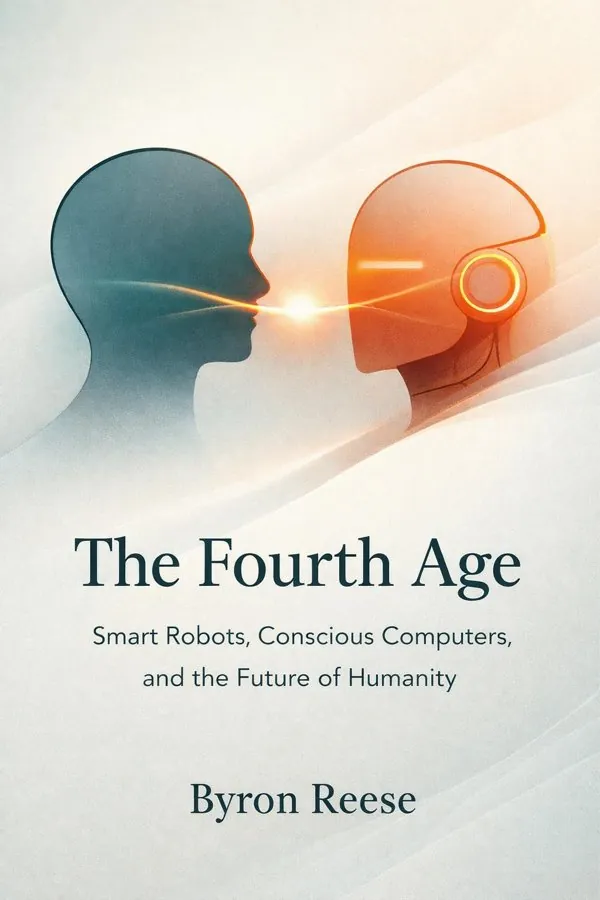
The Fourth Age: Smart Robots, Conscious Computers, and the Future of Humanity: Summary & Key Insights
by Byron Reese
 10 min8 chaptersAudio available
What Is The Fourth Age: Smart Robots, Conscious Computers, and the Future of Humanity About?
The Fourth Age: Smart Robots, Conscious Computers, and the Future of Humanity by Byron Reese is a ai_ml book spanning 8 pages. The Fourth Age explores how artificial intelligence and robotics are transforming humanity. Byron Reese argues that we are entering a new epoch in human history, following the ages of language, agriculture, and writing. He examines the philosophical and practical implications of conscious machines, automation, and the future of work, offering a hopeful vision of technological progress and human potential.
This FizzRead summary covers all 8 key chapters of The Fourth Age: Smart Robots, Conscious Computers, and the Future of Humanity in approximately 10 minutes, distilling the most important ideas, arguments, and takeaways from Byron Reese's work. Also available as an audio summary and Key Quotes Podcast.
The Fourth Age: Smart Robots, Conscious Computers, and the Future of Humanity
The Fourth Age explores how artificial intelligence and robotics are transforming humanity. Byron Reese argues that we are entering a new epoch in human history, following the ages of language, agriculture, and writing. He examines the philosophical and practical implications of conscious machines, automation, and the future of work, offering a hopeful vision of technological progress and human potential.
Who Should Read The Fourth Age: Smart Robots, Conscious Computers, and the Future of Humanity?
This book is perfect for anyone interested in ai_ml and looking to gain actionable insights in a short read. Whether you're a student, professional, or lifelong learner, the key ideas from The Fourth Age: Smart Robots, Conscious Computers, and the Future of Humanity by Byron Reese will help you think differently.
- ✓Readers who enjoy ai_ml and want practical takeaways
- ✓Professionals looking to apply new ideas to their work and life
- ✓Anyone who wants the core insights of The Fourth Age: Smart Robots, Conscious Computers, and the Future of Humanity in just 10 minutes
Want the full summary?
Get instant access to this book summary and 100K+ more with Fizz Moment.
Get Free SummaryAvailable on App Store • Free to download
Key Chapters
To understand why the Fourth Age matters, we first have to look back and recognize how profoundly each previous transformation remade humanity. When our ancestors first began to speak, they built something far more powerful than individual intelligence. They created shared minds — communities that could coordinate, plan, and imagine futures together. Language wasn't just communication; it was the birth of collective thought.
Agriculture followed, giving rise to settlement, specialization, and infrastructure. Humans learned to domesticate not just plants and animals, but time itself — planning seasons, storing surplus, and building institutions to manage abundance and scarcity. This was also the beginning of structured society, of hierarchies and laws — the foundation for civilization.
Writing extended our mental reach once again. It allowed knowledge to break free of memory, freeing generations to build upon the discoveries of their predecessors. The written word created history, contracts, literature, and science. It was the technology of abstraction — letting us manipulate symbols to represent complex ideas.
Each age was born from a simple invention that amplified one essential human trait: our ability to process information. In language, it was shared memory; in agriculture, planned coordination; in writing, cumulative knowledge. Now, in the Fourth Age, artificial intelligence promises to extend those capacities beyond biology itself.
When I call this new era the Fourth Age, I’m not just referring to the proliferation of smart devices or robots in factories. I’m referring to a change in our fundamental relationship with technology. In previous ages, our inventions magnified our physical abilities — the plow, the wheel, the written page. In the Fourth Age, we are beginning to create machines that might one day replicate or even surpass aspects of our mental life.
This transformation brings both promise and provocation. On a practical level, artificial intelligence is poised to make our world vastly more productive. Machine learning systems already sort information, recognize patterns, and make predictions on scales no human could manage. Robotics extends these capabilities into the physical world, enabling automation of tasks once thought to require human dexterity or judgment. But beneath the surface lies a more profound question: what does it mean to delegate thinking itself to something non-human?
The Fourth Age challenges the very categories of 'tool' and 'user.' If a machine can learn, adapt, and perhaps even make ethical decisions, then it participates in the same intellectual and moral space we’ve long considered exclusively human. It invites us to reimagine identity and consciousness — not as possessions we guard, but as phenomena we might eventually understand deeply enough to recreate.
My central argument is that this is not an end to humanity, but a continuation of what humanity has always done: expand its capacity for understanding. The Fourth Age, like the others before it, is not an accident of progress but a natural extension of our species’ relentless curiosity.
+ 6 more chapters — available in the FizzRead app
All Chapters in The Fourth Age: Smart Robots, Conscious Computers, and the Future of Humanity
About the Author
Byron Reese is an American entrepreneur, author, and futurist known for his work on technology and its impact on society. He has written extensively on artificial intelligence and the future of humanity, and serves as CEO of technology companies focused on data and innovation.
Get This Summary in Your Preferred Format
Read or listen to the The Fourth Age: Smart Robots, Conscious Computers, and the Future of Humanity summary by Byron Reese anytime, anywhere. FizzRead offers multiple formats so you can learn on your terms — all free.
Available formats: App · Audio · PDF · EPUB — All included free with FizzRead
Download The Fourth Age: Smart Robots, Conscious Computers, and the Future of Humanity PDF and EPUB Summary
Key Quotes from The Fourth Age: Smart Robots, Conscious Computers, and the Future of Humanity
“To understand why the Fourth Age matters, we first have to look back and recognize how profoundly each previous transformation remade humanity.”
“When I call this new era the Fourth Age, I’m not just referring to the proliferation of smart devices or robots in factories.”
Frequently Asked Questions about The Fourth Age: Smart Robots, Conscious Computers, and the Future of Humanity
The Fourth Age: Smart Robots, Conscious Computers, and the Future of Humanity by Byron Reese is a ai_ml book that explores key ideas across 8 chapters. The Fourth Age explores how artificial intelligence and robotics are transforming humanity. Byron Reese argues that we are entering a new epoch in human history, following the ages of language, agriculture, and writing. He examines the philosophical and practical implications of conscious machines, automation, and the future of work, offering a hopeful vision of technological progress and human potential.
You Might Also Like
Life 3.0
Max Tegmark
10 min
Superintelligence
Nick Bostrom
10 min
TensorFlow in Action
Thushan Ganegedara
10 min
AI Made Simple: A Beginner’s Guide to Generative AI, ChatGPT, and the Future of Work
Rajeev Kapur
10 min
AI Snake Oil
Arvind Narayanan, Sayash Kapoor
10 min
AI Superpowers: China, Silicon Valley, and the New World Order
Kai-Fu Lee
10 minBrowse by Category
Ready to read The Fourth Age: Smart Robots, Conscious Computers, and the Future of Humanity?
Get the full summary and 100K+ more books with Fizz Moment.