
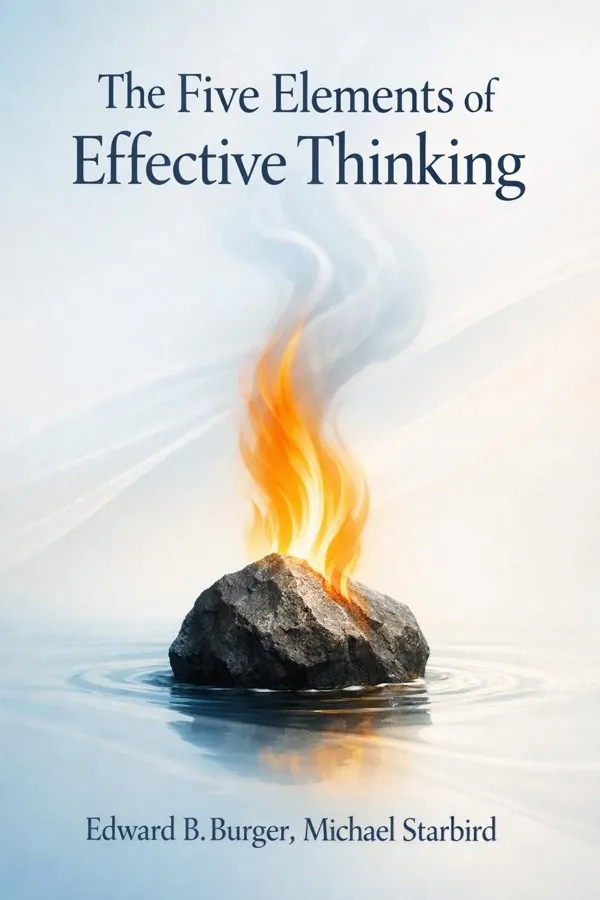
The Five Elements of Effective Thinking: Summary & Key Insights
by Edward B. Burger, Michael Starbird
 10 min5 chaptersAudio available
What Is The Five Elements of Effective Thinking About?
The Five Elements of Effective Thinking by Edward B. Burger, Michael Starbird is a mindset book spanning 5 pages. The Five Elements of Effective Thinking offers practical methods for becoming more creative, insightful, and successful in learning and problem-solving. Drawing on the metaphor of the classical elements—earth, fire, air, water, and the quintessential change—the authors present strategies to deepen understanding, ignite imagination, and embrace failure as a path to progress. The book encourages readers to think more clearly, ask better questions, and continuously refine their ideas.
This FizzRead summary covers all 5 key chapters of The Five Elements of Effective Thinking in approximately 10 minutes, distilling the most important ideas, arguments, and takeaways from Edward B. Burger, Michael Starbird's work. Also available as an audio summary and Key Quotes Podcast.
The Five Elements of Effective Thinking
The Five Elements of Effective Thinking offers practical methods for becoming more creative, insightful, and successful in learning and problem-solving. Drawing on the metaphor of the classical elements—earth, fire, air, water, and the quintessential change—the authors present strategies to deepen understanding, ignite imagination, and embrace failure as a path to progress. The book encourages readers to think more clearly, ask better questions, and continuously refine their ideas.
Who Should Read The Five Elements of Effective Thinking?
This book is perfect for anyone interested in mindset and looking to gain actionable insights in a short read. Whether you're a student, professional, or lifelong learner, the key ideas from The Five Elements of Effective Thinking by Edward B. Burger, Michael Starbird will help you think differently.
- ✓Readers who enjoy mindset and want practical takeaways
- ✓Professionals looking to apply new ideas to their work and life
- ✓Anyone who wants the core insights of The Five Elements of Effective Thinking in just 10 minutes
Want the full summary?
Get instant access to this book summary and 100K+ more with Fizz Moment.
Get Free SummaryAvailable on App Store • Free to download
Key Chapters
If you want to think effectively, begin where all solid structures begin—with the ground beneath your feet. Earth represents understanding deeply. Too often, we rush past the basics, mistaking familiarity for mastery. Real understanding means stripping away assumptions until you reveal the elemental truths of a concept. When we built this framework, we saw that transformative learning starts not with accumulation but with distillation: trimming ideas down to their essence until you can hold their meaning in your hands.
In practice, understanding deeply is about asking yourself: What do I truly know? What hidden assumptions am I carrying? When learners slow down and examine their foundations, they uncover cracks they never knew existed—and that process of rebuilding makes comprehension unshakable.
Mathematics, for example, teaches this vividly. Many students memorize formulas without understanding where they come from. But discovery happens when they ask: Why does this formula hold? How is it derived? By tracing ideas back to their roots, the knowledge becomes flexible and adaptable. Whether you’re studying geometry, writing a poem, or developing a business model, the same principle applies: clarity of foundation determines the strength of everything built above it.
In our classrooms, we’ve seen how forcing ourselves to explain a concept from scratch—to teach it to an imaginary student—reveals what we do and do not understand. That conversation with ourselves deepens comprehension and exposes opportunity for growth. Earth, therefore, is not passive; it is the deliberate act of grounding yourself in truth so your intellectual architecture can rise higher. Once your foundations are strong, every insight that follows has something solid to stand on.
Failure terrifies learners—but it shouldn’t. Fire, the second element, transforms that fear into energy. Every mistake contains a spark, a hint of insight waiting to ignite. Failure is not a dead end but the fiery forge in which understanding is strengthened and creativity is born.
In our experience, we’ve seen the most dramatic growth in those who are willing to err boldly. A failed proof, a wrong assumption, a misstep—all of these, when examined honestly, become teachers more eloquent than success itself. Fire asks you to celebrate your errors as data. Each failure tells you where your reasoning misfired and offers a pathway toward deeper truth.
Imagine an inventor surrounded by discarded prototypes. Each one failed in some way—too fragile, too slow, too expensive—but each also reveals what to avoid, what to change, what to keep. The same holds for intellectual discovery. When a student miscalculates a problem, the key isn’t to erase the error but to dissect it. What wrong assumption led here? Did a missing connection cause this? Fire transforms frustration into fascination.
The difference between mediocrity and mastery lies not in avoiding mistakes but in reacting to them skillfully. To think effectively, you must kindle this fire intentionally—seed challenges that will stretch you and invite small failures that yield big learning. The heat of error refines thought; the courage to embrace it redefines growth.
+ 3 more chapters — available in the FizzRead app
All Chapters in The Five Elements of Effective Thinking
About the Authors
Edward B. Burger is a mathematician and educator known for his work in mathematical thinking and innovation in education. Michael Starbird is a professor of mathematics at the University of Texas at Austin, recognized for his contributions to teaching and mathematical exposition. Together, they have collaborated on several works promoting effective thinking and learning.
Get This Summary in Your Preferred Format
Read or listen to the The Five Elements of Effective Thinking summary by Edward B. Burger, Michael Starbird anytime, anywhere. FizzRead offers multiple formats so you can learn on your terms — all free.
Available formats: App · Audio · PDF · EPUB — All included free with FizzRead
Download The Five Elements of Effective Thinking PDF and EPUB Summary
Key Quotes from The Five Elements of Effective Thinking
“If you want to think effectively, begin where all solid structures begin—with the ground beneath your feet.”
“Failure terrifies learners—but it shouldn’t.”
Frequently Asked Questions about The Five Elements of Effective Thinking
The Five Elements of Effective Thinking by Edward B. Burger, Michael Starbird is a mindset book that explores key ideas across 5 chapters. The Five Elements of Effective Thinking offers practical methods for becoming more creative, insightful, and successful in learning and problem-solving. Drawing on the metaphor of the classical elements—earth, fire, air, water, and the quintessential change—the authors present strategies to deepen understanding, ignite imagination, and embrace failure as a path to progress. The book encourages readers to think more clearly, ask better questions, and continuously refine their ideas.
You Might Also Like



Browse by Category
Ready to read The Five Elements of Effective Thinking?
Get the full summary and 100K+ more books with Fizz Moment.