
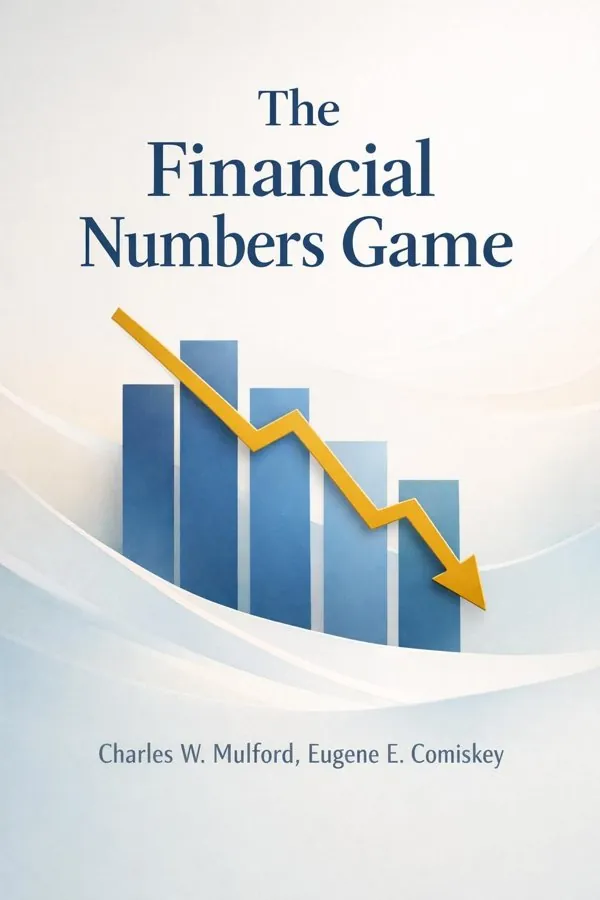
The Financial Numbers Game: Detecting Creative Accounting Practices: Summary & Key Insights
by Charles W. Mulford, Eugene E. Comiskey
 10 min13 chaptersAudio available
What Is The Financial Numbers Game: Detecting Creative Accounting Practices About?
The Financial Numbers Game: Detecting Creative Accounting Practices by Charles W. Mulford, Eugene E. Comiskey is a finance book spanning 13 pages. This book provides a comprehensive guide to understanding how companies manipulate financial statements and accounting numbers. It teaches readers how to detect creative accounting practices and interpret financial reports with a critical eye, offering practical tools for investors, analysts, and auditors to identify red flags in corporate disclosures.
This FizzRead summary covers all 13 key chapters of The Financial Numbers Game: Detecting Creative Accounting Practices in approximately 10 minutes, distilling the most important ideas, arguments, and takeaways from Charles W. Mulford, Eugene E. Comiskey's work. Also available as an audio summary and Key Quotes Podcast.
The Financial Numbers Game: Detecting Creative Accounting Practices
This book provides a comprehensive guide to understanding how companies manipulate financial statements and accounting numbers. It teaches readers how to detect creative accounting practices and interpret financial reports with a critical eye, offering practical tools for investors, analysts, and auditors to identify red flags in corporate disclosures.
Who Should Read The Financial Numbers Game: Detecting Creative Accounting Practices?
This book is perfect for anyone interested in finance and looking to gain actionable insights in a short read. Whether you're a student, professional, or lifelong learner, the key ideas from The Financial Numbers Game: Detecting Creative Accounting Practices by Charles W. Mulford, Eugene E. Comiskey will help you think differently.
- ✓Readers who enjoy finance and want practical takeaways
- ✓Professionals looking to apply new ideas to their work and life
- ✓Anyone who wants the core insights of The Financial Numbers Game: Detecting Creative Accounting Practices in just 10 minutes
Want the full summary?
Get instant access to this book summary and 100K+ more with Fizz Moment.
Get Free SummaryAvailable on App Store • Free to download
Key Chapters
Creative accounting, as we use the term, is not about outright falsification—it’s about exploiting the flexibility inherent in accounting standards to shape perception. It’s legal, often accepted, and sometimes even expected. But its impact on the reliability of financial statements is profound.
When management stretches accounting judgment, they distort the picture investors rely on to make informed decisions. A small change in how revenue is recognized, a subtle shift in expense timing, or a selective valuation of assets can dramatically alter performance indicators. The danger lies in how these isolated choices accumulate, forming a pattern that transforms financial truth into financial fiction.
Take for instance the aggressive capitalization of costs during an expansion period. It can make short-term profits look stable while hiding the fact that future expenses are being pushed forward. Or consider when managers adjust reserves or provisions at year-end—technically legitimate, yet often motivated by earnings targets rather than economic reality. Once you start to look for these clues, the illusion becomes clear.
The impact goes beyond misleading investors. Financial misrepresentation inflates share prices, distorts executive compensation, and erodes the integrity of markets. By understanding creative accounting, we recognize that transparency is not merely an ethical ideal—it’s a financial necessity.
To understand the financial numbers game, we must accept a fundamental truth: managers are human, and their decisions are driven by incentives. Companies are judged by quarterly results; bonuses depend on meeting targets; and market expectations often create immense pressure to deliver steady growth. When legitimate performance falls short, creative accounting provides a tempting escape.
Earnings management is the process of using accounting discretion to achieve desired results, often smoothing volatility or meeting analysts’ forecasts. It is frequently rationalized as protecting shareholder value, yet it undermines the very foundation of investor trust.
We’ve observed that these motivations take many forms. Some stem from external pressures—like maintaining stock price stability or meeting debt covenants. Others are internal—linked to promotions, bonuses, or reputational risk. A CFO under pressure may accelerate revenue recognition; an executive trying to mask operational inefficiency may defer expenses.
What we want readers to remember is that these actions are rarely overtly fraudulent. They are embedded in normalcy, appearing as small adjustments or legitimate interpretations of GAAP. The true hazard comes when judgment turns into manipulation, and management narratives replace financial reality. Recognizing this behavioral dimension is the key to decoding corporate disclosures.
+ 11 more chapters — available in the FizzRead app
All Chapters in The Financial Numbers Game: Detecting Creative Accounting Practices
About the Authors
Charles W. Mulford is a professor of accounting at Georgia Institute of Technology, specializing in financial reporting and analysis. Eugene E. Comiskey is also a professor of accounting at Georgia Institute of Technology, known for his research in financial statement analysis and corporate accounting practices.
Get This Summary in Your Preferred Format
Read or listen to the The Financial Numbers Game: Detecting Creative Accounting Practices summary by Charles W. Mulford, Eugene E. Comiskey anytime, anywhere. FizzRead offers multiple formats so you can learn on your terms — all free.
Available formats: App · Audio · PDF · EPUB — All included free with FizzRead
Download The Financial Numbers Game: Detecting Creative Accounting Practices PDF and EPUB Summary
Key Quotes from The Financial Numbers Game: Detecting Creative Accounting Practices
“Creative accounting, as we use the term, is not about outright falsification—it’s about exploiting the flexibility inherent in accounting standards to shape perception.”
“To understand the financial numbers game, we must accept a fundamental truth: managers are human, and their decisions are driven by incentives.”
Frequently Asked Questions about The Financial Numbers Game: Detecting Creative Accounting Practices
The Financial Numbers Game: Detecting Creative Accounting Practices by Charles W. Mulford, Eugene E. Comiskey is a finance book that explores key ideas across 13 chapters. This book provides a comprehensive guide to understanding how companies manipulate financial statements and accounting numbers. It teaches readers how to detect creative accounting practices and interpret financial reports with a critical eye, offering practical tools for investors, analysts, and auditors to identify red flags in corporate disclosures.
You Might Also Like



Browse by Category
Ready to read The Financial Numbers Game: Detecting Creative Accounting Practices?
Get the full summary and 100K+ more books with Fizz Moment.