
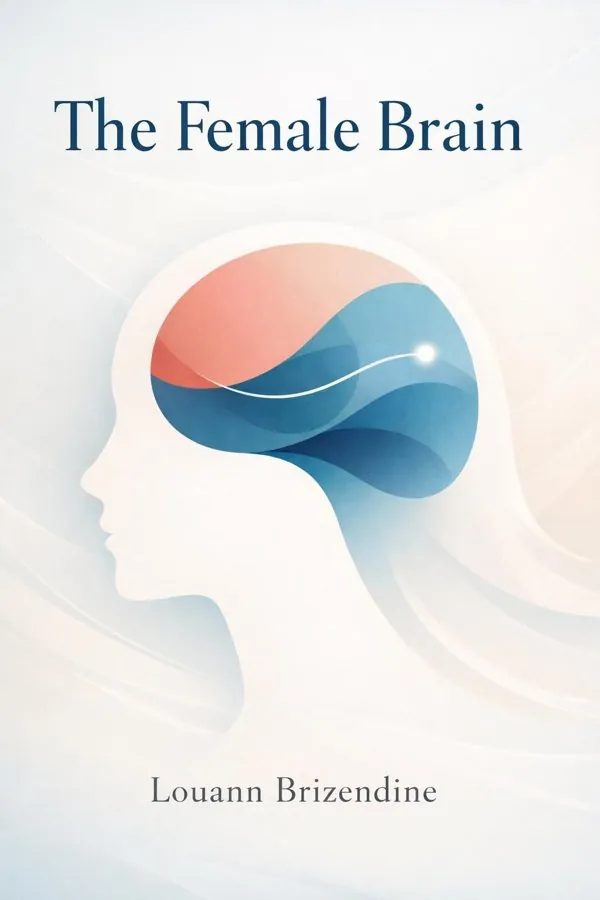
The Female Brain: Summary & Key Insights
 10 min9 chaptersAudio available
What Is The Female Brain About?
The Female Brain by Louann Brizendine is a neuroscience book spanning 9 pages. The Female Brain es una obra de la neuropsiquiatra Louann Brizendine que explora cómo las diferencias hormonales y neurológicas influyen en el pensamiento, las emociones y el comportamiento de las mujeres. Basada en décadas de investigación clínica y científica, el libro ofrece una visión accesible sobre la biología del cerebro femenino y su impacto en las relaciones, la comunicación y la toma de decisiones.
This FizzRead summary covers all 9 key chapters of The Female Brain in approximately 10 minutes, distilling the most important ideas, arguments, and takeaways from Louann Brizendine's work. Also available as an audio summary and Key Quotes Podcast.
The Female Brain
The Female Brain es una obra de la neuropsiquiatra Louann Brizendine que explora cómo las diferencias hormonales y neurológicas influyen en el pensamiento, las emociones y el comportamiento de las mujeres. Basada en décadas de investigación clínica y científica, el libro ofrece una visión accesible sobre la biología del cerebro femenino y su impacto en las relaciones, la comunicación y la toma de decisiones.
Who Should Read The Female Brain?
This book is perfect for anyone interested in neuroscience and looking to gain actionable insights in a short read. Whether you're a student, professional, or lifelong learner, the key ideas from The Female Brain by Louann Brizendine will help you think differently.
- ✓Readers who enjoy neuroscience and want practical takeaways
- ✓Professionals looking to apply new ideas to their work and life
- ✓Anyone who wants the core insights of The Female Brain in just 10 minutes
Want the full summary?
Get instant access to this book summary and 100K+ more with Fizz Moment.
Get Free SummaryAvailable on App Store • Free to download
Key Chapters
In the earliest stage of life, before consciousness or memory, the brain is sculpted by hormones in the womb. The female fetus bathes in an environment rich in estrogen, which subtly influences neuronal growth and the formation of regions responsible for communication and emotional processing. By contrast, male fetuses experience a surge of testosterone that later suppresses some of these areas while enhancing spatial and aggression-related circuits.
As I have observed in clinical neuroscience, these differences are not deterministic—they lay the groundwork for tendencies. For the female brain, estrogen enhances sensitivity to facial expressions and emotional cues even before birth. The architecture of the limbic system, particularly the amygdala and hippocampus, reflects this hormonal influence, preparing girls for a life where communication and empathy are powerful tools.
In this prenatal stage, hormones act as builders and editors. The female brain’s wiring favors interconnected regions rather than isolated hubs, enabling faster contextual processing and deeper emotional understanding. It is this intricate connectivity that later enables women to perceive nuances in tone, body language, and intention. Such subtle abilities are not learned; they are inherited scaffolds formed under hormonal influence.
Understanding this early development allows us to move beyond stereotypes. Biology is not a sentence; it’s a starting point. The fetal brain is both a blueprint and a promise—its complexity designed for sensitivity and adaptability. These early hormonal dialogues create a foundation that interacts dynamically with experience, meaning that the female brain is always evolving, always negotiating between nature and nurture.
+ 7 more chapters — available in the FizzRead app
All Chapters in The Female Brain
About the Author
Louann Brizendine es una neuropsiquiatra estadounidense, profesora en la Universidad de California, San Francisco. Es conocida por su trabajo sobre las diferencias neurobiológicas entre hombres y mujeres y por sus libros The Female Brain y The Male Brain, que han sido traducidos a múltiples idiomas y han influido en la divulgación científica sobre el comportamiento humano.
Get This Summary in Your Preferred Format
Read or listen to the The Female Brain summary by Louann Brizendine anytime, anywhere. FizzRead offers multiple formats so you can learn on your terms — all free.
Available formats: App · Audio · PDF · EPUB — All included free with FizzRead
Download The Female Brain PDF and EPUB Summary
Key Quotes from The Female Brain
“In the earliest stage of life, before consciousness or memory, the brain is sculpted by hormones in the womb.”
“As the female child grows, her brain enters a stage ruled by connection and learning.”
Frequently Asked Questions about The Female Brain
The Female Brain by Louann Brizendine is a neuroscience book that explores key ideas across 9 chapters. The Female Brain es una obra de la neuropsiquiatra Louann Brizendine que explora cómo las diferencias hormonales y neurológicas influyen en el pensamiento, las emociones y el comportamiento de las mujeres. Basada en décadas de investigación clínica y científica, el libro ofrece una visión accesible sobre la biología del cerebro femenino y su impacto en las relaciones, la comunicación y la toma de decisiones.
More by Louann Brizendine
You Might Also Like

Anxious
Joseph LeDoux
10 min
Hallucinations
Oliver Sacks
10 min
The Biological Mind: How Brain, Body, and Environment Collaborate to Make Us Who We Are
Alan Jasanoff
10 min
The Feeling of Life Itself: Why Consciousness Is Widespread but Can't Be Computed
Christof Koch
10 min
The No-Nonsense Meditation Book
Steven Laureys
10 min
A General Theory of Love
Thomas Lewis, Fari Amini, Richard Lannon
10 minBrowse by Category
Ready to read The Female Brain?
Get the full summary and 100K+ more books with Fizz Moment.