
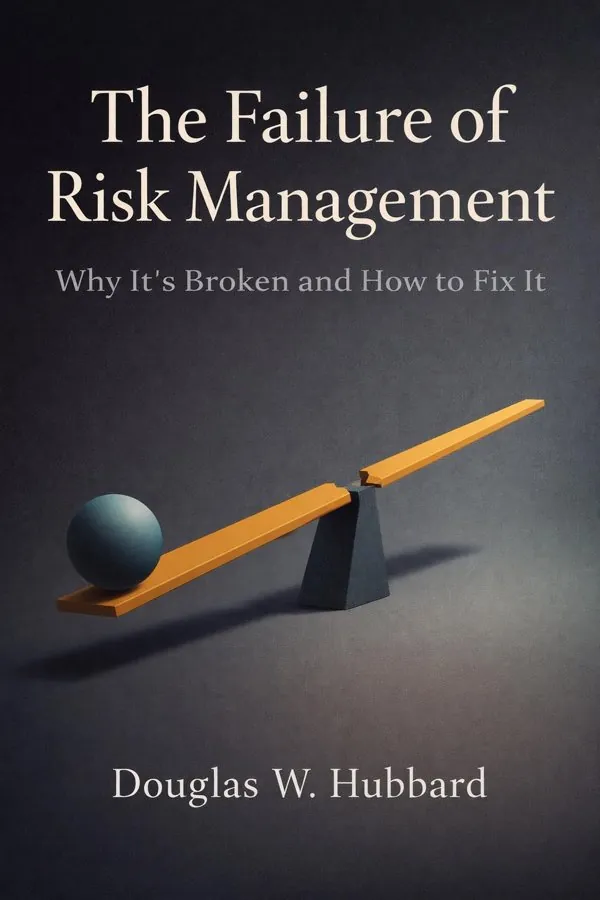
The Failure of Risk Management: Why It's Broken and How to Fix It: Summary & Key Insights
 10 min12 chaptersAudio available
What Is The Failure of Risk Management: Why It's Broken and How to Fix It About?
The Failure of Risk Management: Why It's Broken and How to Fix It by Douglas W. Hubbard is a finance book spanning 12 pages. The Failure of Risk Management: Why It's Broken and How to Fix It examines the widespread misuse of risk analysis methods and offers a practical framework for improving decision-making under uncertainty. Douglas W. Hubbard critiques common risk management practices and introduces calibrated risk analysis techniques that help organizations make more accurate and data-driven assessments of risk.
This FizzRead summary covers all 12 key chapters of The Failure of Risk Management: Why It's Broken and How to Fix It in approximately 10 minutes, distilling the most important ideas, arguments, and takeaways from Douglas W. Hubbard's work. Also available as an audio summary and Key Quotes Podcast.
The Failure of Risk Management: Why It's Broken and How to Fix It
The Failure of Risk Management: Why It's Broken and How to Fix It examines the widespread misuse of risk analysis methods and offers a practical framework for improving decision-making under uncertainty. Douglas W. Hubbard critiques common risk management practices and introduces calibrated risk analysis techniques that help organizations make more accurate and data-driven assessments of risk.
Who Should Read The Failure of Risk Management: Why It's Broken and How to Fix It?
This book is perfect for anyone interested in finance and looking to gain actionable insights in a short read. Whether you're a student, professional, or lifelong learner, the key ideas from The Failure of Risk Management: Why It's Broken and How to Fix It by Douglas W. Hubbard will help you think differently.
- ✓Readers who enjoy finance and want practical takeaways
- ✓Professionals looking to apply new ideas to their work and life
- ✓Anyone who wants the core insights of The Failure of Risk Management: Why It's Broken and How to Fix It in just 10 minutes
Want the full summary?
Get instant access to this book summary and 100K+ more with Fizz Moment.
Get Free SummaryAvailable on App Store • Free to download
Key Chapters
Too many organizations think of risk in ways that feel organized but are in fact misleading. They create charts, assign scores from one to five, and call it quantitative assessment. But the dirty secret of these conventions is that they don’t correspond to measurable probabilities. A '5' in likelihood might mean something entirely different to each participant in a workshop, and yet those numbers get averaged and presented as though they were statistical facts.
I have seen this in government agencies, industry, and even scientific institutions. They rely heavily on what seems comfortable—expert opinion and consensus judgment—without asking the most crucial question: have these judgments been shown to predict real-world outcomes better than chance? Typically, they haven’t. The illusion of precision that arises from ranking and scoring conceals an underlying lack of calibration. We think we are managing risk merely because we have a chart that looks analytical, but in practice, we are only managing our anxiety.
Psychological biases amplify these misconceptions. Humans suffer from overconfidence; we misjudge the likelihood of rare events and underestimate variance. We rely on stories rather than data. The first major step in fixing risk management is recognizing that intuition—no matter how seasoned—is not enough. True understanding begins with measuring uncertainty, not labeling it.
Subjective risk matrices allow decision-makers to feel in control when they are not. The problem is structural: the categories they use are arbitrary, the scales nonlinear, and the results unvalidated. The executives feel reassured when they see red and green boxes neatly arranged on a slide, yet these visuals often misdirect resources toward vividly perceived but statistically minor threats.
Through empirical tests, I found that traditional expert assessments did not outperform random guesses. In fact, the more confident an expert felt about a judgment, the more likely they were to be wrong if untrained in probabilistic calibration. Confidence is seductive, but it is not evidence of correctness. The challenge, therefore, is not to eliminate human judgment, but to discipline it. Risk managers must learn to represent uncertainty in measurable, testable terms—recognizing that the goal of risk management is not to eliminate uncertainty, but to make better choices despite it.
When we trade evidence for the comfort of control, we end up building beautiful maps of nowhere—systems that feel powerful but fail under stress. Illusions of control are dangerous precisely because they suppress curiosity. Those who think they already know rarely ask what data could prove them wrong.
+ 10 more chapters — available in the FizzRead app
All Chapters in The Failure of Risk Management: Why It's Broken and How to Fix It
About the Author
Douglas W. Hubbard is an American author and consultant known for his work in quantitative analysis and decision science. He is the founder of Hubbard Decision Research and the creator of the Applied Information Economics method. His books focus on improving measurement and risk management in business and government.
Get This Summary in Your Preferred Format
Read or listen to the The Failure of Risk Management: Why It's Broken and How to Fix It summary by Douglas W. Hubbard anytime, anywhere. FizzRead offers multiple formats so you can learn on your terms — all free.
Available formats: App · Audio · PDF · EPUB — All included free with FizzRead
Download The Failure of Risk Management: Why It's Broken and How to Fix It PDF and EPUB Summary
Key Quotes from The Failure of Risk Management: Why It's Broken and How to Fix It
“Too many organizations think of risk in ways that feel organized but are in fact misleading.”
“Subjective risk matrices allow decision-makers to feel in control when they are not.”
Frequently Asked Questions about The Failure of Risk Management: Why It's Broken and How to Fix It
The Failure of Risk Management: Why It's Broken and How to Fix It by Douglas W. Hubbard is a finance book that explores key ideas across 12 chapters. The Failure of Risk Management: Why It's Broken and How to Fix It examines the widespread misuse of risk analysis methods and offers a practical framework for improving decision-making under uncertainty. Douglas W. Hubbard critiques common risk management practices and introduces calibrated risk analysis techniques that help organizations make more accurate and data-driven assessments of risk.
You Might Also Like




Browse by Category
Ready to read The Failure of Risk Management: Why It's Broken and How to Fix It?
Get the full summary and 100K+ more books with Fizz Moment.