
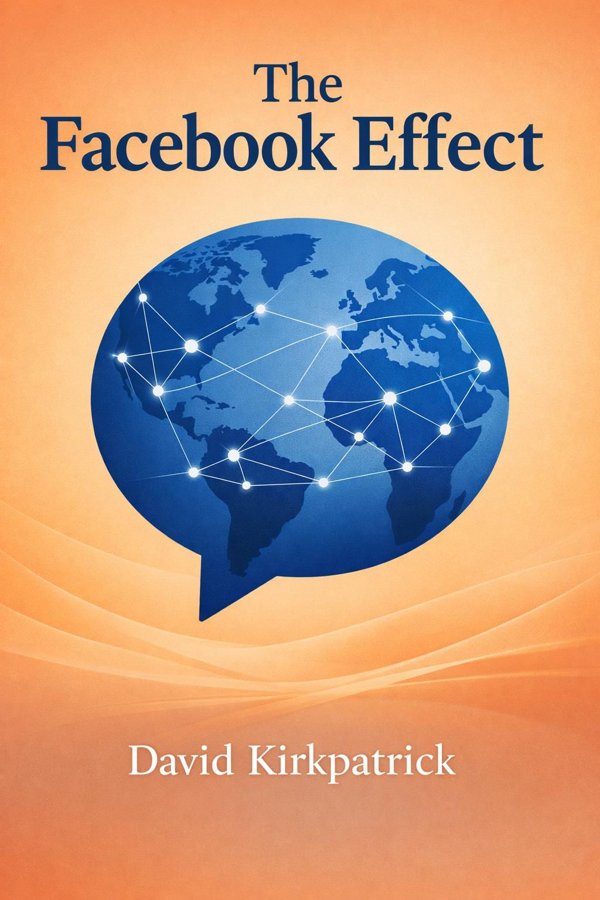
The Facebook Effect: The Inside Story of the Company That Is Connecting the World: Summary & Key Insights
 10 min9 chaptersAudio available
Key Takeaways from The Facebook Effect: The Inside Story of the Company That Is Connecting the World
Great companies often begin not with a grand corporate plan, but with a problem that feels immediate and personal.
The most disruptive products often look simple at first.
Growth is often strongest when not everyone can join at once.
Companies often reveal their values less through mission statements than through the habits they reward.
One of Facebook’s most important and controversial ideas was that people benefit when more information is shared more easily.
What Is The Facebook Effect: The Inside Story of the Company That Is Connecting the World About?
The Facebook Effect: The Inside Story of the Company That Is Connecting the World by David Kirkpatrick is a digital_culture book spanning 6 pages. The Facebook Effect by David Kirkpatrick is one of the earliest and most revealing accounts of how Facebook grew from a college experiment into one of the most powerful companies in modern history. More than a startup story, the book shows how a simple idea—putting real identity and social connection online—reshaped communication, media, marketing, politics, and personal relationships. Kirkpatrick traces Facebook’s rise through its internal decisions, leadership conflicts, product philosophy, and relentless expansion, showing how the platform changed the way people present themselves and interact with the world. What makes this book especially valuable is the author’s access. As a veteran technology journalist and former Fortune editor, Kirkpatrick interviewed Mark Zuckerberg and many of Facebook’s early insiders, giving readers a rare look at the company’s culture and mindset during its formative years. The result is both a business narrative and a cultural history. For readers interested in entrepreneurship, digital platforms, social media, or the ethics of technological scale, The Facebook Effect offers a vivid explanation of how one company came to influence daily life for billions—and why that influence still matters.
This FizzRead summary covers all 9 key chapters of The Facebook Effect: The Inside Story of the Company That Is Connecting the World in approximately 10 minutes, distilling the most important ideas, arguments, and takeaways from David Kirkpatrick's work. Also available as an audio summary and Key Quotes Podcast.
The Facebook Effect: The Inside Story of the Company That Is Connecting the World
The Facebook Effect by David Kirkpatrick is one of the earliest and most revealing accounts of how Facebook grew from a college experiment into one of the most powerful companies in modern history. More than a startup story, the book shows how a simple idea—putting real identity and social connection online—reshaped communication, media, marketing, politics, and personal relationships. Kirkpatrick traces Facebook’s rise through its internal decisions, leadership conflicts, product philosophy, and relentless expansion, showing how the platform changed the way people present themselves and interact with the world.
What makes this book especially valuable is the author’s access. As a veteran technology journalist and former Fortune editor, Kirkpatrick interviewed Mark Zuckerberg and many of Facebook’s early insiders, giving readers a rare look at the company’s culture and mindset during its formative years. The result is both a business narrative and a cultural history. For readers interested in entrepreneurship, digital platforms, social media, or the ethics of technological scale, The Facebook Effect offers a vivid explanation of how one company came to influence daily life for billions—and why that influence still matters.
Who Should Read The Facebook Effect: The Inside Story of the Company That Is Connecting the World?
This book is perfect for anyone interested in digital_culture and looking to gain actionable insights in a short read. Whether you're a student, professional, or lifelong learner, the key ideas from The Facebook Effect: The Inside Story of the Company That Is Connecting the World by David Kirkpatrick will help you think differently.
- ✓Readers who enjoy digital_culture and want practical takeaways
- ✓Professionals looking to apply new ideas to their work and life
- ✓Anyone who wants the core insights of The Facebook Effect: The Inside Story of the Company That Is Connecting the World in just 10 minutes
Want the full summary?
Get instant access to this book summary and 100K+ more with Fizz Moment.
Get Free SummaryAvailable on App Store • Free to download
Key Chapters
Great companies often begin not with a grand corporate plan, but with a problem that feels immediate and personal. In The Facebook Effect, David Kirkpatrick shows that Facebook emerged from Harvard because Harvard supplied exactly the right mix of status competition, intellectual energy, technical talent, and social fragmentation. Students lived in a world full of clubs, houses, classes, and social circles, yet there was no efficient digital map of who people were or how they were connected. Mark Zuckerberg saw that gap clearly.
Before Facebook, Zuckerberg had already built smaller software projects that revealed his habits as a creator: he liked solving social problems through code, he moved quickly, and he cared more about usefulness than polish. Harvard gave him an environment where adoption could spread rapidly. If one student found a tool useful, an entire social network of classmates would hear about it almost immediately. That closed ecosystem also made experimentation easier because the product could be tested on a concentrated, motivated audience.
Kirkpatrick suggests that Facebook was not just born at Harvard by accident; it was shaped by the campus’s culture of identity and exclusivity. A place obsessed with who belongs, who knows whom, and who has access naturally rewards a platform built around real names and visible social ties. That early context mattered because it taught Facebook a foundational lesson: online tools become powerful when they mirror real-world relationships rather than replacing them.
For entrepreneurs, the practical application is clear. The best startup ideas often emerge from a tightly defined community with obvious friction points. Instead of starting broad, begin with a specific environment you understand deeply, solve a real social or operational problem, and let dense networks accelerate adoption. Actionable takeaway: look for a community you know intimately and identify one recurring coordination problem that people would eagerly use software to solve.
The most disruptive products often look simple at first. When Zuckerberg, Dustin Moskovitz, Eduardo Saverin, and Chris Hughes launched thefacebook.com in 2004, the immediate goal was modest: create an online directory where Harvard students could find one another, share basic information, and signal social presence. Yet beneath that simplicity was a radical design decision that distinguished Facebook from earlier internet communities—it was built around real identity.
At a time when much of the internet encouraged anonymity, pseudonyms, and performative self-invention, Facebook tied profiles to actual people and actual institutions. You did not create a fantasy avatar; you represented yourself. That design choice increased trust, relevance, and accountability. If someone sent a message, joined a group, or updated their profile, users understood that action in relation to a real social world. This made the platform immediately sticky because it was useful in everyday life: meeting classmates, learning who was in your dorm, discovering mutual friends, or navigating campus events.
Kirkpatrick shows that Facebook’s early success was not mainly about technical complexity. It was about understanding social architecture. The founders built a product that mirrored how people naturally organize themselves—through schools, networks, and relationships. Once students experienced the convenience of seeing their social graph made visible, the site became part of daily life.
This idea still matters for builders and marketers. Products gain power when they reduce uncertainty and increase social clarity. A networking app, alumni platform, or workplace tool works better when identity is verified and context is clear. Facebook’s early design demonstrates that trust is not a side feature; it is often the core value proposition. Actionable takeaway: when designing a digital product, ask whether users can immediately understand who others are, why they matter, and how they are connected.
Growth is often strongest when not everyone can join at once. One of Facebook’s smartest early moves was controlled expansion. Rather than opening the service to the entire internet immediately, Facebook rolled out campus by campus, beginning with elite universities and then gradually extending to other schools. Kirkpatrick explains that this strategy created demand, preserved trust, and reinforced the platform’s social legitimacy.
Scarcity made Facebook desirable. Students at schools without access wanted in because they could see peers elsewhere using it. At the same time, the gated model protected quality. Each new network had a clear membership rule—typically a school email address—which reduced spam, fake accounts, and random noise. Because users entered alongside classmates, the service arrived already populated with relevant people, making the experience valuable from day one.
This disciplined growth also impressed investors. Facebook was not merely adding users; it was demonstrating a repeatable network effect. Each launch showed that when a real-world community received the product, participation spread organically. That pattern helped attract serious backers and strategic guidance, even as the company resisted some of the conventional pressures to monetize too early or sell out.
The lesson extends far beyond social media. Many founders assume scale means immediate universality, but Facebook’s path suggests the opposite. Sequenced adoption can be more powerful than indiscriminate reach. A software tool rolled out by department, a marketplace launched city by city, or a membership product introduced through trusted communities can produce deeper engagement than a mass launch.
The key is to preserve density and relevance. A network becomes compelling when each user quickly encounters value through meaningful connections. Actionable takeaway: if you are building a community-driven product, design your growth strategy around concentrated groups where every new user increases value for others, instead of chasing broad but shallow adoption.
Companies often reveal their values less through mission statements than through the habits they reward. Facebook’s early culture, as described by Kirkpatrick, was defined by speed, product obsession, engineering confidence, and a belief that openness was inherently good. Mark Zuckerberg encouraged employees to ship quickly, improve continuously, and prioritize growth and user utility over bureaucracy. This mindset helped Facebook outmaneuver slower, more hierarchical competitors.
Inside the company, coding was not just a function; it was a source of status and decision-making power. Engineers were central because the company believed that product changes could shape social behavior at massive scale. That conviction created a culture where experimentation was normal and imperfect launches were acceptable if they accelerated learning. Facebook’s now-famous ethos of moving fast reflected a broader worldview: waiting for certainty was often more dangerous than releasing and iterating.
But Kirkpatrick also shows the tension inside that philosophy. A culture built on speed can create blind spots. Decisions that seem minor in code can have major consequences in privacy, trust, or public perception. The company’s enthusiasm for openness often outpaced users’ comfort levels, leading to repeated backlash. In that sense, Facebook’s internal culture was both the engine of its success and the source of many of its controversies.
For leaders, this is a valuable case study in cultural design. Strong cultures produce momentum, but every strength casts a shadow. Speed can become recklessness; openness can become intrusion; confidence can become arrogance. The challenge is not abandoning a powerful culture, but balancing it with feedback and safeguards. Actionable takeaway: identify the one value your organization prizes most, then ask what risk that value creates when taken too far—and build a counterweight before crisis forces you to.
One of Facebook’s most important and controversial ideas was that people benefit when more information is shared more easily. Kirkpatrick presents Zuckerberg as someone who genuinely believed that increasing openness would improve society by making people more accountable, more informed, and more connected. This belief shaped Facebook’s products, from profiles and News Feed to privacy settings and platform integrations.
The logic had real force. When people can see more of what their friends, coworkers, or communities are doing, coordination becomes easier. Events spread faster, recommendations become more useful, and weak social ties become visible in practical ways. Businesses can understand audiences better. Organizations can mobilize supporters more efficiently. Social visibility can create opportunity.
Yet the same mechanisms that make information useful can make it uncomfortable. Users may want connection without constant exposure. They may value sharing in one context but not another. Facebook repeatedly discovered that people did not always react well when new features made previously scattered information newly visible. Technically, the data might already exist; socially, its aggregation changed its meaning.
This is one of the book’s enduring insights: privacy is not simply about secrecy, but about control, context, and timing. A person may be happy to post photos for friends but disturbed when an algorithm amplifies them. A company may think it is improving transparency while users feel surveilled.
The broader lesson applies to product design, leadership, and communication. More openness is not automatically better unless users understand and choose it. Trust depends on perceived agency. Actionable takeaway: whenever introducing a feature that increases visibility, ask not only what becomes easier to share, but whether users feel they still control who sees what, when, and why.
A product becomes truly formidable when each new user makes it more valuable for everyone else. Facebook’s rise is one of the clearest modern examples of network effects in action. Kirkpatrick shows how the service became harder to ignore as more people joined, because the value of being on Facebook depended increasingly on who else was already there. Friends, classmates, colleagues, family members, and organizations all reinforced one another’s participation.
This kind of growth creates momentum that goes beyond marketing. Users did not need to be persuaded abstractly that Facebook was useful; they joined because their social world was already moving there. Once enough of a person’s relationships, messages, invitations, and identity cues were attached to the platform, leaving became inconvenient. That is why competitors with good features still struggled. They were not just fighting a product; they were fighting a social infrastructure.
Facebook strengthened this advantage by becoming a platform, not just a website. Developers, brands, and media organizations were encouraged to build around it, making Facebook even more central to online life. The company’s strategy was not merely to host interaction, but to become the default layer through which interaction happened.
For business thinkers, this highlights the difference between linear and compounding value. A traditional company may add customers one by one. A network-driven company improves as participation grows, creating durable defensibility. However, network effects also increase responsibility. When people depend on your system for identity, communication, and discovery, your decisions carry social consequences far beyond ordinary product updates.
Actionable takeaway: if you want to build a durable digital business, focus on how users can create value for one another—not just consume value from you. The strongest growth loop is often user-to-user utility, not company-to-user promotion.
Many founders chase exits, but Zuckerberg’s defining characteristic in Kirkpatrick’s portrayal is that he consistently thought in terms of mission and scale. Even when Facebook was still young, he resisted opportunities to sell because he believed the company was building something historically important. Whether one admires or questions his decisions, that conviction shaped Facebook’s trajectory. It allowed the company to prioritize long-term growth and influence over short-term financial security.
Zuckerberg’s leadership style was unusual. He was not the polished, charismatic executive often associated with large companies. He could be blunt, intensely focused, and difficult to read. But he had a clear sense of the product’s purpose and a stubborn willingness to keep control in order to pursue it. Kirkpatrick argues that this was essential: a more conventional leader might have diluted the company’s direction or accepted a lucrative acquisition before Facebook matured.
The book also shows the cost of visionary leadership. Strong conviction can inspire extraordinary execution, but it can also reduce openness to criticism. When a leader believes deeply in a social theory—such as radical openness—that theory can become embedded in product decisions before its downsides are fully understood. Vision accelerates progress, but reflection must keep pace.
For founders and managers, this is a nuanced lesson. Ambition matters because large outcomes require unusual persistence. But mission-driven leadership is healthiest when paired with humility, diverse counsel, and mechanisms for correction. It is not enough to know where you want to go; you must also understand how your assumptions affect others.
Actionable takeaway: define the long-term mission that makes your work worth protecting, then create a deliberate process for hearing criticism before your conviction hardens into blind certainty.
The most revealing phase of a company’s story often begins after it wins. As Facebook became dominant, the central question shifted from whether it could scale to whether it understood the consequences of that scale. Kirkpatrick captures this moment of tension as Facebook confronted criticism over privacy, control, influence, and responsibility. The company increasingly had to ask not just what it could build, but what it should build.
This is a crucial shift in the life of any powerful institution. In the startup phase, urgency is about product-market fit. In the platform phase, urgency is about governance. A design choice that once affected thousands now affects millions or more. A policy update becomes a social event. A technical adjustment can reshape public conversation, personal boundaries, and commercial incentives. The company’s internal assumptions are no longer internal—they become social norms.
Kirkpatrick does not present easy answers, but he makes clear that Facebook’s story cannot be understood only as entrepreneurial triumph. It is also a case study in how innovation outruns reflection. The platform connected people in unprecedented ways, yet those same connections raised difficult questions about surveillance, manipulation, and the concentration of private power over public interaction.
This idea is especially useful for leaders, creators, and users in any digital field. Scale magnifies moral stakes. The larger your reach, the more important it becomes to examine second-order effects, unintended incentives, and the experiences of vulnerable users. Ethical thinking cannot be bolted on after growth; it must evolve alongside it.
Actionable takeaway: if your work influences many people, schedule regular decision reviews focused specifically on unintended consequences, not just performance metrics. Measure impact by what your system encourages, not only by how fast it grows.
All Chapters in The Facebook Effect: The Inside Story of the Company That Is Connecting the World
About the Author
David Kirkpatrick is an American journalist, author, and technology analyst best known for his reporting on the internet industry and its cultural consequences. He spent many years at Fortune magazine, where he served as senior editor for Internet and technology and developed a reputation for deeply sourced, insightful coverage of Silicon Valley’s most influential companies. Kirkpatrick is particularly skilled at explaining how technical products become business forces and, eventually, social institutions. His book The Facebook Effect reflects that strength, blending access-driven reporting with broader analysis of digital change. In addition to his journalism and books, he founded Techonomy, a media and conference platform focused on how technology is reshaping business, government, and society. His work sits at the intersection of innovation, leadership, and public impact.
Get This Summary in Your Preferred Format
Read or listen to the The Facebook Effect: The Inside Story of the Company That Is Connecting the World summary by David Kirkpatrick anytime, anywhere. FizzRead offers multiple formats so you can learn on your terms — all free.
Available formats: App · Audio · PDF · EPUB — All included free with FizzRead
Download The Facebook Effect: The Inside Story of the Company That Is Connecting the World PDF and EPUB Summary
Key Quotes from The Facebook Effect: The Inside Story of the Company That Is Connecting the World
“Great companies often begin not with a grand corporate plan, but with a problem that feels immediate and personal.”
“The most disruptive products often look simple at first.”
“Growth is often strongest when not everyone can join at once.”
“Companies often reveal their values less through mission statements than through the habits they reward.”
“One of Facebook’s most important and controversial ideas was that people benefit when more information is shared more easily.”
Frequently Asked Questions about The Facebook Effect: The Inside Story of the Company That Is Connecting the World
The Facebook Effect: The Inside Story of the Company That Is Connecting the World by David Kirkpatrick is a digital_culture book that explores key ideas across 9 chapters. The Facebook Effect by David Kirkpatrick is one of the earliest and most revealing accounts of how Facebook grew from a college experiment into one of the most powerful companies in modern history. More than a startup story, the book shows how a simple idea—putting real identity and social connection online—reshaped communication, media, marketing, politics, and personal relationships. Kirkpatrick traces Facebook’s rise through its internal decisions, leadership conflicts, product philosophy, and relentless expansion, showing how the platform changed the way people present themselves and interact with the world. What makes this book especially valuable is the author’s access. As a veteran technology journalist and former Fortune editor, Kirkpatrick interviewed Mark Zuckerberg and many of Facebook’s early insiders, giving readers a rare look at the company’s culture and mindset during its formative years. The result is both a business narrative and a cultural history. For readers interested in entrepreneurship, digital platforms, social media, or the ethics of technological scale, The Facebook Effect offers a vivid explanation of how one company came to influence daily life for billions—and why that influence still matters.
You Might Also Like

An Ugly Truth: Inside Facebook’s Battle for Domination
Sheera Frenkel, Cecilia Kang
10 min
Cyber Citizens
Ian Goodfellow
10 min
Digital Minimalism: Choosing a Focused Life in a Noisy World
Cal Newport
10 min
E‑Books & Beyond
Various Authors
10 min
The Future of Media
Various Authors
10 min
This Is Why We Can't Have Nice Things
Whitney Phillips
10 minBrowse by Category
Ready to read The Facebook Effect: The Inside Story of the Company That Is Connecting the World?
Get the full summary and 100K+ more books with Fizz Moment.