
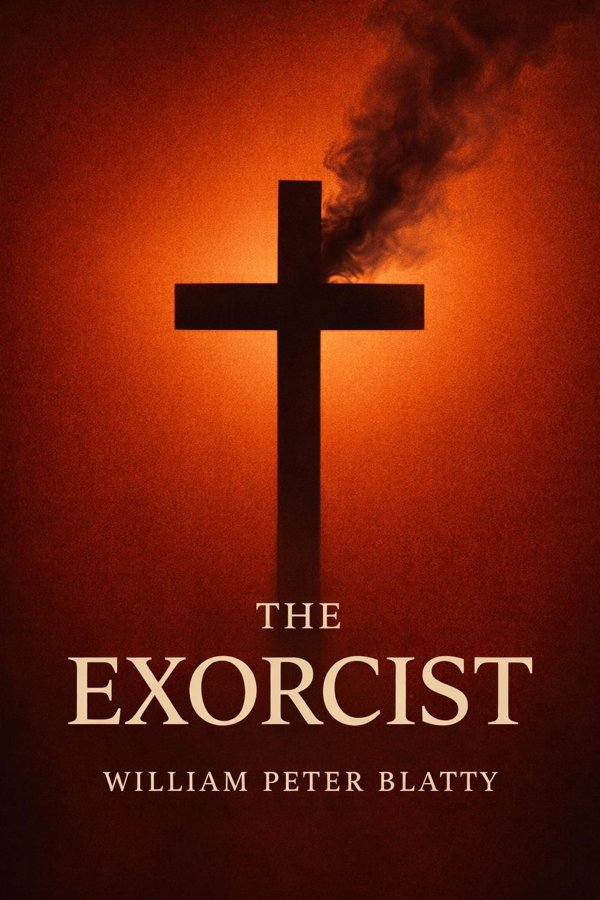
The Exorcist: Summary & Key Insights
 10 min9 chaptersAudio available
Key Takeaways from The Exorcist
Horror is most effective when it invades a life that feels safe, ordinary, and familiar.
The most terrifying transformations are the ones that unfold gradually enough to keep hope alive.
A crisis of faith becomes most compelling when it happens inside someone trained to believe.
One of the novel’s most unsettling claims is that rational systems can be necessary and still insufficient.
Sometimes wisdom returns not as novelty, but as the hard-earned strength to confront what others cannot name.
What Is The Exorcist About?
The Exorcist by William Peter Blatty is a bestsellers book spanning 5 pages. What makes The Exorcist endure is not simply that it is frightening, but that it turns horror into a serious inquiry about faith, suffering, and the reality of evil. William Peter Blatty’s novel begins in a recognizable world: a successful actress, Chris MacNeil, rents a house in Georgetown while working on a film, raising her bright and affectionate daughter Regan in what seems like ordinary comfort. Then small disturbances begin. Strange noises, behavioral changes, medical mysteries, and impossible knowledge slowly push the family beyond reason and into spiritual crisis. What follows is one of modern literature’s most famous confrontations between innocence and corruption, skepticism and belief, despair and sacrifice. Blatty writes with unusual authority because he treats the supernatural not as a gimmick, but as a moral and theological challenge. Drawing on his deep interest in Catholic thought, psychology, and the human need for meaning, he created a novel that works on several levels at once: as a gripping thriller, a psychological drama, and a meditation on whether grace can survive in a world that contains unbearable darkness.
This FizzRead summary covers all 9 key chapters of The Exorcist in approximately 10 minutes, distilling the most important ideas, arguments, and takeaways from William Peter Blatty's work. Also available as an audio summary and Key Quotes Podcast.
The Exorcist
What makes The Exorcist endure is not simply that it is frightening, but that it turns horror into a serious inquiry about faith, suffering, and the reality of evil. William Peter Blatty’s novel begins in a recognizable world: a successful actress, Chris MacNeil, rents a house in Georgetown while working on a film, raising her bright and affectionate daughter Regan in what seems like ordinary comfort. Then small disturbances begin. Strange noises, behavioral changes, medical mysteries, and impossible knowledge slowly push the family beyond reason and into spiritual crisis. What follows is one of modern literature’s most famous confrontations between innocence and corruption, skepticism and belief, despair and sacrifice. Blatty writes with unusual authority because he treats the supernatural not as a gimmick, but as a moral and theological challenge. Drawing on his deep interest in Catholic thought, psychology, and the human need for meaning, he created a novel that works on several levels at once: as a gripping thriller, a psychological drama, and a meditation on whether grace can survive in a world that contains unbearable darkness.
Who Should Read The Exorcist?
This book is perfect for anyone interested in bestsellers and looking to gain actionable insights in a short read. Whether you're a student, professional, or lifelong learner, the key ideas from The Exorcist by William Peter Blatty will help you think differently.
- ✓Readers who enjoy bestsellers and want practical takeaways
- ✓Professionals looking to apply new ideas to their work and life
- ✓Anyone who wants the core insights of The Exorcist in just 10 minutes
Want the full summary?
Get instant access to this book summary and 100K+ more with Fizz Moment.
Get Free SummaryAvailable on App Store • Free to download
Key Chapters
Horror is most effective when it invades a life that feels safe, ordinary, and familiar. That is exactly how The Exorcist begins. Chris MacNeil is a famous actress, intelligent, practical, and busy with film work in Georgetown, Washington, D.C. She is not presented as gullible or melodramatic. She is a modern mother trying to maintain a stable home for her twelve-year-old daughter, Regan, while balancing career demands, social obligations, and the everyday uncertainties of single parenthood. Regan, in turn, is cheerful, affectionate, and deeply human. Their home is warm, cultured, and outwardly secure.
Blatty’s genius lies in how carefully he establishes normal life before disrupting it. The creaking sounds in the attic, the strange moods, and the first unsettling incidents matter because they arise within a believable domestic routine. The novel reminds us that evil does not always announce itself with spectacle. It often begins as inconvenience, confusion, or something easy to dismiss. That pattern is psychologically realistic. In real life, families facing illness, addiction, trauma, or emotional decline rarely recognize the full scale of the problem at once. They explain away symptoms, hope things will improve, and cling to normality.
This opening section also grounds the novel’s larger themes. Chris represents reason, love, and modern skepticism. She wants causes, diagnoses, and solutions. Her instinct is to trust experts and evidence. That makes her ordeal more compelling, because the story does not begin in superstition. It begins in intelligence confronting the inexplicable.
A practical lesson emerges here: when reality begins to shift, take early signs seriously rather than dismissing them because they are inconvenient or frightening. Whether in family life, health, or work, problems often reveal themselves in subtle ways first. The actionable takeaway is simple: pay attention to small disturbances in otherwise normal patterns, and respond with calm curiosity before crisis deepens.
The most terrifying transformations are the ones that unfold gradually enough to keep hope alive. Regan’s change is not immediate theatrical horror; it develops in stages. She becomes moody, then profane, then physically altered in ways that defy medicine and common sense. Her language grows obscene and unnervingly adult. Her knowledge becomes impossible. Her body and voice no longer seem fully her own. The child Chris loves remains present enough to be mourned, yet absent enough to terrify.
Blatty understands that the unseen is often more disturbing than what is fully explained. Before possession is named, it is felt through disruption: the sense that personality has been invaded, that identity is unstable, that the boundaries of the self can be breached. This is why the novel resonates beyond supernatural horror. Regan’s condition can also be read as a metaphor for experiences families cannot control or fully understand, such as mental illness, trauma, severe behavioral change, or the collapse of trust in what once felt certain.
The procession of doctors, tests, and specialists is crucial. Blatty does not rush past science; he lets science exhaust itself. That process intensifies the fear because every rational avenue is tried before the supernatural explanation emerges. In practical terms, the novel honors disciplined inquiry while acknowledging that not every crisis yields quickly to established systems. It portrays what happens when evidence accumulates but meaning remains elusive.
For readers, this idea has clear application. When confronting a disturbing change in someone you love, avoid simplistic conclusions. Investigate thoroughly. Seek medical, psychological, and relational understanding before embracing extreme explanations. Yet also recognize the emotional truth that some experiences exceed our categories and require humility. The actionable takeaway: face difficult realities step by step, combining evidence, patience, and openness when ordinary explanations fail.
A crisis of faith becomes most compelling when it happens inside someone trained to believe. Father Damien Karras is one of the novel’s most important achievements because he is not a simplistic holy hero. He is a Jesuit priest and psychiatrist, intellectually serious, emotionally exhausted, and spiritually fractured. He mourns his mother, feels guilty for not caring for her better, and suffers from an interior emptiness that leaves him vulnerable to despair. If Chris represents modern rationality confronting the supernatural, Karras represents religious vocation confronting silence.
His doubt is central to the novel’s power. Karras does not glide into the case as a fearless exorcist. He resists. He questions. He suspects psychological illness, fraud, or projection. In this way, Blatty turns faith into struggle rather than certainty. Karras’s priesthood does not spare him from grief, anxiety, or skepticism. Instead, those wounds make him more human and ultimately more capable of compassion. He is torn between the desire for proof and the ache for transcendence.
This makes Karras deeply relevant to modern readers. Many people assume belief and doubt are opposites, but The Exorcist suggests they often coexist. Professionals, parents, caregivers, and spiritual seekers all face moments when the frameworks that once guided them seem thin. Karras shows that doubt need not mean moral failure. It can become the terrain through which courage, honesty, and commitment are tested.
In practical life, his journey encourages intellectual integrity. He does not abandon reason, but neither does he idolize it. He learns that true responsibility may require both analysis and moral presence. The actionable takeaway: when your convictions feel unstable, do not confuse uncertainty with defeat. Examine your doubts seriously, stay present to suffering, and let honest struggle refine rather than erase your deepest commitments.
One of the novel’s most unsettling claims is that rational systems can be necessary and still insufficient. Before turning to the Church, Chris pursues every modern solution available. Regan is examined by doctors, psychiatrists, and specialists. Tests are run. Diagnoses are proposed and discarded. The medical world is depicted neither as foolish nor villainous. On the contrary, it is diligent, procedural, and sincere. Yet each explanation eventually fails to contain the reality before it.
This tension gives The Exorcist much of its intellectual depth. Blatty is not arguing that science is worthless. He is showing that scientific methods answer certain kinds of questions very well, while other dimensions of human experience may resist reduction. Medicine can measure symptoms, but not always the full meaning of suffering. Psychology can interpret behavior, but not always exhaust what a person or family is experiencing. In the novel, skepticism performs an essential function by filtering out hysteria and forcing discipline. But skepticism becomes inadequate when it refuses the possibility that reality might exceed existing categories.
In modern life, this lesson applies widely. A workplace problem may be treated as a technical issue when it is really a moral one. A family conflict may be analyzed behaviorally while the deeper wound remains spiritual or relational. A person may optimize productivity while neglecting grief, guilt, or purpose. The Exorcist invites readers to respect expertise without surrendering to a worldview so narrow that mystery becomes impossible.
The healthiest response is integration. Seek evidence. Consult experts. Use reason. But also ask larger questions: What kind of suffering is this? What moral and emotional realities are present? What does healing require beyond diagnosis? The actionable takeaway: trust rational tools fully within their domain, yet remain humble enough to recognize when a crisis demands wisdom, not just explanation.
Sometimes wisdom returns not as novelty, but as the hard-earned strength to confront what others cannot name. Father Lankester Merrin enters The Exorcist with an almost mythic gravity. Unlike Karras, whose struggle is internal and unresolved, Merrin arrives shaped by prior encounters with evil and by a profound awareness of what is at stake. His presence changes the atmosphere of the novel because he understands that the battle is not merely about symptoms, spectacle, or even Regan’s body. It is a contest aimed at the soul, at hope, and at the humiliation of human dignity.
Merrin’s significance lies in his clarity. He recognizes that demonic force seeks more than destruction; it seeks demoralization. It wants observers to despair, to lose faith in goodness, and to believe human beings are filthy, weak, and abandoned. This insight transforms the exorcism from a dramatic ritual into a theological confrontation. The priests are not magicians. They are men standing against a power that feeds on fear, blasphemy, and exhaustion.
In practical terms, Merrin represents the value of seasoned guidance. In moments of severe crisis, knowledge alone may not be enough; people also need steadiness, perspective, and moral courage borrowed from someone who has endured darkness before. This can apply to therapy, mentorship, leadership, caregiving, or spiritual direction. Experience matters not because it eliminates danger, but because it prevents panic from becoming the dominant force.
Merrin also teaches restraint. He does not indulge the demon’s theatrics or debate its insults. He stays fixed on purpose. Readers can apply this to many modern pressures, from online hostility to manipulative relationships: not every provocation deserves engagement. The actionable takeaway: in serious conflict, seek grounded mentors, focus on the deeper objective, and refuse to let chaos dictate your attention.
Real love is tested not by sentiment, but by what it is willing to suffer for another person. The climax of The Exorcist is unforgettable not simply because it is dramatic, but because it reveals sacrifice as the novel’s deepest moral logic. Chris endures humiliation, terror, and helplessness for Regan’s sake. Merrin gives his weakened body to a brutal spiritual struggle. Karras, after wavering through doubt and grief, ultimately acts with decisive self-giving courage. In each case, love becomes costly, embodied, and redemptive.
Blatty’s treatment of sacrifice avoids abstraction. It is exhausting, frightening, and often lonely. No character gains easy triumph. The battle leaves scars. That realism matters because it prevents redemption from feeling cheap. The novel suggests that evil is not defeated by superior cleverness alone, but by the willingness to bear pain without surrendering one’s humanity. Karras’s final act is especially powerful because it fuses compassion, faith, and moral agency in one moment. He cannot solve the mystery of evil intellectually, but he can choose what he offers in response.
This idea has broad relevance beyond religion. Parents sacrifice sleep, freedom, and certainty for children. Caregivers absorb emotional strain for the vulnerable. Ethical leaders accept personal cost to protect others. Even in ordinary life, meaningful love often requires inconvenience, discipline, and endurance rather than emotion alone.
The novel therefore asks a hard question: what are we prepared to give when someone we love is suffering? Not every crisis demands heroic extremity, but many demand presence, courage, and the refusal to abandon another person when help becomes difficult. The actionable takeaway: measure love less by feeling and more by faithful action, especially when care becomes costly.
Evil in The Exorcist is frightening not only because it causes pain, but because it desecrates what should be innocent, sacred, and human. The possessing force does not behave like a simple monster. It taunts, mimics, humiliates, and degrades. It turns Regan’s body and voice into instruments of mockery. It weaponizes obscenity, false intimacy, hidden knowledge, and emotional cruelty. Blatty thereby portrays evil as parasitic: it cannot create goodness, so it corrupts what already exists.
This conception gives the novel lasting philosophical force. Evil is shown as distortion rather than independent majesty. It twists language, love, memory, and religious symbols into tools of despair. That pattern matters because many destructive forces in real life operate similarly. Abuse often begins with manipulation of trust. Propaganda corrupts language. Cynicism degrades ideals until people stop believing integrity is possible. Addiction can distort desire until pleasure becomes compulsion. In each case, something human is not merely destroyed but bent out of shape.
Blatty’s insight is therefore morally practical. To resist corruption, one must notice how degradation presents itself. It often arrives disguised as humor, sophistication, liberation, or power. The demon’s mockery aims to make dignity look ridiculous and reverence look weak. Once people internalize that message, resistance becomes harder because they begin cooperating with their own diminishment.
The antidote is seriousness about the value of the person. Protect language. Protect innocence. Protect boundaries. Refuse to normalize humiliation simply because it is loud or entertaining. The actionable takeaway: watch for forms of corruption that begin by mocking what is good, and respond early by defending dignity, truth, and moral clarity in everyday life.
The emotional center of The Exorcist is not the ritual but the relationship between mother and child. Chris MacNeil’s ordeal gives the novel much of its enduring pathos because her terror is inseparable from helpless love. She cannot reason Regan back to health, protect her through status, or outsource her fear to experts. She is forced to witness suffering she cannot stop. That experience captures one of the most painful truths of human life: loving deeply always exposes us to vulnerability.
Chris is a particularly compelling character because she is competent, independent, and worldly. Yet none of those strengths shield her from maternal anguish. Blatty uses her perspective to show how modern confidence collapses when someone precious is threatened. Her desperation also humanizes the novel’s theological material. Before The Exorcist becomes a story about priests and ritual, it is a story about a mother trying everything possible to save her daughter.
Readers can apply this insight beyond parenting. Any meaningful attachment creates risk. Friendship, marriage, caregiving, and community all involve the possibility that another person’s suffering will wound us. Many people try to avoid that pain through detachment, control, or emotional distance. But The Exorcist suggests that vulnerability is not a weakness to eliminate; it is part of what makes love real.
At the same time, Chris demonstrates the importance of persistence. She does not surrender when solutions fail. She keeps seeking help, even when exhausted and frightened. In practical life, that kind of advocacy matters enormously for loved ones facing illness, crisis, or confusion. The actionable takeaway: accept that love makes you vulnerable, and let that vulnerability deepen your commitment to show up, ask for help, and keep searching for the care someone needs.
The Exorcist endures because it uses fear not as an endpoint, but as a doorway into larger questions. Beneath the shocks and supernatural dread lies a serious meditation on whether the universe is morally meaningful. If evil is real, then what resources does humanity have to confront it? If suffering appears senseless, can faith still be rational? If doubt persists, can action still be redemptive? Blatty’s answer is complex: terror strips away illusion, but it can also force a confrontation with ultimate things.
This is why the novel has attracted readers far beyond horror fans. Its lasting power comes from the fusion of suspense with metaphysical seriousness. Fear becomes clarifying. Characters are pushed beyond comfort, theory, and self-image until what remains is character, conviction, and the need for grace. Importantly, faith in the novel is not presented as naïve certainty. It is battle-tested, costly, and often born in the very place where certainty collapses.
In contemporary life, people often distract themselves from existential questions with busyness, entertainment, and analysis. Crisis interrupts that pattern. Illness, loss, failure, or trauma can suddenly expose the fragility of the frameworks we rely on. While such moments are painful, they can also provoke moral and spiritual honesty. We ask what truly matters, what we trust, and what we are living for.
The novel does not demand one religious conclusion from every reader, but it does insist that fear can awaken seriousness. Instead of merely fleeing discomfort, we can let it reveal our hidden assumptions. The actionable takeaway: when fear exposes the limits of your control, use that moment to ask deeper questions about meaning, commitment, and the kind of hope you want to live by.
All Chapters in The Exorcist
About the Author
William Peter Blatty (1928–2017) was an American writer, screenwriter, and filmmaker whose work combined sharp storytelling with serious spiritual and philosophical inquiry. Born in New York City to Lebanese immigrant parents, he studied at Georgetown University, an influence that later shaped the setting and atmosphere of The Exorcist. Before becoming famous for horror, Blatty wrote humorous books and screenplays, showing a versatility that remained visible in his precise dialogue and narrative control. His 1971 novel The Exorcist became an international phenomenon, and he later wrote and produced its acclaimed film adaptation, which won Academy Awards and transformed modern horror cinema. Across his career, Blatty returned repeatedly to themes of faith, evil, doubt, and redemption, making him a distinctive voice in both popular and literary storytelling.
Get This Summary in Your Preferred Format
Read or listen to the The Exorcist summary by William Peter Blatty anytime, anywhere. FizzRead offers multiple formats so you can learn on your terms — all free.
Available formats: App · Audio · PDF · EPUB — All included free with FizzRead
Download The Exorcist PDF and EPUB Summary
Key Quotes from The Exorcist
“Horror is most effective when it invades a life that feels safe, ordinary, and familiar.”
“The most terrifying transformations are the ones that unfold gradually enough to keep hope alive.”
“A crisis of faith becomes most compelling when it happens inside someone trained to believe.”
“One of the novel’s most unsettling claims is that rational systems can be necessary and still insufficient.”
“Sometimes wisdom returns not as novelty, but as the hard-earned strength to confront what others cannot name.”
Frequently Asked Questions about The Exorcist
The Exorcist by William Peter Blatty is a bestsellers book that explores key ideas across 9 chapters. What makes The Exorcist endure is not simply that it is frightening, but that it turns horror into a serious inquiry about faith, suffering, and the reality of evil. William Peter Blatty’s novel begins in a recognizable world: a successful actress, Chris MacNeil, rents a house in Georgetown while working on a film, raising her bright and affectionate daughter Regan in what seems like ordinary comfort. Then small disturbances begin. Strange noises, behavioral changes, medical mysteries, and impossible knowledge slowly push the family beyond reason and into spiritual crisis. What follows is one of modern literature’s most famous confrontations between innocence and corruption, skepticism and belief, despair and sacrifice. Blatty writes with unusual authority because he treats the supernatural not as a gimmick, but as a moral and theological challenge. Drawing on his deep interest in Catholic thought, psychology, and the human need for meaning, he created a novel that works on several levels at once: as a gripping thriller, a psychological drama, and a meditation on whether grace can survive in a world that contains unbearable darkness.
You Might Also Like
The Godfather
Mario Puzo
10 min
The Handmaid's Tale
Margaret Atwood
10 min
The Hunger Games
Suzanne Collins
10 min
The Nightingale
Kristin Hannah
10 min
The Seven Husbands of Evelyn Hugo
Taylor Jenkins Reid
10 min
Backwater Justice
Fern Michaels
10 minBrowse by Category
Ready to read The Exorcist?
Get the full summary and 100K+ more books with Fizz Moment.