
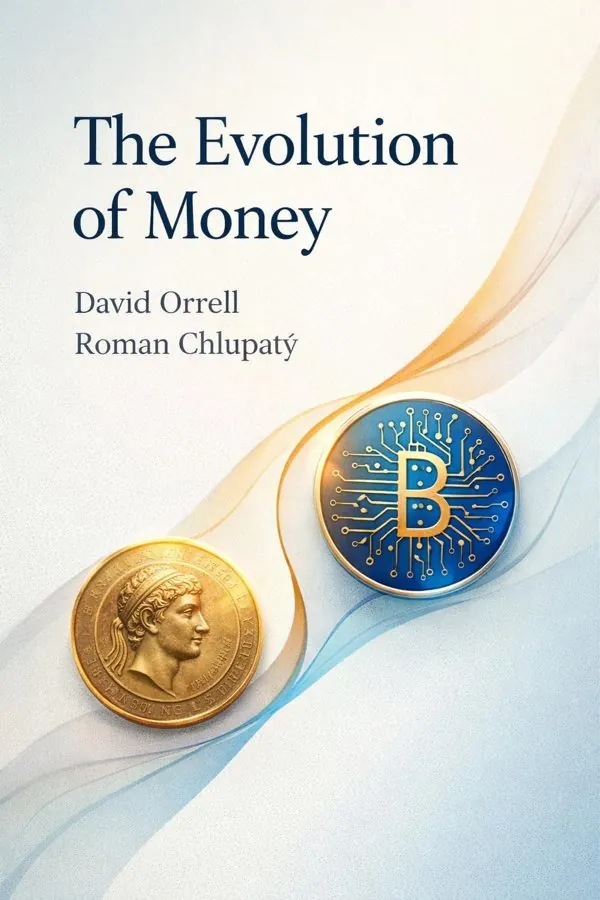
The Evolution of Money: Summary & Key Insights
by David Orrell, Roman Chlupatý
 10 min10 chaptersAudio available
Key Takeaways from The Evolution of Money
The most surprising truth about money is that it did not begin as cold calculation.
If you want to understand a society, follow who gets to create, tax, and regulate money.
Money is often treated as purely practical, but throughout history it has been loaded with ethical, spiritual, and philosophical meaning.
One of the biggest misunderstandings about money is the belief that banks simply move around existing savings.
Money became something different in the industrial age: not just a medium of exchange, but the operating system of a machine-driven economy.
What Is The Evolution of Money About?
The Evolution of Money by David Orrell, Roman Chlupatý is a economics book spanning 10 pages. Money seems ordinary only because it is everywhere. We use it to buy food, pay rent, measure success, and organize entire economies, yet few of us stop to ask what money really is, where it came from, or why it commands such power over human life. In The Evolution of Money, David Orrell and Roman Chlupatý take readers on a sweeping intellectual journey from ancient gift economies and early state coinage to modern banking, financial crises, and cryptocurrencies. Their central argument is that money is not merely a neutral tool of exchange. It is a social technology shaped by politics, culture, religion, information, and power. What makes this book especially valuable is the range of perspectives it brings together. Orrell’s background in mathematics and complex systems helps explain why financial systems behave in unpredictable and fragile ways, while Chlupatý’s expertise in economics and global markets grounds the discussion in real-world institutions and trends. The result is a thoughtful, accessible exploration of how money has evolved and why its future matters. For anyone trying to understand inequality, debt, banking, inflation, or digital currencies, this book offers a clearer lens on the forces shaping modern life.
This FizzRead summary covers all 10 key chapters of The Evolution of Money in approximately 10 minutes, distilling the most important ideas, arguments, and takeaways from David Orrell, Roman Chlupatý's work. Also available as an audio summary and Key Quotes Podcast.
The Evolution of Money
Money seems ordinary only because it is everywhere. We use it to buy food, pay rent, measure success, and organize entire economies, yet few of us stop to ask what money really is, where it came from, or why it commands such power over human life. In The Evolution of Money, David Orrell and Roman Chlupatý take readers on a sweeping intellectual journey from ancient gift economies and early state coinage to modern banking, financial crises, and cryptocurrencies. Their central argument is that money is not merely a neutral tool of exchange. It is a social technology shaped by politics, culture, religion, information, and power.
What makes this book especially valuable is the range of perspectives it brings together. Orrell’s background in mathematics and complex systems helps explain why financial systems behave in unpredictable and fragile ways, while Chlupatý’s expertise in economics and global markets grounds the discussion in real-world institutions and trends. The result is a thoughtful, accessible exploration of how money has evolved and why its future matters. For anyone trying to understand inequality, debt, banking, inflation, or digital currencies, this book offers a clearer lens on the forces shaping modern life.
Who Should Read The Evolution of Money?
This book is perfect for anyone interested in economics and looking to gain actionable insights in a short read. Whether you're a student, professional, or lifelong learner, the key ideas from The Evolution of Money by David Orrell, Roman Chlupatý will help you think differently.
- ✓Readers who enjoy economics and want practical takeaways
- ✓Professionals looking to apply new ideas to their work and life
- ✓Anyone who wants the core insights of The Evolution of Money in just 10 minutes
Want the full summary?
Get instant access to this book summary and 100K+ more with Fizz Moment.
Get Free SummaryAvailable on App Store • Free to download
Key Chapters
The most surprising truth about money is that it did not begin as cold calculation. Before markets became dominant, many societies were organized around reciprocity, obligation, and gift exchange rather than impersonal trade. People did not necessarily swap one object directly for another in a system of universal barter. Instead, they built webs of trust: families shared resources, neighbors helped one another, and social status often came from giving, not hoarding. In that sense, the earliest forms of economic life were less about price and more about relationship.
This matters because it challenges the familiar story that money naturally emerged to solve the inconvenience of barter. Orrell and Chlupatý show that money arose within social structures, political systems, and moral ideas. Long before a coin existed, communities already had ways to record value through memory, ritual, and obligation. A favor owed, a contribution to a feast, or a tribute to a ruler could all function like economic claims. Money later formalized and standardized these claims, but it did not invent them from nothing.
You can still see this older logic today. Parents lend children money without interest. Friends split costs unevenly and settle up later. Online communities exchange time, support, and reputation in ways that are only partly monetary. Even modern banking depends on trust, promises, and expectations as much as on physical cash.
The practical lesson is simple: when thinking about money, look beyond coins, bills, or apps. Ask what network of trust, obligation, or authority gives it meaning. Actionable takeaway: treat money not just as a thing you possess, but as a social relationship you participate in.
If you want to understand a society, follow who gets to create, tax, and regulate money. The evolution of money has always been bound up with authority. As kingdoms and states became more complex, rulers recognized that monetary control was a powerful way to organize armies, collect tribute, fund public works, and enforce hierarchy. Coinage was never just a convenience for trade; it was also a political technology. A ruler’s face on a coin signaled sovereignty, and taxes payable in that currency created demand for it.
This insight helps explain why monetary systems are rarely neutral. Governments and elites often shape them in ways that benefit certain groups over others. Control over minting, banking licenses, interest rates, and debt laws influences who can borrow, who bears risk, and who has access to opportunity. Money therefore acts as an instrument of governance as much as exchange.
Modern examples are everywhere. Central banks can lower interest rates to support growth or raise them to fight inflation, affecting jobs, mortgages, and asset prices. Sanctions can cut countries off from global payment systems. During crises, states often rescue banks because monetary stability is tied to political stability. Even debates over digital currencies are really debates about who should control the infrastructure of finance: governments, commercial banks, tech firms, or decentralized networks.
Readers can apply this by becoming more attentive to the institutional side of money. Instead of asking only how much things cost, ask who defines the rules of credit, taxation, and payment. Actionable takeaway: whenever you hear a policy about inflation, debt, or digital currency, identify the power structure behind it before judging its fairness.
Money is often treated as purely practical, but throughout history it has been loaded with ethical, spiritual, and philosophical meaning. Different civilizations have asked whether wealth is virtuous or corrupting, whether interest is productive or exploitative, and whether economic value should be measured in material gain or human flourishing. These debates are not side notes to monetary history; they are part of its core.
Religious traditions frequently shaped attitudes toward debt, charity, usury, and ownership. In medieval Christianity, lending at interest was often condemned because money was seen as sterile and its multiplication as morally suspicious. Islamic finance developed its own principles limiting interest and emphasizing risk-sharing. Classical philosophers also worried that the pursuit of money could distort civic life by turning means into ends. Once wealth accumulation becomes society’s main objective, other values such as justice, duty, and community can weaken.
These older concerns remain highly relevant. Consider payday lending, speculative bubbles, or executive compensation detached from social contribution. Even today, people argue not only about how finance works but about whether it serves the common good. Ethical investing, microfinance, and environmental, social, and governance frameworks all reflect the idea that money should be judged morally, not just technically.
For individuals, this means financial decisions are never only financial. Where you save, invest, donate, or borrow expresses a view about what matters. Actionable takeaway: create a personal money philosophy by writing down three values you want your financial choices to support, such as security, fairness, generosity, or sustainability.
One of the biggest misunderstandings about money is the belief that banks simply move around existing savings. In reality, modern finance transformed money into a system largely based on credit creation. When banks make loans, they do not merely lend out preexisting cash; they often create new money in the process by expanding deposits. This shift changed the scale and speed of economic life. Money became less a physical object and more a dynamic web of promises, balance sheets, and institutional trust.
This development fueled growth, entrepreneurship, and industrial expansion. Businesses could borrow to invest before earning profits. Households could finance homes, education, or consumption. Governments could issue debt to fund infrastructure or war. But the same mechanism also introduced fragility. If money is built on credit, then confidence becomes essential. Bank runs, defaults, and liquidity crises occur when people stop believing those promises will be honored.
You can see this in everyday life. Mortgages create housing booms, but excessive lending can inflate bubbles. Credit cards increase spending flexibility, but they can also trap households in long-term debt. Venture capital can finance innovation, yet easy money can encourage speculation detached from productive value.
Understanding credit changes how you read the economy. Growth is not simply about producing more goods; it often depends on expanding future claims. That can be useful, but it can also become unsustainable if debt outpaces real capacity.
Actionable takeaway: review your financial life through a credit lens. List every form of debt and every institution you rely on, then ask which obligations support long-term value and which merely pull future income into the present.
Gold has long appealed to the human imagination because it seems tangible, scarce, and outside political manipulation. For that reason, many people view the gold standard as the ideal monetary system: disciplined, honest, and stable. But Orrell and Chlupatý show that this nostalgia is misleading. Tying money to gold did create constraints, yet those constraints often transferred stress into the real economy. Stability in theory did not always mean resilience in practice.
Under the gold standard, governments and central banks had less flexibility to respond to recessions, banking panics, or wartime needs. Because currencies were linked to fixed quantities of gold, countries often had to prioritize convertibility over employment or social stability. Deflation could become severe, debt burdens heavier, and recovery slower. The collapse of the gold standard revealed that modern economies needed a more elastic monetary system able to respond to changing conditions.
This is not just a historical point. Whenever people call for a return to hard money, they are usually expressing distrust of governments and central banks. That concern can be valid. Inflation, currency debasement, and irresponsible borrowing are real risks. But hard constraints can create their own dangers if they prevent adaptation during crisis.
A practical example is household finance. Strict rules can prevent overspending, but extreme rigidity can make emergencies harder to manage. The same is true for economies. Discipline matters, but so does flexibility.
Actionable takeaway: be skeptical of any monetary system marketed as a perfect anchor. Ask not only how it limits abuse, but also how it handles shock, crisis, and human complexity.
Financial crises rarely come from one bad actor or one isolated mistake. More often, they emerge from complexity itself. Modern monetary systems are densely interconnected networks of banks, borrowers, investors, regulators, technologies, and narratives. Because these parts influence one another, small shocks can cascade into large failures. A default in one sector can trigger forced selling in another. A rumor can become a run. Confidence can vanish faster than institutions can respond.
Orrell’s background in complex systems is especially useful here. Traditional economics often imagines markets tending toward equilibrium, but real financial systems behave more like unstable ecosystems. Feedback loops, herd behavior, leverage, and opacity can amplify volatility. The 2008 global financial crisis is a classic example: risky mortgages were bundled into securities, spread across institutions, misunderstood by investors, and magnified by debt. What seemed diversified turned out to be tightly linked.
This matters because many people still assume that more sophisticated finance automatically means better risk management. In fact, complexity can conceal vulnerability. New products may distribute risk, but they can also make it harder to see where risk truly sits. The same dynamic now applies to algorithmic trading, shadow banking, and global capital flows.
Individuals can learn from this by avoiding blind faith in systems that appear efficient but are hard to understand. Diversification, liquidity, and simplicity are underrated forms of resilience.
Actionable takeaway: stress-test your own finances. Ask what happens if income drops, markets fall, or credit tightens. Build buffers in cash, reduce unnecessary leverage, and avoid investments you cannot explain in plain language.
The rise of digital and virtual money is not just a technological upgrade; it is a battle over trust, architecture, and control. As money moves from paper and bank ledgers toward apps, platforms, cryptocurrencies, and potential central bank digital currencies, the question becomes: who operates the system, who sees the data, and who sets the rules? The form of money is changing, but so are the institutions behind it.
Cryptocurrencies emerged partly as a response to dissatisfaction with traditional finance. They promise decentralized verification, limited supply, and reduced dependence on banks or states. For supporters, this offers freedom and resilience. For critics, it introduces volatility, speculation, and governance problems of its own. Meanwhile, mobile payment systems and fintech platforms increase convenience but can concentrate power in private networks. Central bank digital currencies could improve efficiency and inclusion, yet they also raise concerns about surveillance and state control.
The practical implications are already visible. Consumers can send payments instantly, hold multiple forms of digital value, or participate in online economies that barely existed a decade ago. But they also face cyber risks, scams, unstable tokens, and changing regulation. The future of money may be faster and smarter, but not automatically fairer.
The key insight is that every monetary innovation solves some problems while creating others. Convenience can reduce friction, but it can also reduce privacy. Decentralization can expand access, but it can also shift responsibility onto users.
Actionable takeaway: before adopting any digital currency or payment platform, ask three questions: who guarantees it, how secure is it, and what rights or data am I giving up in exchange for convenience?
Perhaps the book’s most important conclusion is that money is not a finished invention. It keeps evolving because societies keep changing. New technologies, environmental pressures, geopolitical shifts, demographic trends, and social values will all shape what money becomes next. That means the future of money is not something we merely predict; it is something we collectively design through policy, innovation, and public debate.
Orrell and Chlupatý encourage readers to move beyond simplistic binaries such as state versus market or cash versus crypto. The real challenge is building monetary systems that are not only efficient, but also legitimate, inclusive, and stable. A good system should support productive activity rather than endless speculation, distribute opportunity more fairly, and remain adaptable in times of shock. It should recognize that money is embedded in society and cannot be treated as an isolated machine.
This forward-looking view has practical importance. Questions about inflation, public debt, digital identity, climate finance, and global inequality are all, in part, questions about money design. How should credit be directed? Who gets access to liquidity? What forms of value should be rewarded? These are political and ethical choices, not just technical ones.
For readers, the empowering message is that monetary literacy is a form of citizenship. Understanding money helps you interpret policy, evaluate innovation, and protect your own interests in a rapidly changing world.
Actionable takeaway: follow money as an active observer, not a passive user. Pick one issue, such as inflation, central bank digital currencies, or housing finance, and learn how monetary design affects your daily life and your society.
All Chapters in The Evolution of Money
About the Authors
David Orrell is a Canadian mathematician, author, and researcher known for his work on complexity, economics, and the limits of prediction. His writing often explores how financial and economic systems behave in ways that traditional models fail to capture, making him a distinctive voice in contemporary economic thought. Roman Chlupatý is a Czech economist, journalist, and consultant specializing in financial markets, global trends, and policy analysis. He has written extensively on international economics and brings a practical understanding of how monetary systems operate in the real world. Together, Orrell and Chlupatý combine analytical depth with broad historical and social insight, making The Evolution of Money both intellectually rigorous and highly accessible to general readers.
Get This Summary in Your Preferred Format
Read or listen to the The Evolution of Money summary by David Orrell, Roman Chlupatý anytime, anywhere. FizzRead offers multiple formats so you can learn on your terms — all free.
Available formats: App · Audio · PDF · EPUB — All included free with FizzRead
Download The Evolution of Money PDF and EPUB Summary
Key Quotes from The Evolution of Money
“The most surprising truth about money is that it did not begin as cold calculation.”
“If you want to understand a society, follow who gets to create, tax, and regulate money.”
“Money is often treated as purely practical, but throughout history it has been loaded with ethical, spiritual, and philosophical meaning.”
“One of the biggest misunderstandings about money is the belief that banks simply move around existing savings.”
“Money became something different in the industrial age: not just a medium of exchange, but the operating system of a machine-driven economy.”
Frequently Asked Questions about The Evolution of Money
The Evolution of Money by David Orrell, Roman Chlupatý is a economics book that explores key ideas across 10 chapters. Money seems ordinary only because it is everywhere. We use it to buy food, pay rent, measure success, and organize entire economies, yet few of us stop to ask what money really is, where it came from, or why it commands such power over human life. In The Evolution of Money, David Orrell and Roman Chlupatý take readers on a sweeping intellectual journey from ancient gift economies and early state coinage to modern banking, financial crises, and cryptocurrencies. Their central argument is that money is not merely a neutral tool of exchange. It is a social technology shaped by politics, culture, religion, information, and power. What makes this book especially valuable is the range of perspectives it brings together. Orrell’s background in mathematics and complex systems helps explain why financial systems behave in unpredictable and fragile ways, while Chlupatý’s expertise in economics and global markets grounds the discussion in real-world institutions and trends. The result is a thoughtful, accessible exploration of how money has evolved and why its future matters. For anyone trying to understand inequality, debt, banking, inflation, or digital currencies, this book offers a clearer lens on the forces shaping modern life.
You Might Also Like

Business Adventures
John Brooks
10 min
Nudge
Richard H. Thaler, Cass R. Sunstein
10 min
The Hitchhiker"s Guide to the Galaxy
Douglas Adams
10 minThe Muqaddimah
Ibn Khaldun
10 minThe Outsiders
William N. Thorndike
10 min
A Little History of Economics
Niall Kishtainy
10 minBrowse by Category
Ready to read The Evolution of Money?
Get the full summary and 100K+ more books with Fizz Moment.