
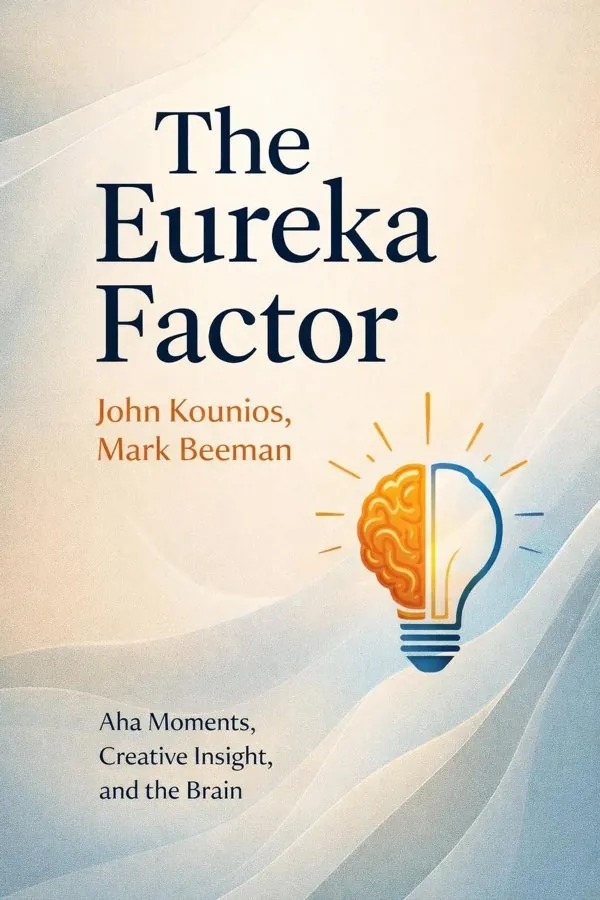
The Eureka Factor: Aha Moments, Creative Insight, and the Brain: Summary & Key Insights
 10 min6 chaptersAudio available
What Is The Eureka Factor: Aha Moments, Creative Insight, and the Brain About?
The Eureka Factor: Aha Moments, Creative Insight, and the Brain by John Kounios, Mark Beeman is a neuroscience book spanning 6 pages. The Eureka Factor explores the neuroscience behind sudden creative insights, or 'aha moments.' Cognitive neuroscientists John Kounios and Mark Beeman reveal how the brain generates these flashes of inspiration, what conditions foster them, and how individuals can cultivate environments that enhance creativity and problem-solving. Drawing on decades of research, the book connects brain science with real-world creativity in art, science, and everyday life.
This FizzRead summary covers all 6 key chapters of The Eureka Factor: Aha Moments, Creative Insight, and the Brain in approximately 10 minutes, distilling the most important ideas, arguments, and takeaways from John Kounios, Mark Beeman's work. Also available as an audio summary and Key Quotes Podcast.
The Eureka Factor: Aha Moments, Creative Insight, and the Brain
The Eureka Factor explores the neuroscience behind sudden creative insights, or 'aha moments.' Cognitive neuroscientists John Kounios and Mark Beeman reveal how the brain generates these flashes of inspiration, what conditions foster them, and how individuals can cultivate environments that enhance creativity and problem-solving. Drawing on decades of research, the book connects brain science with real-world creativity in art, science, and everyday life.
Who Should Read The Eureka Factor: Aha Moments, Creative Insight, and the Brain?
This book is perfect for anyone interested in neuroscience and looking to gain actionable insights in a short read. Whether you're a student, professional, or lifelong learner, the key ideas from The Eureka Factor: Aha Moments, Creative Insight, and the Brain by John Kounios, Mark Beeman will help you think differently.
- ✓Readers who enjoy neuroscience and want practical takeaways
- ✓Professionals looking to apply new ideas to their work and life
- ✓Anyone who wants the core insights of The Eureka Factor: Aha Moments, Creative Insight, and the Brain in just 10 minutes
Want the full summary?
Get instant access to this book summary and 100K+ more with Fizz Moment.
Get Free SummaryAvailable on App Store • Free to download
Key Chapters
Throughout history, sudden insight has been celebrated as divine inspiration. Archimedes’ shout of 'Eureka!' still echoes as the symbol of discovery. Yet we now understand that these moments, though seemingly mystical, have biological foundations. When we examine scientists like Kekulé, who dreamed of a snake biting its tail to reveal the structure of benzene, or artists describing spontaneous vision, a common thread emerges: insight often comes after long struggle, when conscious effort quiets and the subconscious speaks.
In my own research, I’ve seen how culture shapes the way we interpret these flashes. In ancient Greece, insight was attributed to the gods; in modern science, we seek neural correlates. But the internal experience remains the same—a moment of sudden coherence. What fascinates me is that across centuries, people have noticed the relationship between relaxation and revelation. Archimedes was bathing. Kekulé was daydreaming. Insight tends to arrive when the analytical mind loosens its grip, allowing diffuse networks to recombine information in novel ways.
This understanding reshapes our cultural view of creativity. Insight is not reserved for geniuses; it is a universal cognitive phenomenon. By studying its biology, we invite everyone to participate in what once seemed divine. It democratizes creativity, showing that every brain is wired for discovery.
At the core of *The Eureka Factor* lies the scientific quest to pinpoint what happens inside the brain at that moment of realization. Our laboratory studies use puzzles designed so that participants may solve them either analytically or through sudden insight. While EEG and fMRI record their brain activity, we observe patterns that distinguish these forms of problem-solving.
The right temporal lobe, particularly in the anterior superior region, consistently lights up just before people report an 'aha!' moment. This region is specialized for integrating distant associations—linking seemingly unrelated ideas. Simultaneously, we see reduced activity in the left hemisphere’s language centers, reflecting the temporary suspension of deliberate analysis. The anterior cingulate cortex also activates, signaling conflict monitoring and a readiness to restructure perception. In other words, the brain quite literally reorganizes itself, preparing to accept a new way of seeing.
An insightful solution is fast, holistic, and emotionally charged. Unlike analytical reasoning—step-by-step and deliberate—insight arrives fully formed. Neuroimaging confirms this: gamma-band bursts in right temporal areas precede conscious awareness, as if the brain knows the answer milliseconds before the mind does. These findings reveal that insight is rooted in unconscious processing; our brains are continuously exploring possibilities beneath awareness, primed to deliver a solution when patterns align.
Understanding this mechanism lets us respect the dance between analysis and intuition. Analytical problem-solving relies more on systematic prefrontal control, while insight depends on flexible, associative networks. Knowing when to engage each mode—when to focus and when to release—is key to cultivating creative excellence.
+ 4 more chapters — available in the FizzRead app
All Chapters in The Eureka Factor: Aha Moments, Creative Insight, and the Brain
About the Authors
John Kounios is a professor of psychology at Drexel University and director of its Creativity Research Lab. Mark Beeman is a professor of psychology at Northwestern University, known for his research on the neural basis of insight and creativity. Together, they have collaborated extensively on studies exploring how the brain produces sudden moments of understanding.
Get This Summary in Your Preferred Format
Read or listen to the The Eureka Factor: Aha Moments, Creative Insight, and the Brain summary by John Kounios, Mark Beeman anytime, anywhere. FizzRead offers multiple formats so you can learn on your terms — all free.
Available formats: App · Audio · PDF · EPUB — All included free with FizzRead
Download The Eureka Factor: Aha Moments, Creative Insight, and the Brain PDF and EPUB Summary
Key Quotes from The Eureka Factor: Aha Moments, Creative Insight, and the Brain
“Throughout history, sudden insight has been celebrated as divine inspiration.”
“At the core of *The Eureka Factor* lies the scientific quest to pinpoint what happens inside the brain at that moment of realization.”
Frequently Asked Questions about The Eureka Factor: Aha Moments, Creative Insight, and the Brain
The Eureka Factor: Aha Moments, Creative Insight, and the Brain by John Kounios, Mark Beeman is a neuroscience book that explores key ideas across 6 chapters. The Eureka Factor explores the neuroscience behind sudden creative insights, or 'aha moments.' Cognitive neuroscientists John Kounios and Mark Beeman reveal how the brain generates these flashes of inspiration, what conditions foster them, and how individuals can cultivate environments that enhance creativity and problem-solving. Drawing on decades of research, the book connects brain science with real-world creativity in art, science, and everyday life.
You Might Also Like
Anxious
Joseph LeDoux
10 min
Hallucinations
Oliver Sacks
10 min
The Biological Mind: How Brain, Body, and Environment Collaborate to Make Us Who We Are
Alan Jasanoff
10 min
The Feeling of Life Itself: Why Consciousness Is Widespread but Can't Be Computed
Christof Koch
10 min
The No-Nonsense Meditation Book
Steven Laureys
10 min
A General Theory of Love
Thomas Lewis, Fari Amini, Richard Lannon
10 minBrowse by Category
Ready to read The Eureka Factor: Aha Moments, Creative Insight, and the Brain?
Get the full summary and 100K+ more books with Fizz Moment.