
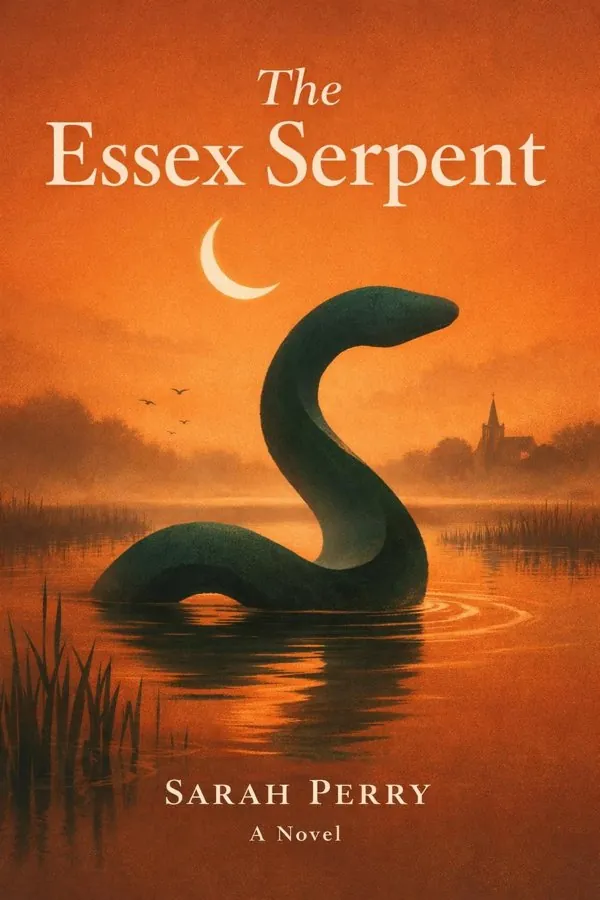
The Essex Serpent: A Novel: Summary & Key Insights
by Sarah Perry
 10 min9 chaptersAudio available
Key Takeaways from The Essex Serpent: A Novel
Freedom does not always arrive looking like joy; sometimes it arrives disguised as loss.
The most powerful conflicts are often not between enemies, but between intelligent people who see the world through different truths.
Monsters often reveal less about the world than about the people who imagine them.
Clarity is overrated; many of life’s most important transformations occur before answers arrive.
Not all profound love can be comfortably named, and Perry builds much of the novel’s emotional power from that fact.
What Is The Essex Serpent: A Novel About?
The Essex Serpent: A Novel by Sarah Perry is a bestsellers book spanning 4 pages. Set in the damp, luminous world of late Victorian England, The Essex Serpent follows Cora Seaborne, a newly widowed woman who leaves London for the Essex coast in search of intellectual freedom, natural wonders, and a life beyond social expectation. In the village of Aldwinter, she becomes intrigued by local reports of a mysterious creature said to haunt the marshes. What begins as a rational investigation into folklore soon deepens into something richer: a searching exploration of belief, desire, grief, community, and the stories people tell to survive uncertainty. At the center of the novel is Cora’s intense bond with the village vicar, William Ransome, whose religious faith and moral seriousness challenge her scientific curiosity and skepticism. Sarah Perry brings unusual authority to this material through her deep feel for Essex history, her literary craftsmanship, and her ability to weave gothic atmosphere with psychological precision. More than a historical novel or a mystery, The Essex Serpent is a meditation on how human beings navigate the unknown. It matters because it asks timeless questions: What do we worship? What do we fear? And can reason and wonder coexist without diminishing each other?
This FizzRead summary covers all 9 key chapters of The Essex Serpent: A Novel in approximately 10 minutes, distilling the most important ideas, arguments, and takeaways from Sarah Perry's work. Also available as an audio summary and Key Quotes Podcast.
The Essex Serpent: A Novel
Set in the damp, luminous world of late Victorian England, The Essex Serpent follows Cora Seaborne, a newly widowed woman who leaves London for the Essex coast in search of intellectual freedom, natural wonders, and a life beyond social expectation. In the village of Aldwinter, she becomes intrigued by local reports of a mysterious creature said to haunt the marshes. What begins as a rational investigation into folklore soon deepens into something richer: a searching exploration of belief, desire, grief, community, and the stories people tell to survive uncertainty. At the center of the novel is Cora’s intense bond with the village vicar, William Ransome, whose religious faith and moral seriousness challenge her scientific curiosity and skepticism.
Sarah Perry brings unusual authority to this material through her deep feel for Essex history, her literary craftsmanship, and her ability to weave gothic atmosphere with psychological precision. More than a historical novel or a mystery, The Essex Serpent is a meditation on how human beings navigate the unknown. It matters because it asks timeless questions: What do we worship? What do we fear? And can reason and wonder coexist without diminishing each other?
Who Should Read The Essex Serpent: A Novel?
This book is perfect for anyone interested in bestsellers and looking to gain actionable insights in a short read. Whether you're a student, professional, or lifelong learner, the key ideas from The Essex Serpent: A Novel by Sarah Perry will help you think differently.
- ✓Readers who enjoy bestsellers and want practical takeaways
- ✓Professionals looking to apply new ideas to their work and life
- ✓Anyone who wants the core insights of The Essex Serpent: A Novel in just 10 minutes
Want the full summary?
Get instant access to this book summary and 100K+ more with Fizz Moment.
Get Free SummaryAvailable on App Store • Free to download
Key Chapters
Freedom does not always arrive looking like joy; sometimes it arrives disguised as loss. Cora Seaborne begins the novel newly widowed, and while society expects solemn grief, what she experiences is a complicated release from a controlling and emotionally damaging marriage. Her departure from London for Essex is not merely a change of setting. It is a declaration that her life may now be shaped by curiosity rather than obligation. Perry presents widowhood not as a simple tragedy but as a threshold through which Cora steps into self-definition.
In Essex, Cora pursues her fascination with natural history and fossil hunting, embracing questions that Victorian womanhood would prefer she leave to men. Her unconventional dress, restless intelligence, and resistance to domestic expectations make her a striking outsider. Yet her awakening is not triumphant in a simple sense. She remains uncertain, emotionally guarded, and vulnerable to the habits of her past. This complexity makes her compelling: liberation does not erase damage, but it opens a path toward becoming.
Readers can see in Cora’s journey a broader lesson about reinvention. Major life changes, even painful ones, can become occasions for reassessing who we are when old constraints fall away. A move, career shift, divorce, bereavement, or illness may expose the possibility of a more authentic self. The challenge is to treat upheaval not only as an ending but as a field of inquiry.
Actionable takeaway: Identify one role or expectation that no longer fits your life, and take one concrete step this week toward a version of yourself shaped by genuine interest rather than inherited duty.
The most powerful conflicts are often not between enemies, but between intelligent people who see the world through different truths. In Aldwinter, Cora meets William Ransome, the local vicar, and their relationship becomes the novel’s intellectual and emotional core. Cora is drawn toward empirical explanation, eager to interpret the so-called Essex Serpent as a natural phenomenon, perhaps a surviving species or a case of mass fear. Will, by contrast, is a man of faith, but not of crude superstition. He is thoughtful, compassionate, and capable of doubt, making him a worthy counterpart rather than a straw man.
Their exchanges are compelling because Perry refuses to simplify either position. Science is not presented as cold certainty, nor religion as ignorance. Instead, both emerge as frameworks for confronting mystery, suffering, and moral responsibility. Cora and Will are drawn to one another because each recognizes in the other a seriousness of mind. Yet that same seriousness creates tension, because belief is never merely abstract. It shapes intimacy, community, and the limits of acceptable desire.
The novel’s insight remains relevant today. Many contemporary debates are trapped by caricature: reason versus faith, data versus values, skepticism versus devotion. Perry suggests that genuine dialogue begins when we stop trying to defeat the other side and start asking what human need their worldview serves. In relationships, workplaces, and public life, productive disagreement depends on curiosity as much as conviction.
Actionable takeaway: In your next disagreement about values or beliefs, ask one sincere question aimed at understanding the other person’s underlying fear, hope, or principle before offering your rebuttal.
Monsters often reveal less about the world than about the people who imagine them. The rumored Essex Serpent casts a long shadow over Aldwinter, but Perry’s deeper interest is not whether such a creature exists. It is how fear spreads through a community hungry for explanation. Failed catches, sudden deaths, unexplained events, and social unease become woven into a shared narrative of haunting. The serpent becomes a vessel into which villagers pour dread, guilt, grief, and helplessness.
This is one of the novel’s sharpest observations: when people feel vulnerable, they seek stories that make suffering intelligible. The serpent is terrifying not simply because it might be real, but because it gives shape to anxiety that would otherwise remain diffuse. In this sense, superstition is not stupidity. It is an emotional technology for organizing uncertainty. At the same time, such stories can become dangerous. They intensify panic, isolate outsiders, and encourage communities to mistake symbolic explanations for practical responses.
The pattern is deeply familiar in modern life. Rumors on social media, moral panics, conspiracy theories, and public scapegoating all follow similar logic. In times of instability, people gravitate toward explanations that are dramatic, memorable, and emotionally satisfying, even if they are false. The novel encourages readers to notice how quickly fear can harden into collective conviction.
Yet Perry also shows that dismissing fear is ineffective. People must feel heard before they can think clearly. Rationality that lacks empathy often fails. To calm a frightened group, one must address both the facts and the emotions attached to them.
Actionable takeaway: The next time you encounter a fear-driven rumor, pause to ask two questions: what evidence supports it, and what anxiety might be making it persuasive?
Clarity is overrated; many of life’s most important transformations occur before answers arrive. As The Essex Serpent unfolds, its characters are not granted neat revelations that resolve every mystery. Instead, they are changed by the process of searching. Cora’s investigation, Will’s moral struggle, Stella’s suffering, and the village’s unrest all push the characters toward uncomfortable recognitions about love, duty, mortality, and the limits of control.
Perry is especially interested in the idea that revelation is often relational. Characters come to understand themselves not in solitude, but through encounters that unsettle them. Cora sees aspects of herself reflected in Will’s steadiness and Stella’s grace. Will confronts the intensity of his attachment to Cora and the strain it places on his vocation and marriage. Even peripheral figures undergo shifts as illness, desire, and disappointment expose the gap between the lives they have and the lives they imagined. Transformation, then, is not a reward for certainty. It is the consequence of staying open while certainty remains unavailable.
This matters because modern readers are often conditioned to seek closure fast: define the problem, fix it, move on. The novel resists that impulse. It suggests that growth may require prolonged ambiguity. We do not always need immediate answers about our relationships, careers, beliefs, or futures. Sometimes the deeper task is to become the kind of person who can bear not knowing without collapsing into panic or denial.
Actionable takeaway: When facing a major unresolved issue, resist forcing a premature conclusion. Instead, write down what the uncertainty is teaching you about your values, fears, and capacities.
Not all profound love can be comfortably named, and Perry builds much of the novel’s emotional power from that fact. The connection between Cora and Will is charged, intimate, and transformative, yet it does not fit neatly into conventional romantic categories. It is intellectual admiration, spiritual provocation, emotional dependence, and forbidden desire all at once. Because Will is married to Stella, and because both he and Cora are constrained by ethics as well as feeling, their bond becomes a study in longing without easy resolution.
What makes this dynamic compelling is Perry’s refusal to reduce love to possession. Cora and Will do not simply want each other; they awaken parts of each other. Their conversations matter as much as their attraction. They become mirrors and tests, each forcing the other to confront ideals and contradictions. At the same time, the novel honors other forms of love: marital tenderness, parental devotion, friendship, care for the sick, and loyalty to a community. Stella, in particular, is not merely an obstacle to passion but a radiant presence whose vulnerability and generosity deepen the ethical stakes.
For readers, this offers a more mature understanding of attachment. Some of the most meaningful relationships in life may remain unresolved, bounded, or impossible. Their value does not depend on consummation. In real life, too, one may encounter relationships that enlarge the self without becoming formal partnerships. The challenge is learning to distinguish nourishing connection from selfish pursuit.
Actionable takeaway: Reflect on one important relationship in your life and ask not only what you want from it, but what kind of person it invites you to become.
The natural world in The Essex Serpent is never just background; it is an active force that shapes perception, emotion, and meaning. Perry’s Essex is full of tidal flats, marsh grasses, fossil beds, estuarial light, and weather that seems to alter human thought. Cora’s fascination with geology and creatures arises from a genuine hunger to read nature as evidence, while the villagers often experience the same landscape as eerie, unstable, and spiritually charged. This tension reveals one of the novel’s richest ideas: nature invites both scientific study and imaginative projection.
Perry does not ask us to choose between these responses. Instead, she shows that the natural world exceeds every framework we impose on it. To Cora, it promises discovery and liberation. To others, it reflects danger, divine warning, or enchantment. In this way, landscape becomes a mirror for consciousness. The serpent itself may be elusive, but the estuary’s atmosphere makes belief in it feel almost plausible. Place shapes what people think they know.
This insight has practical resonance. Our environments influence our inner lives more than we often admit. Certain landscapes calm us, sharpen us, unsettle us, or awaken curiosity. Time in nature can expand attention, but it can also surface fears we usually keep hidden. Perry reminds us that to observe a place closely is also to observe ourselves.
In an age of distraction, her attentiveness to the physical world feels almost corrective. Looking carefully at a shoreline, a garden, or a city street can reintroduce wonder into ordinary life without requiring certainty or mastery.
Actionable takeaway: Spend thirty uninterrupted minutes in a natural setting this week, observing details without your phone, and note how the environment alters your thoughts and emotional state.
Human beings cling to the illusion that enough knowledge, virtue, or planning can keep loss at bay. The Essex Serpent repeatedly challenges that illusion through illness and bodily vulnerability. Stella Ransome’s deteriorating health introduces a profound tenderness and dread into the narrative, while Luke Garrett’s role as a surgeon highlights both the promise and limitation of medical progress. These threads place Victorian confidence in science beside the stubborn fact that the body remains precarious, mysterious, and beyond full command.
Perry handles illness with unusual sensitivity. It is not used merely as a plot device but as a force that rearranges relationships, priorities, and beliefs. Those who care for the sick confront exhaustion, helplessness, and moral complexity. Those who are ill may become more spiritually lucid, more isolated, or more dependent on forms of love they cannot repay. In such moments, grand theories matter less than presence. The novel suggests that mortality clarifies values by stripping away performance.
This is one reason the book feels emotionally durable. It acknowledges that modernity did not abolish vulnerability. Even now, advanced medicine coexists with uncertainty, chronic conditions, grief, and the limits of intervention. Readers may recognize in Perry’s characters the same modern tension: we trust expertise, yet we still encounter experiences that cannot be fixed, only accompanied.
The practical lesson is humility. Competence matters, but so do compassion, patience, and the willingness to stand beside what cannot be solved. Care is not failure when cure is impossible.
Actionable takeaway: Reach out to someone dealing with illness or grief and offer one specific, practical act of support rather than a vague statement of sympathy.
Facts help us survive, but stories help us endure. Across The Essex Serpent, people interpret their lives through narratives: of divine providence, scientific discovery, romantic destiny, social duty, progress, punishment, and haunting. Perry’s genius lies in showing that these stories are neither wholly false nor wholly sufficient. They are frameworks that shape action, emotion, and identity. The serpent itself functions as the book’s central symbolic story, drawing together fear of nature, fear of change, and fear of the unknown within the self.
The novel asks a subtle question: when does a story illuminate reality, and when does it imprison us? Cora’s scientific narrative grants her agency and excitement, but it can also distance her from emotional truths. Religious narratives give Will purpose and language for suffering, yet they cannot spare him from conflict. Village folklore creates communal coherence, yet it can spiral into panic. In every case, meaning is both necessary and risky.
This idea has immediate application. We all live by stories about who we are: successful or overlooked, rational or broken, independent or unlucky, chosen or abandoned. These narratives can motivate us, but they can also become cages when repeated too rigidly. Growth often begins when we notice the story we are using and test whether it still serves us.
Perry does not recommend abandoning meaning-making. Rather, she calls for a more supple imagination, one capable of revision. The best stories are those that preserve wonder while leaving room for evidence, compassion, and change.
Actionable takeaway: Write down one story you repeatedly tell about your life, then rewrite it in a way that includes complexity, agency, and the possibility of a different future.
All Chapters in The Essex Serpent: A Novel
About the Author
Sarah Perry is a British novelist born in 1979 in Chelmsford, Essex, a landscape that has profoundly influenced her imagination and fiction. She studied creative writing at Royal Holloway, University of London, where she later completed a PhD. Perry is known for novels that blend historical texture, gothic atmosphere, and intellectual inquiry, often exploring faith, desire, illness, folklore, and the uneasy boundary between rational explanation and mystery. She first drew major attention with After Me Comes the Flood, but achieved wide international acclaim with The Essex Serpent, a literary bestseller praised for its lush prose and philosophical richness. Her later work, including Melmoth, further confirmed her reputation as a distinctive contemporary writer capable of making historical fiction feel emotionally immediate and thematically expansive.
Get This Summary in Your Preferred Format
Read or listen to the The Essex Serpent: A Novel summary by Sarah Perry anytime, anywhere. FizzRead offers multiple formats so you can learn on your terms — all free.
Available formats: App · Audio · PDF · EPUB — All included free with FizzRead
Download The Essex Serpent: A Novel PDF and EPUB Summary
Key Quotes from The Essex Serpent: A Novel
“Freedom does not always arrive looking like joy; sometimes it arrives disguised as loss.”
“The most powerful conflicts are often not between enemies, but between intelligent people who see the world through different truths.”
“Monsters often reveal less about the world than about the people who imagine them.”
“Clarity is overrated; many of life’s most important transformations occur before answers arrive.”
“Not all profound love can be comfortably named, and Perry builds much of the novel’s emotional power from that fact.”
Frequently Asked Questions about The Essex Serpent: A Novel
The Essex Serpent: A Novel by Sarah Perry is a bestsellers book that explores key ideas across 9 chapters. Set in the damp, luminous world of late Victorian England, The Essex Serpent follows Cora Seaborne, a newly widowed woman who leaves London for the Essex coast in search of intellectual freedom, natural wonders, and a life beyond social expectation. In the village of Aldwinter, she becomes intrigued by local reports of a mysterious creature said to haunt the marshes. What begins as a rational investigation into folklore soon deepens into something richer: a searching exploration of belief, desire, grief, community, and the stories people tell to survive uncertainty. At the center of the novel is Cora’s intense bond with the village vicar, William Ransome, whose religious faith and moral seriousness challenge her scientific curiosity and skepticism. Sarah Perry brings unusual authority to this material through her deep feel for Essex history, her literary craftsmanship, and her ability to weave gothic atmosphere with psychological precision. More than a historical novel or a mystery, The Essex Serpent is a meditation on how human beings navigate the unknown. It matters because it asks timeless questions: What do we worship? What do we fear? And can reason and wonder coexist without diminishing each other?
You Might Also Like

The Godfather
Mario Puzo
10 min
The Handmaid's Tale
Margaret Atwood
10 min
The Hunger Games
Suzanne Collins
10 min
The Nightingale
Kristin Hannah
10 min
The Seven Husbands of Evelyn Hugo
Taylor Jenkins Reid
10 min
Backwater Justice
Fern Michaels
10 minBrowse by Category
Ready to read The Essex Serpent: A Novel?
Get the full summary and 100K+ more books with Fizz Moment.