
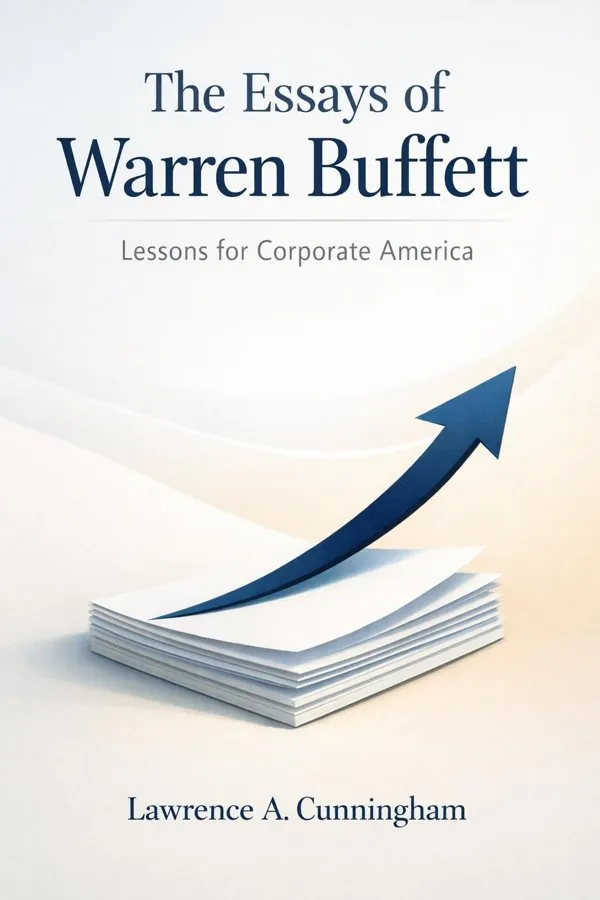
The Essays of Warren Buffett: Lessons for Corporate America: Summary & Key Insights
 10 min10 chaptersAudio available
Key Takeaways from The Essays of Warren Buffett: Lessons for Corporate America
A company often fails long before its numbers reveal trouble: it fails when managers stop acting like owners and start acting like protectors of their own power.
Most people think management is about operations, but Buffett argues that the highest function of leadership is deciding what to do with capital.
This shift in mindset changes everything.
Few corporate actions look more exciting than a major acquisition, and few destroy more value when pursued carelessly.
Financial statements are essential, but Buffett repeatedly reminds readers that accounting is a starting point, not the final truth.
What Is The Essays of Warren Buffett: Lessons for Corporate America About?
The Essays of Warren Buffett: Lessons for Corporate America by Lawrence A. Cunningham is a finance book spanning 10 pages. The Essays of Warren Buffett: Lessons for Corporate America turns decades of Warren Buffett’s Berkshire Hathaway shareholder letters into a structured guide to business judgment, investing discipline, and ethical leadership. Edited by Lawrence A. Cunningham, the book does not merely collect Buffett’s thoughts; it organizes them by topic so readers can clearly see the principles that have shaped one of the greatest long-term records in corporate history. The result is a practical handbook on how to think like an owner, allocate capital intelligently, assess management honestly, and value businesses rationally. What makes this book especially important is that Buffett’s wisdom applies far beyond the stock market. His ideas speak to executives deciding where to invest company resources, board members evaluating governance, entrepreneurs building durable businesses, and individual investors trying to avoid costly mistakes. At its core, the book argues that sound results come from simple but demanding habits: integrity, patience, rationality, and a relentless focus on intrinsic value. Cunningham is uniquely qualified to present these lessons. A respected scholar of corporate governance and value investing, he translates Buffett’s letters into a coherent framework, making the book both accessible to newcomers and rich enough for experienced readers.
This FizzRead summary covers all 10 key chapters of The Essays of Warren Buffett: Lessons for Corporate America in approximately 10 minutes, distilling the most important ideas, arguments, and takeaways from Lawrence A. Cunningham's work. Also available as an audio summary and Key Quotes Podcast.
The Essays of Warren Buffett: Lessons for Corporate America
The Essays of Warren Buffett: Lessons for Corporate America turns decades of Warren Buffett’s Berkshire Hathaway shareholder letters into a structured guide to business judgment, investing discipline, and ethical leadership. Edited by Lawrence A. Cunningham, the book does not merely collect Buffett’s thoughts; it organizes them by topic so readers can clearly see the principles that have shaped one of the greatest long-term records in corporate history. The result is a practical handbook on how to think like an owner, allocate capital intelligently, assess management honestly, and value businesses rationally.
What makes this book especially important is that Buffett’s wisdom applies far beyond the stock market. His ideas speak to executives deciding where to invest company resources, board members evaluating governance, entrepreneurs building durable businesses, and individual investors trying to avoid costly mistakes. At its core, the book argues that sound results come from simple but demanding habits: integrity, patience, rationality, and a relentless focus on intrinsic value. Cunningham is uniquely qualified to present these lessons. A respected scholar of corporate governance and value investing, he translates Buffett’s letters into a coherent framework, making the book both accessible to newcomers and rich enough for experienced readers.
Who Should Read The Essays of Warren Buffett: Lessons for Corporate America?
This book is perfect for anyone interested in finance and looking to gain actionable insights in a short read. Whether you're a student, professional, or lifelong learner, the key ideas from The Essays of Warren Buffett: Lessons for Corporate America by Lawrence A. Cunningham will help you think differently.
- ✓Readers who enjoy finance and want practical takeaways
- ✓Professionals looking to apply new ideas to their work and life
- ✓Anyone who wants the core insights of The Essays of Warren Buffett: Lessons for Corporate America in just 10 minutes
Want the full summary?
Get instant access to this book summary and 100K+ more with Fizz Moment.
Get Free SummaryAvailable on App Store • Free to download
Key Chapters
A company often fails long before its numbers reveal trouble: it fails when managers stop acting like owners and start acting like protectors of their own power. Buffett’s view of corporate governance begins with a simple moral and economic principle: executives and directors are stewards of shareholder capital. Their job is not to preserve titles, justify bureaucracy, or pursue empire-building. It is to increase long-term per-share value while treating shareholders as true partners.
In Buffett’s framework, the best managers think like controlling owners even when they hold only a small personal stake. They communicate candidly, admit mistakes, and resist the temptation to hide behind adjusted metrics or optimistic forecasts. Likewise, effective boards do not serve as ceremonial endorsers of management; they ask hard questions, evaluate capital allocation decisions, and ensure executive compensation aligns with performance that actually benefits owners.
A practical example is Buffett’s criticism of boards that approve excessive stock option grants or tolerate acquisitions that increase company size but destroy value per share. Growth in revenue, headcount, or prestige is meaningless if shareholders become poorer. By contrast, a well-governed company may appear conservative or even slow-moving, but it protects owner capital by avoiding vanity projects and maintaining accountability.
For investors, this means evaluating not just financial statements but behavior: Does management speak plainly? Do they buy back shares only when undervalued? Do they take responsibility when outcomes disappoint? For executives, the lesson is equally direct: every policy should be tested against one question—would you welcome it if all shareholders were family members?
Actionable takeaway: Judge governance by stewardship, not appearances; back leaders who consistently act as if the company’s capital were their own.
Most people think management is about operations, but Buffett argues that the highest function of leadership is deciding what to do with capital. A business may have competent sales, strong branding, and efficient production, yet still create poor results if management allocates cash badly. Every retained dollar carries an obligation: it should produce at least one dollar of market value over time, and ideally much more.
Buffett breaks capital allocation into a few basic choices. A company can reinvest in the existing business, acquire other businesses, pay down debt, repurchase shares, or distribute cash through dividends. None of these options is automatically right. The right choice depends on where the highest risk-adjusted return lies. If the core business can reinvest at high rates, retaining earnings makes sense. If opportunities are limited, returning cash is often superior to pretending growth exists.
This perspective sharply contrasts with corporate habits that equate retained earnings with managerial ambition. Buffett warns that many executives hoard cash or pursue acquisitions simply because action feels impressive. But activity is not value creation. A disciplined manager might choose a dividend or a buyback precisely because it is the most rational use of capital.
Consider a company trading well below intrinsic value. Repurchasing shares in that case benefits continuing shareholders because each remaining share represents a larger claim on the business. But if shares are overpriced, buybacks destroy value. The same logic applies to acquisitions: buying a mediocre business at an inflated price weakens even an excellent company.
For business leaders, this idea turns finance into a test of honesty and rationality. For investors, it offers a powerful lens: study where cash goes. Follow the capital, and you often discover the quality of management.
Actionable takeaway: Evaluate every use of capital against intrinsic value and expected long-term returns, not against custom, pressure, or corporate ego.
The market encourages people to think in tickers, price charts, and headlines, but Buffett insists on a more grounded truth: a stock is not a lottery ticket, it is a fractional ownership interest in a real business. This shift in mindset changes everything. Once investors stop asking, "Will the stock go up next month?" and start asking, "Would I want to own this business for years?" speculation gives way to disciplined investing.
Buffett’s approach to common stocks centers on business quality, management integrity, economic durability, and purchase price. He prefers companies with understandable operations, favorable long-term economics, and managers who are both talented and shareholder-oriented. Just as important, he wants a margin of safety between price and intrinsic value. A wonderful business can be a poor investment if bought at too high a price.
This owner’s perspective also reduces emotional error. If market prices fall but the underlying business remains strong, the rational investor sees lower prices as opportunity, not catastrophe. Conversely, a rising stock does not prove that a business has become better. Markets can be euphoric or fearful, but business value changes more gradually.
A practical application is to analyze a stock as if there were no market quote for five years. Would the company still appeal based on cash generation, competitive position, and reinvestment prospects? This filter eliminates many fashionable but fragile investments. It also encourages patience, because wealth compounds through ownership of sound businesses over long periods, not through constant trading.
Buffett’s insight is especially useful for individual investors overwhelmed by daily noise. Simplicity becomes an advantage: understand the business, estimate value conservatively, and wait for an attractive price.
Actionable takeaway: Before buying any stock, write down why the underlying business is worth owning independent of short-term market movement.
Few corporate actions look more exciting than a major acquisition, and few destroy more value when pursued carelessly. Buffett treats mergers and acquisitions with unusual skepticism because the incentives around deals are often distorted. Executives may chase size, advisers earn fees from completion, and boards are tempted by strategic narratives that sound compelling but rest on fragile assumptions.
The core Buffett principle is straightforward: an acquisition should make economic sense for the acquiring company’s shareholders, not just strategic or cosmetic sense. That means the buyer must understand the target business, trust its economics, assess management honestly, and pay a price that allows a satisfactory return. Synergy stories, accounting adjustments, and prestige should never substitute for arithmetic.
Buffett also distinguishes between buying businesses and buying earnings. Reported earnings can be manipulated, but durable earning power depends on business quality. Acquiring a weak business at a bargain may still be inferior to buying a great business at a fair price. Yet even great businesses can become poor acquisitions if bidding wars push prices above intrinsic value.
An important practical lesson is the cost of overpayment. If a company uses valuable stock or large amounts of debt to acquire a target at an inflated price, the error can burden shareholders for years. Integration problems, cultural clashes, and unrealistic savings assumptions only worsen the damage. Buffett’s own preference has often been for simple deals with understandable businesses and trustworthy operators who can continue running their companies with minimal disruption.
For managers, the book’s message is humbling: doing no deal is frequently better than doing a mediocre one. For investors, acquisition announcements should trigger skepticism, not automatic excitement.
Actionable takeaway: Treat every acquisition as a capital allocation decision that must stand on conservative assumptions, clear economics, and a disciplined price.
Financial statements are essential, but Buffett repeatedly reminds readers that accounting is a starting point, not the final truth. Reported earnings, book value, and conventional ratios can illuminate reality or obscure it depending on how they are interpreted. Intelligent investors and managers must understand what the numbers say, what they leave out, and where incentives may distort them.
One of Buffett’s most important contributions is his emphasis on economic reality over accounting form. For example, depreciation is a real expense, even when companies try to downplay it. On the other hand, some accounting treatments can make strong businesses appear weaker or weaker businesses appear healthier than they truly are. Purchase accounting, goodwill treatment, and one-time adjustments can all cloud understanding if used mechanically.
Buffett also stresses intrinsic value, which cannot be read directly from any balance sheet. Intrinsic value is the discounted value of the cash that can be taken out of a business over its remaining life. That requires judgment about future economics, capital needs, and competitive durability. Book value may sometimes serve as a rough proxy, especially in financial businesses, but it is never a complete substitute for thoughtful valuation.
A practical application is to examine owner earnings rather than relying solely on reported net income. Owner earnings begin with accounting profits and adjust for non-cash charges and the capital expenditures required to maintain the business. This provides a clearer view of what the business can actually distribute or reinvest.
For readers, Buffett’s treatment of accounting offers both caution and confidence: caution because superficial metrics can mislead, confidence because a disciplined framework can cut through noise.
Actionable takeaway: Use accounting statements as tools, not verdicts, and always ask what the business is truly earning in economic terms.
In investing and finance, complexity is often mistaken for sophistication. Buffett argues the opposite: many financial disasters begin when people commit capital to instruments they cannot clearly explain. Alternative investments, derivatives, highly structured products, and speculative vehicles may promise diversification or enhanced returns, but they often introduce hidden leverage, opacity, and behavioral risk.
Buffett does not reject every nontraditional investment out of hand. Rather, he insists that investors understand the underlying economics, counterparties, incentives, and downside scenarios. If an investment cannot be explained in plain language, that is usually a warning sign. Complexity may hide poor economics just as easily as it may package sound ones.
This principle became especially relevant in periods when investors chased exotic products because traditional assets seemed boring. Hedge funds, derivative structures, and other alternatives can attract capital through exclusivity and the illusion of control. But Buffett’s method asks simpler questions: What cash flows support this investment? What could cause permanent capital loss? Who benefits most from the fee structure? How liquid is the position under stress?
The practical lesson applies beyond institutional products. Individual investors encounter complexity in option strategies, leveraged funds, cryptocurrency schemes, and thematic products built more for marketing than for long-term wealth creation. In many cases, a high-quality business bought at a sensible price is safer and more productive than a complicated instrument sold with a polished story.
Buffett’s intellectual humility is central here. Staying within one’s circle of competence is not weakness; it is discipline. The world offers endless opportunities, and investors do not need to understand all of them to succeed.
Actionable takeaway: Refuse any investment you cannot explain clearly, including how it makes money, what could go wrong, and why the expected return justifies the risk.
A company’s culture is often invisible in quarterly reports, yet Buffett treats it as one of the strongest predictors of long-term outcomes. Strategy can be copied, incentives can be redesigned, and systems can be upgraded, but culture shapes everyday decisions when no one is watching. Over time, that makes it either a compounding asset or a silent liability.
Buffett admires organizations where trust, autonomy, frugality, and integrity are built into the operating fabric. Berkshire Hathaway itself is a model of decentralized management. Buffett chooses managers he respects, gives them broad freedom, and judges them by results and character rather than by bureaucratic conformity. This works because the culture attracts people who are internally motivated and aligned with owners.
The book shows that Buffett’s management philosophy rejects both micromanagement and corporate theatrics. He does not believe in endless layers of reporting merely to create the appearance of control. Instead, he emphasizes selecting exceptional managers, setting clear expectations, and preserving a culture where honesty travels faster than spin. A business with a strong culture can move quickly, admit errors early, and retain talented people who value purpose over politics.
For leaders, the practical application is profound. Compensation matters, but so do norms. If promotion goes to empire-builders, the culture will reward ego. If candor is punished, problems will be hidden. If managers are trusted and measured fairly, initiative flourishes. For investors, culture can be observed indirectly through turnover, communication quality, capital discipline, and management behavior during difficult periods.
Buffett’s insight is that culture is not soft. It is an economic force that influences risk, efficiency, and reputation.
Actionable takeaway: Build or back organizations where integrity, owner-orientation, and candor are reinforced in daily practice, not merely stated in values documents.
Markets speak constantly, but they rarely speak wisely. Buffett’s perspective on financial markets and the broader economic environment is rooted in temperament: investors do better when they distinguish between price volatility and business risk. The market exists to serve you, not instruct you. Its daily fluctuations create opportunity, but only for those who remain grounded in value rather than emotion.
Buffett warns against making decisions based on forecasts about interest rates, recessions, elections, or macro headlines. He does not deny that economic conditions matter. Rather, he argues that most investors overestimate their ability to predict them and underestimate the value of owning resilient businesses through uncertainty. Long-term wealth is usually built not by correctly timing macro turns but by buying good businesses and allowing compounding to work.
This does not mean ignoring risk. Buffett respects leverage, liquidity needs, and business fragility. A highly indebted firm may be crushed by an economic downturn even if its industry remains attractive. By contrast, a conservatively financed company with durable demand can survive periods of stress and emerge stronger. Economic reality matters most through its effect on business fundamentals, not through the drama of headlines.
Practically, this idea helps investors and leaders avoid reactive behavior. When markets are euphoric, discipline prevents overpayment. When panic spreads, discipline prevents forced selling and may even permit opportunistic buying. For business managers, it means preparing balance sheets for adversity rather than assuming favorable conditions will continue indefinitely.
Buffett’s calm approach is one of the book’s deepest lessons: rationality is a competitive advantage in environments dominated by fear and greed.
Actionable takeaway: Make decisions based on business resilience and valuation, not on short-term market forecasts or emotional swings in the economic narrative.
The deepest lesson in Buffett’s essays is that superior business and investing results are not produced by brilliance alone. They depend on temperament, ethics, and patience. In a world that celebrates speed, complexity, and aggression, Buffett’s philosophy of business and life is almost radical in its simplicity: be rational, stay within your competence, tell the truth, and let time reward sound decisions.
Buffett repeatedly emphasizes that reputation is built slowly and can be destroyed quickly. This is why he values integrity so highly in managers and partners. Intelligence and energy, without character, are dangerous. A business can recover from a poor quarter more easily than from a culture of deception or a habit of chasing easy gains at the expense of trust.
Patience is the companion virtue. Compounding requires time, and time favors those who avoid self-inflicted wounds. Investors who trade excessively, managers who pursue constant dealmaking, and companies that optimize for quarterly optics all interrupt the very process that creates enduring wealth. Buffett’s philosophy encourages selective action: wait for opportunities that are understandable, favorable, and attractively priced, then act decisively.
This worldview applies beyond investing. Professionals can use it to make better career choices, entrepreneurs can use it to build durable firms, and leaders can use it to create institutions that outlast personality-driven success. The common thread is long-term orientation anchored in values.
What makes this message enduring is its practicality. One does not need Buffett’s scale to apply Buffett’s habits. Rational decisions, honest communication, and patient compounding are available at every level.
Actionable takeaway: Build your decisions around character, competence, and long time horizons, and resist any success that depends on compromising those foundations.
All Chapters in The Essays of Warren Buffett: Lessons for Corporate America
About the Author
Lawrence A. Cunningham is a respected scholar, author, and professor known for his work on corporate governance, business law, and long-term value investing. He has taught at leading institutions and built a reputation for making complex financial and governance ideas accessible to both professionals and general readers. Cunningham is especially recognized for editing and organizing Warren Buffett’s shareholder letters into The Essays of Warren Buffett: Lessons for Corporate America, a book that helped bring Buffett’s philosophy to a much wider audience. His broader body of work explores fiduciary duty, board effectiveness, shareholder rights, and the habits of enduring businesses. By combining academic rigor with practical business insight, Cunningham has become an influential voice in conversations about responsible capitalism and intelligent corporate leadership.
Get This Summary in Your Preferred Format
Read or listen to the The Essays of Warren Buffett: Lessons for Corporate America summary by Lawrence A. Cunningham anytime, anywhere. FizzRead offers multiple formats so you can learn on your terms — all free.
Available formats: App · Audio · PDF · EPUB — All included free with FizzRead
Download The Essays of Warren Buffett: Lessons for Corporate America PDF and EPUB Summary
Key Quotes from The Essays of Warren Buffett: Lessons for Corporate America
“A company often fails long before its numbers reveal trouble: it fails when managers stop acting like owners and start acting like protectors of their own power.”
“Most people think management is about operations, but Buffett argues that the highest function of leadership is deciding what to do with capital.”
“This shift in mindset changes everything.”
“Few corporate actions look more exciting than a major acquisition, and few destroy more value when pursued carelessly.”
“Financial statements are essential, but Buffett repeatedly reminds readers that accounting is a starting point, not the final truth.”
Frequently Asked Questions about The Essays of Warren Buffett: Lessons for Corporate America
The Essays of Warren Buffett: Lessons for Corporate America by Lawrence A. Cunningham is a finance book that explores key ideas across 10 chapters. The Essays of Warren Buffett: Lessons for Corporate America turns decades of Warren Buffett’s Berkshire Hathaway shareholder letters into a structured guide to business judgment, investing discipline, and ethical leadership. Edited by Lawrence A. Cunningham, the book does not merely collect Buffett’s thoughts; it organizes them by topic so readers can clearly see the principles that have shaped one of the greatest long-term records in corporate history. The result is a practical handbook on how to think like an owner, allocate capital intelligently, assess management honestly, and value businesses rationally. What makes this book especially important is that Buffett’s wisdom applies far beyond the stock market. His ideas speak to executives deciding where to invest company resources, board members evaluating governance, entrepreneurs building durable businesses, and individual investors trying to avoid costly mistakes. At its core, the book argues that sound results come from simple but demanding habits: integrity, patience, rationality, and a relentless focus on intrinsic value. Cunningham is uniquely qualified to present these lessons. A respected scholar of corporate governance and value investing, he translates Buffett’s letters into a coherent framework, making the book both accessible to newcomers and rich enough for experienced readers.
More by Lawrence A. Cunningham
You Might Also Like



Browse by Category
Ready to read The Essays of Warren Buffett: Lessons for Corporate America?
Get the full summary and 100K+ more books with Fizz Moment.