
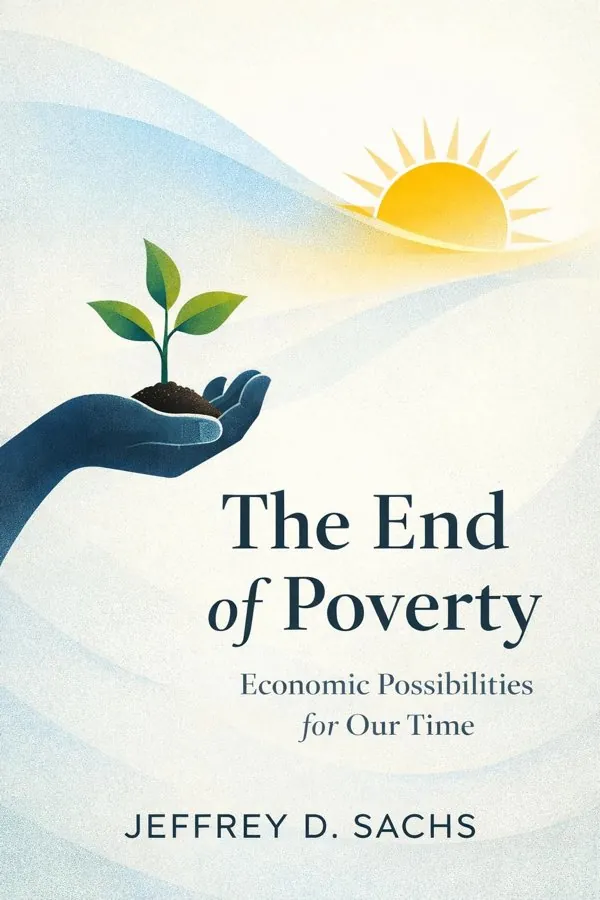
The End of Poverty: Economic Possibilities for Our Time: Summary & Key Insights
 10 min5 chaptersAudio available
What Is The End of Poverty: Economic Possibilities for Our Time About?
The End of Poverty: Economic Possibilities for Our Time by Jeffrey D. Sachs is a economics book spanning 5 pages. In this influential work, economist Jeffrey D. Sachs outlines a comprehensive plan to eradicate extreme poverty worldwide. Drawing on his experience as an advisor to developing nations and international organizations, Sachs argues that with targeted investments in health, education, infrastructure, and governance, the world can end extreme poverty within a generation. The book combines economic theory, case studies, and policy recommendations to present a roadmap for sustainable global development.
This FizzRead summary covers all 5 key chapters of The End of Poverty: Economic Possibilities for Our Time in approximately 10 minutes, distilling the most important ideas, arguments, and takeaways from Jeffrey D. Sachs's work. Also available as an audio summary and Key Quotes Podcast.
The End of Poverty: Economic Possibilities for Our Time
In this influential work, economist Jeffrey D. Sachs outlines a comprehensive plan to eradicate extreme poverty worldwide. Drawing on his experience as an advisor to developing nations and international organizations, Sachs argues that with targeted investments in health, education, infrastructure, and governance, the world can end extreme poverty within a generation. The book combines economic theory, case studies, and policy recommendations to present a roadmap for sustainable global development.
Who Should Read The End of Poverty: Economic Possibilities for Our Time?
This book is perfect for anyone interested in economics and looking to gain actionable insights in a short read. Whether you're a student, professional, or lifelong learner, the key ideas from The End of Poverty: Economic Possibilities for Our Time by Jeffrey D. Sachs will help you think differently.
- ✓Readers who enjoy economics and want practical takeaways
- ✓Professionals looking to apply new ideas to their work and life
- ✓Anyone who wants the core insights of The End of Poverty: Economic Possibilities for Our Time in just 10 minutes
Want the full summary?
Get instant access to this book summary and 100K+ more with Fizz Moment.
Get Free SummaryAvailable on App Store • Free to download
Key Chapters
The greatest obstacle to development is not laziness or cultural backwardness; it is the poverty trap. Poor countries remain poor because their people lack the basic tools and resources required to begin the process of sustained growth. When villagers in Malawi have no roads to reach markets, when families in Bangladesh cannot afford antibiotics or textbooks, economic productivity stalls before it even begins. The poverty trap is self-reinforcing: low income leads to low savings, which prevents investment, which in turn keeps income low.
Economists often assume that markets naturally lift people from poverty, yet in places where disease, isolation, and environmental stress prevail, markets barely function. A sick farmer cannot till his land; a child who misses school cannot contribute to the economy; a community without electricity cannot connect to larger networks of trade. These conditions create what I call a ‘poverty equilibrium’ — a state in which individual effort, while heroic, cannot overcome systemic deprivation.
Breaking free requires what I term ‘the big push’: concentrated, up-front investments in health, education, infrastructure, and governance. These are the catalytic inputs that ignite growth. Once communities achieve a minimal threshold of health and productivity, the cycle reverses: savings accumulate, investment becomes possible, and local enterprise flourishes. My work with the UN Millennium Project demonstrated that targeted aid can provide this spark. In places like rural Kenya and Malawi, when fertilizer subsidies and mosquito nets were provided, agricultural yields soared, diseases declined, and economic momentum took root.
The poverty trap is not a natural condition; it is a failure of the international system to invest where returns are greatest. What poor nations need are not handouts but handholds — strategic access to technology, finance, and infrastructure that allow them to climb onto the ladder of development. Once that first step is achieved, momentum sustains itself. The challenge, therefore, is coordination: ensuring that all necessary inputs arrive simultaneously so that communities can move decisively forward.
Geography is destiny — but not fate. Physical location helps explain why development has occurred unevenly across the globe. Coastal nations tend to thrive due to ease of trade, fertile lands, and access to global markets. Landlocked countries burdened by harsh climates, disease vectors, or poor soils face greater obstacles. But as I emphasize, geography constrains opportunity only if technology and policy fail to compensate for it.
Throughout history, technological progress has repeatedly broken geographic barriers. The Industrial Revolution transformed cold, damp Britain into the world’s powerhouse. Railroads opened the American interior. Antibiotics and vaccines reduced tropical disease burdens. Yet even today, malaria, poor transport networks, and isolation continue to shape vast regions — particularly sub-Saharan Africa. This is why successful development must begin with a recognition of geographic disadvantages and an intentional strategy to overcome them.
When I advise governments, the first question I ask is not how to balance the budget but how to connect their citizens to the global economy. Roads, ports, electricity grids, and communication networks are the arteries of growth. Without them, the best-laid economic plan collapses under logistical impossibility. Geography matters because access matters — and access can be engineered.
Take the case of China’s coastal special economic zones. By strategically situating development along trade routes and leveraging global markets, China turned geographic advantage into exponential growth. Conversely, many African nations struggle because transport costs make their exports uncompetitive. The lesson is clear: geography should inform policy, not determine destiny. When we invest in infrastructure that transcends physical isolation, we liberate entire populations from the limits imposed by their landscapes.
+ 3 more chapters — available in the FizzRead app
All Chapters in The End of Poverty: Economic Possibilities for Our Time
About the Author
Jeffrey D. Sachs is an American economist, public policy analyst, and director of the Center for Sustainable Development at Columbia University. Known for his work on sustainable development and the fight against poverty, Sachs has served as an advisor to the United Nations and numerous governments. His research and advocacy have influenced global economic and environmental policy.
Get This Summary in Your Preferred Format
Read or listen to the The End of Poverty: Economic Possibilities for Our Time summary by Jeffrey D. Sachs anytime, anywhere. FizzRead offers multiple formats so you can learn on your terms — all free.
Available formats: App · Audio · PDF · EPUB — All included free with FizzRead
Download The End of Poverty: Economic Possibilities for Our Time PDF and EPUB Summary
Key Quotes from The End of Poverty: Economic Possibilities for Our Time
“The greatest obstacle to development is not laziness or cultural backwardness; it is the poverty trap.”
“Physical location helps explain why development has occurred unevenly across the globe.”
Frequently Asked Questions about The End of Poverty: Economic Possibilities for Our Time
The End of Poverty: Economic Possibilities for Our Time by Jeffrey D. Sachs is a economics book that explores key ideas across 5 chapters. In this influential work, economist Jeffrey D. Sachs outlines a comprehensive plan to eradicate extreme poverty worldwide. Drawing on his experience as an advisor to developing nations and international organizations, Sachs argues that with targeted investments in health, education, infrastructure, and governance, the world can end extreme poverty within a generation. The book combines economic theory, case studies, and policy recommendations to present a roadmap for sustainable global development.
You Might Also Like

Business Adventures
John Brooks
10 min
Nudge
Richard H. Thaler, Cass R. Sunstein
10 min
The Hitchhiker"s Guide to the Galaxy
Douglas Adams
10 minThe Muqaddimah
Ibn Khaldun
10 minThe Outsiders
William N. Thorndike
10 min
A Little History of Economics
Niall Kishtainy
10 minBrowse by Category
Ready to read The End of Poverty: Economic Possibilities for Our Time?
Get the full summary and 100K+ more books with Fizz Moment.