
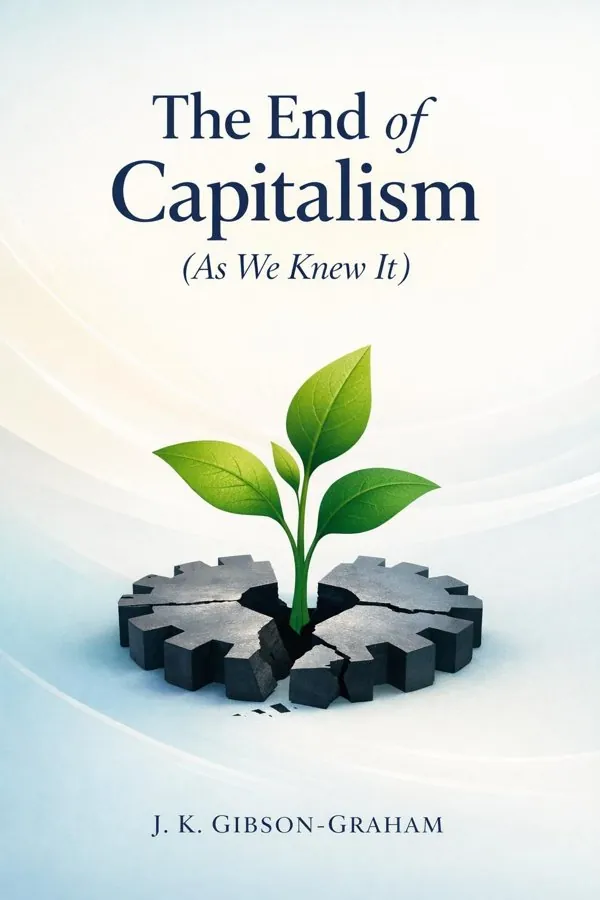
The End of Capitalism (As We Knew It): A Feminist Critique of Political Economy: Summary & Key Insights
 10 min9 chaptersAudio available
What Is The End of Capitalism (As We Knew It): A Feminist Critique of Political Economy About?
The End of Capitalism (As We Knew It): A Feminist Critique of Political Economy by J. K. Gibson-Graham is a economics book spanning 9 pages. This influential work challenges traditional Marxist and capitalist frameworks by rethinking economic theory through a feminist lens. J. K. Gibson-Graham argue that capitalism is not a singular, dominant system but one among many diverse economic practices. The book explores how alternative economies and community-based practices can reshape our understanding of production, labor, and value, offering a hopeful vision for post-capitalist futures.
This FizzRead summary covers all 9 key chapters of The End of Capitalism (As We Knew It): A Feminist Critique of Political Economy in approximately 10 minutes, distilling the most important ideas, arguments, and takeaways from J. K. Gibson-Graham's work. Also available as an audio summary and Key Quotes Podcast.
The End of Capitalism (As We Knew It): A Feminist Critique of Political Economy
This influential work challenges traditional Marxist and capitalist frameworks by rethinking economic theory through a feminist lens. J. K. Gibson-Graham argue that capitalism is not a singular, dominant system but one among many diverse economic practices. The book explores how alternative economies and community-based practices can reshape our understanding of production, labor, and value, offering a hopeful vision for post-capitalist futures.
Who Should Read The End of Capitalism (As We Knew It): A Feminist Critique of Political Economy?
This book is perfect for anyone interested in economics and looking to gain actionable insights in a short read. Whether you're a student, professional, or lifelong learner, the key ideas from The End of Capitalism (As We Knew It): A Feminist Critique of Political Economy by J. K. Gibson-Graham will help you think differently.
- ✓Readers who enjoy economics and want practical takeaways
- ✓Professionals looking to apply new ideas to their work and life
- ✓Anyone who wants the core insights of The End of Capitalism (As We Knew It): A Feminist Critique of Political Economy in just 10 minutes
Want the full summary?
Get instant access to this book summary and 100K+ more with Fizz Moment.
Get Free SummaryAvailable on App Store • Free to download
Key Chapters
Marxism has long provided the most robust critique of capitalism, identifying its exploitative structures and its systemic reproduction of inequality. Yet, in my reading, Marxism also contributed to the totalizing image of capitalism as an all-encompassing, self-sustaining force. By defining history through the logic of capital — through its mode of production, its class relations, its global expansion — Marxist theory ironically reinforced the very dominance it sought to oppose. In this book, I revisit Marxist frameworks not to discard them, but to extend and transform them through a feminist lens.
What becomes clear through this reexamination is that Marxist analyses often privilege production and wage labor, leaving other spheres of economy — unpaid domestic work, informal exchange, volunteerism, and emotional labor — in the shadows. These overlooked practices are typically feminized and devalued, treated as supplementary rather than constitutive of the economy. Feminism, however, insists that these forms of work are central to social reproduction and to the sustenance of any economic order.
By bringing this insight to bear on Marxist thought, we begin to see capitalism differently. It is no longer a singular engine that defines all economic life; rather, it is one system among many, reliant on a host of noncapitalist relations that it both depends upon and obscures. My feminist reinterpretation thus reanimates Marxism, turning it toward a more inclusive and diverse understanding of economic possibility.
Capitalism persists not only as a set of material relations but as a powerful discourse — a way of talking about, imagining, and organizing the world. In the twentieth century, especially within academic and political discourse, capitalism came to signify an immense, cohesive structure, so total that resistance seemed futile. This ideological construction created a sense of inevitability that paralyzed transformative thought.
In this chapter, I reveal how the language of political economy has built this myth. The repeated invocation of capitalism as ‘the system’ leaves little room for its others. Even radical critiques often amplify this dominance, painting capitalism as omnipresent and insurmountable. But if capitalism’s power is partly discursive, then changing the discourse becomes an act of liberation. By diversifying the ways we speak about economies — by naming local and alternative practices, by acknowledging non-market exchanges, by foregrounding cooperative and caring relations — we loosen the grip of capitalist realism.
Feminist theory, drawing on poststructuralism, shows us that language is not neutral. Our economic talk creates the boundaries of what we can imagine. To end capitalism ‘as we knew it’ thus begins with changing how we speak of it — from the singular to the plural, from the monolithic to the multiple.
+ 7 more chapters — available in the FizzRead app
All Chapters in The End of Capitalism (As We Knew It): A Feminist Critique of Political Economy
About the Author
J. K. Gibson-Graham is the joint pen name of feminist economic geographers Julie Graham and Katherine Gibson. Their collaborative work focuses on reimagining economies beyond capitalism, emphasizing community, cooperation, and diversity in economic life.
Get This Summary in Your Preferred Format
Read or listen to the The End of Capitalism (As We Knew It): A Feminist Critique of Political Economy summary by J. K. Gibson-Graham anytime, anywhere. FizzRead offers multiple formats so you can learn on your terms — all free.
Available formats: App · Audio · PDF · EPUB — All included free with FizzRead
Download The End of Capitalism (As We Knew It): A Feminist Critique of Political Economy PDF and EPUB Summary
Key Quotes from The End of Capitalism (As We Knew It): A Feminist Critique of Political Economy
“Marxism has long provided the most robust critique of capitalism, identifying its exploitative structures and its systemic reproduction of inequality.”
“Capitalism persists not only as a set of material relations but as a powerful discourse — a way of talking about, imagining, and organizing the world.”
Frequently Asked Questions about The End of Capitalism (As We Knew It): A Feminist Critique of Political Economy
The End of Capitalism (As We Knew It): A Feminist Critique of Political Economy by J. K. Gibson-Graham is a economics book that explores key ideas across 9 chapters. This influential work challenges traditional Marxist and capitalist frameworks by rethinking economic theory through a feminist lens. J. K. Gibson-Graham argue that capitalism is not a singular, dominant system but one among many diverse economic practices. The book explores how alternative economies and community-based practices can reshape our understanding of production, labor, and value, offering a hopeful vision for post-capitalist futures.
You Might Also Like
Business Adventures
John Brooks
10 min
Nudge
Richard H. Thaler, Cass R. Sunstein
10 min
The Hitchhiker"s Guide to the Galaxy
Douglas Adams
10 minThe Muqaddimah
Ibn Khaldun
10 minThe Outsiders
William N. Thorndike
10 min
A Little History of Economics
Niall Kishtainy
10 minBrowse by Category
Ready to read The End of Capitalism (As We Knew It): A Feminist Critique of Political Economy?
Get the full summary and 100K+ more books with Fizz Moment.