
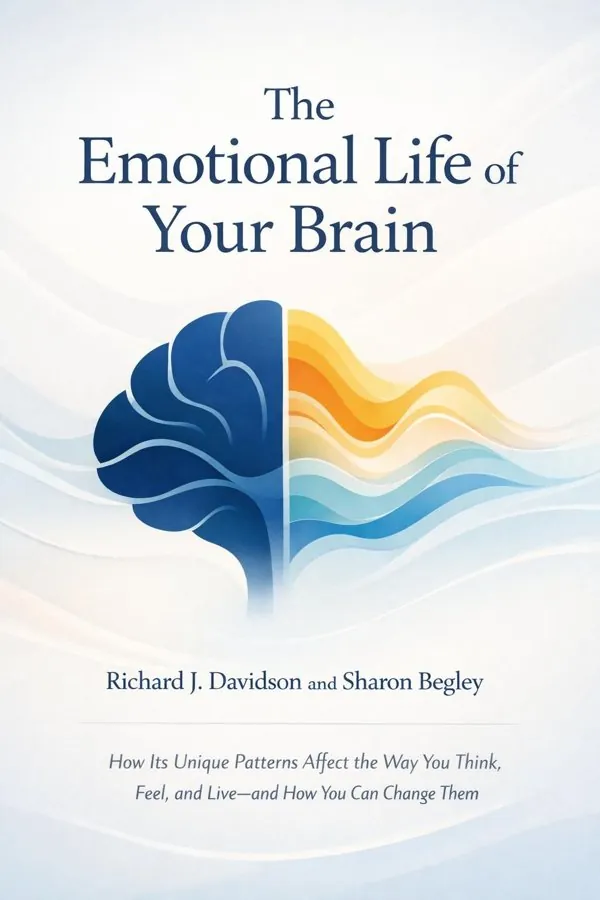
The Emotional Life of Your Brain: How Its Unique Patterns Affect the Way You Think, Feel, and Live—and How You Can Change Them: Summary & Key Insights
by Richard J. Davidson, Sharon Begley
 10 min10 chaptersAudio available
What Is The Emotional Life of Your Brain: How Its Unique Patterns Affect the Way You Think, Feel, and Live—and How You Can Change Them About?
The Emotional Life of Your Brain: How Its Unique Patterns Affect the Way You Think, Feel, and Live—and How You Can Change Them by Richard J. Davidson and Sharon Begley is a neuroscience book spanning 10 pages. In this groundbreaking work, neuroscientist Richard J. Davidson and science writer Sharon Begley explore how individual differences in brain activity shape our emotional lives. Drawing on decades of research, Davidson identifies six dimensions of emotional style—resilience, outlook, social intuition, self-awareness, sensitivity to context, and attention—and explains how these patterns are rooted in specific brain circuits. The book also offers evidence-based strategies for reshaping these neural patterns to enhance well-being and emotional balance.
This FizzRead summary covers all 10 key chapters of The Emotional Life of Your Brain: How Its Unique Patterns Affect the Way You Think, Feel, and Live—and How You Can Change Them in approximately 10 minutes, distilling the most important ideas, arguments, and takeaways from Richard J. Davidson and Sharon Begley's work. Also available as an audio summary and Key Quotes Podcast.
The Emotional Life of Your Brain: How Its Unique Patterns Affect the Way You Think, Feel, and Live—and How You Can Change Them
In this groundbreaking work, neuroscientist Richard J. Davidson and science writer Sharon Begley explore how individual differences in brain activity shape our emotional lives. Drawing on decades of research, Davidson identifies six dimensions of emotional style—resilience, outlook, social intuition, self-awareness, sensitivity to context, and attention—and explains how these patterns are rooted in specific brain circuits. The book also offers evidence-based strategies for reshaping these neural patterns to enhance well-being and emotional balance.
Who Should Read The Emotional Life of Your Brain: How Its Unique Patterns Affect the Way You Think, Feel, and Live—and How You Can Change Them?
This book is perfect for anyone interested in neuroscience and looking to gain actionable insights in a short read. Whether you're a student, professional, or lifelong learner, the key ideas from The Emotional Life of Your Brain: How Its Unique Patterns Affect the Way You Think, Feel, and Live—and How You Can Change Them by Richard J. Davidson and Sharon Begley will help you think differently.
- ✓Readers who enjoy neuroscience and want practical takeaways
- ✓Professionals looking to apply new ideas to their work and life
- ✓Anyone who wants the core insights of The Emotional Life of Your Brain: How Its Unique Patterns Affect the Way You Think, Feel, and Live—and How You Can Change Them in just 10 minutes
Want the full summary?
Get instant access to this book summary and 100K+ more with Fizz Moment.
Get Free SummaryAvailable on App Store • Free to download
Key Chapters
To understand emotional style, we must first appreciate the machinery of the mind that produces it. Emotion begins as a physiological response — a surge of activity flowing through neural networks connecting ancient limbic structures like the amygdala with newer executive regions such as the prefrontal cortex. The amygdala evaluates significance: it is the early warning system, scanning for threat, reward, or novelty. The prefrontal cortex, especially its left and right regions, interprets and regulates these signals, determining whether a situation deserves calm reflection or immediate action. The insula, embedded deep within the cerebral folds, represents a third crucial component: it maps the internal state of the body — heartbeat, breath, muscle tension — weaving that information into conscious feeling.
Decades of my research have shown that emotion is not a transient spark scattered across isolated areas of the brain; it is a dynamic system engaging multiple circuits in continuous conversation. When you feel anxious, it’s not simply the amygdala firing uncontrollably; it’s also the prefrontal cortex failing to calm it efficiently. When you feel joyful, the reward circuits involving dopamine pathways engage harmoniously with positive activation in the left prefrontal cortex. Emotional balance, then, depends on the fluid coordination of these regions. Through sophisticated imaging studies, we learned that stable traits — such as resilience or optimism — correspond to long-term patterns of brain activity, not simple momentary events.
In this light, emotions are not obstacles to rational thought but integral components of it. They guide decision-making, social understanding, and moral judgment. The neuroscience of emotion opens the door to seeing affect as measurable, trainable, and central to human intelligence. Once we grasp that, we can begin to understand the architecture of what I call emotional style.
Imagine your emotional life as a multidimensional space shaped by six core tendencies. Each dimension reflects a continuum — ranging from one extreme to another — grounded in identifiable patterns of brain activity. The first dimension, resilience, measures how quickly you recover after adversity. The second, outlook, reflects how long positive emotion endures. The third, social intuition, captures how well you read others’ signals. The fourth, self-awareness, gauges how clearly you perceive your own internal states. The fifth, sensitivity to context, describes how accurately you adjust behavior depending on social or environmental situations. The sixth, attention, concerns your capacity to sustain focus amid distraction.
These are not abstract psychological labels; they correspond to distinct neural mechanisms. Each person’s emotional style emerges from the balance and efficiency of these circuits, sculpted by genetics, experience, and training. In laboratory settings, we can measure recovery time after stress, patterns of activation in left versus right prefrontal cortex, or responses in the fusiform gyrus to facial expressions. Over time, we discovered that these markers form a coherent system reflecting your unique way of experiencing the world.
Defining emotional style allows us to reconcile the diversity of human personality with the universality of brain biology. It also reframes emotional intelligence: not as a vague social skill but as a tangible pattern of brain function amenable to change. Emotional styles explain why two people facing identical adversity respond differently — one bouncing back quickly, another sinking into despair. They illuminate why optimism feels natural to some and forced to others. Once you know your own style, you can begin to understand which circuits are overactive or underactive and how to bring them into harmony.
+ 8 more chapters — available in the FizzRead app
All Chapters in The Emotional Life of Your Brain: How Its Unique Patterns Affect the Way You Think, Feel, and Live—and How You Can Change Them
About the Authors
Richard J. Davidson is a professor of psychology and psychiatry at the University of Wisconsin–Madison and founder of the Center for Healthy Minds. Sharon Begley was an award-winning science journalist known for her work with Newsweek and The Wall Street Journal.
Get This Summary in Your Preferred Format
Read or listen to the The Emotional Life of Your Brain: How Its Unique Patterns Affect the Way You Think, Feel, and Live—and How You Can Change Them summary by Richard J. Davidson and Sharon Begley anytime, anywhere. FizzRead offers multiple formats so you can learn on your terms — all free.
Available formats: App · Audio · PDF · EPUB — All included free with FizzRead
Download The Emotional Life of Your Brain: How Its Unique Patterns Affect the Way You Think, Feel, and Live—and How You Can Change Them PDF and EPUB Summary
Key Quotes from The Emotional Life of Your Brain: How Its Unique Patterns Affect the Way You Think, Feel, and Live—and How You Can Change Them
“To understand emotional style, we must first appreciate the machinery of the mind that produces it.”
“Imagine your emotional life as a multidimensional space shaped by six core tendencies.”
Frequently Asked Questions about The Emotional Life of Your Brain: How Its Unique Patterns Affect the Way You Think, Feel, and Live—and How You Can Change Them
The Emotional Life of Your Brain: How Its Unique Patterns Affect the Way You Think, Feel, and Live—and How You Can Change Them by Richard J. Davidson and Sharon Begley is a neuroscience book that explores key ideas across 10 chapters. In this groundbreaking work, neuroscientist Richard J. Davidson and science writer Sharon Begley explore how individual differences in brain activity shape our emotional lives. Drawing on decades of research, Davidson identifies six dimensions of emotional style—resilience, outlook, social intuition, self-awareness, sensitivity to context, and attention—and explains how these patterns are rooted in specific brain circuits. The book also offers evidence-based strategies for reshaping these neural patterns to enhance well-being and emotional balance.
You Might Also Like
Anxious
Joseph LeDoux
10 min
Hallucinations
Oliver Sacks
10 min
The Biological Mind: How Brain, Body, and Environment Collaborate to Make Us Who We Are
Alan Jasanoff
10 min
The Feeling of Life Itself: Why Consciousness Is Widespread but Can't Be Computed
Christof Koch
10 min
The No-Nonsense Meditation Book
Steven Laureys
10 min
A General Theory of Love
Thomas Lewis, Fari Amini, Richard Lannon
10 minBrowse by Category
Ready to read The Emotional Life of Your Brain: How Its Unique Patterns Affect the Way You Think, Feel, and Live—and How You Can Change Them?
Get the full summary and 100K+ more books with Fizz Moment.