
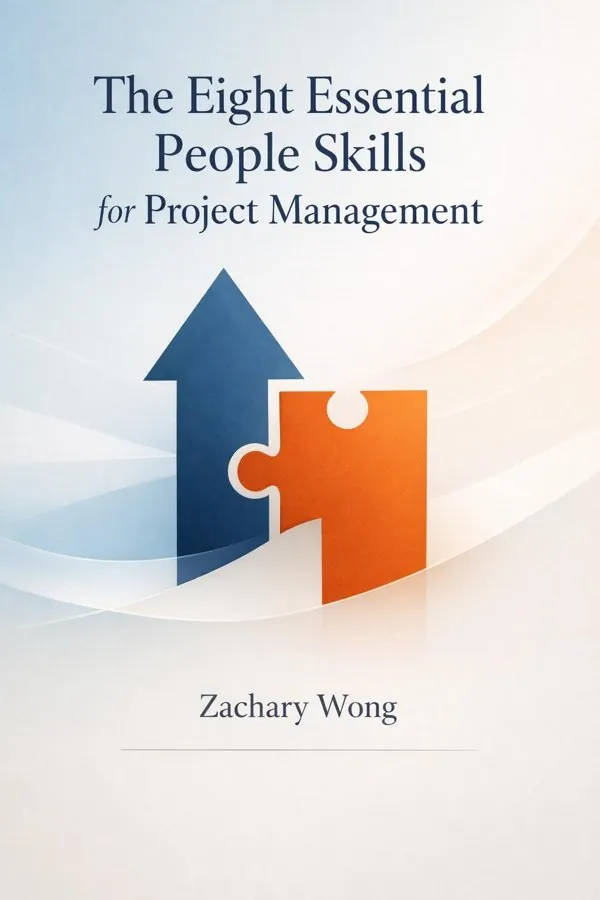
The Eight Essential People Skills for Project Management: Solving the Most Common People Problems for Team Leaders: Summary & Key Insights
by Zachary Wong
 10 min9 chaptersAudio available
Key Takeaways from The Eight Essential People Skills for Project Management: Solving the Most Common People Problems for Team Leaders
A project rarely fails in a single dramatic moment; it usually unravels through small misunderstandings that accumulate over time.
People may comply because of deadlines, but they commit because they see purpose.
Conflict is not the real threat to a project; unmanaged conflict is.
Teams can function for a while without trust, but they cannot perform at their best.
In modern projects, the people you depend on often do not report to you.
What Is The Eight Essential People Skills for Project Management: Solving the Most Common People Problems for Team Leaders About?
The Eight Essential People Skills for Project Management: Solving the Most Common People Problems for Team Leaders by Zachary Wong is a leadership book spanning 9 pages. Most projects do not collapse because the schedule was imperfect or the software was flawed. They break down because people misunderstand each other, avoid difficult conversations, lose trust, or fail to feel committed to a shared outcome. In The Eight Essential People Skills for Project Management, Zachary Wong argues that project success depends as much on human dynamics as on planning, process, and technical skill. The book is a practical guide for project managers, team leaders, and professionals who must coordinate people under pressure, often without full authority. Wong identifies eight essential interpersonal skills that repeatedly determine whether teams cooperate or struggle: communication, motivation, conflict resolution, trust building, influence, empowerment, emotional intelligence, and leadership presence. Rather than treating these as vague soft skills, he shows how they solve concrete project problems such as misalignment, resistance, disengagement, blame, and low accountability. His perspective carries weight because it comes from decades of experience in engineering, consulting, and leadership development across major organizations. The result is a concise, actionable book that helps leaders handle the human side of projects with more clarity, confidence, and effectiveness.
This FizzRead summary covers all 9 key chapters of The Eight Essential People Skills for Project Management: Solving the Most Common People Problems for Team Leaders in approximately 10 minutes, distilling the most important ideas, arguments, and takeaways from Zachary Wong's work. Also available as an audio summary and Key Quotes Podcast.
The Eight Essential People Skills for Project Management: Solving the Most Common People Problems for Team Leaders
Most projects do not collapse because the schedule was imperfect or the software was flawed. They break down because people misunderstand each other, avoid difficult conversations, lose trust, or fail to feel committed to a shared outcome. In The Eight Essential People Skills for Project Management, Zachary Wong argues that project success depends as much on human dynamics as on planning, process, and technical skill. The book is a practical guide for project managers, team leaders, and professionals who must coordinate people under pressure, often without full authority.
Wong identifies eight essential interpersonal skills that repeatedly determine whether teams cooperate or struggle: communication, motivation, conflict resolution, trust building, influence, empowerment, emotional intelligence, and leadership presence. Rather than treating these as vague soft skills, he shows how they solve concrete project problems such as misalignment, resistance, disengagement, blame, and low accountability. His perspective carries weight because it comes from decades of experience in engineering, consulting, and leadership development across major organizations. The result is a concise, actionable book that helps leaders handle the human side of projects with more clarity, confidence, and effectiveness.
Who Should Read The Eight Essential People Skills for Project Management: Solving the Most Common People Problems for Team Leaders?
This book is perfect for anyone interested in leadership and looking to gain actionable insights in a short read. Whether you're a student, professional, or lifelong learner, the key ideas from The Eight Essential People Skills for Project Management: Solving the Most Common People Problems for Team Leaders by Zachary Wong will help you think differently.
- ✓Readers who enjoy leadership and want practical takeaways
- ✓Professionals looking to apply new ideas to their work and life
- ✓Anyone who wants the core insights of The Eight Essential People Skills for Project Management: Solving the Most Common People Problems for Team Leaders in just 10 minutes
Want the full summary?
Get instant access to this book summary and 100K+ more with Fizz Moment.
Get Free SummaryAvailable on App Store • Free to download
Key Chapters
A project rarely fails in a single dramatic moment; it usually unravels through small misunderstandings that accumulate over time. Wong treats communication as the central operating system of project leadership because every deadline, responsibility, and expectation depends on people interpreting messages the same way. Leaders often assume they have communicated clearly when they have only spoken. Real communication happens when the message is understood, accepted, and acted on.
In project settings, communication must do more than transmit information. It must build shared meaning. That means clarifying goals, checking assumptions, tailoring the message to the audience, and creating feedback loops so people can ask questions early instead of correcting errors late. Wong emphasizes that different stakeholders need different forms of communication. Executives may need concise risk summaries, technical staff need precise specifications, and cross-functional partners need context that helps them see how their work connects to the whole.
A practical example is a kickoff meeting. Many leaders use it to review tasks and timelines, but effective leaders also use it to define success, decision rights, escalation paths, and communication norms. They ask team members to restate priorities in their own words, which reveals hidden confusion before work begins. Likewise, status updates should not merely report progress; they should highlight obstacles, confirm next actions, and surface risks that require shared attention.
Wong’s larger point is that communication is not an event but an ongoing discipline. Teams that communicate with consistency and transparency make faster decisions, recover from setbacks more easily, and trust each other more deeply. Actionable takeaway: build a simple communication rhythm for every project, including regular check-ins, clear written follow-ups, and explicit confirmation of roles, priorities, and next steps.
People may comply because of deadlines, but they commit because they see purpose. Wong challenges the common managerial habit of treating motivation as something leaders impose through pressure, rewards, or urgency. Those methods can generate short-term activity, but they rarely create sustained engagement. Real motivation grows when people understand why the work matters, feel capable of contributing, and believe their effort is valued.
In project environments, motivation is especially fragile because teams often face tight timelines, ambiguous authority, competing priorities, and constant change. A leader who relies only on task assignment can easily create a group that does the minimum. Wong argues that motivation requires leaders to know their people well enough to understand what drives them. Some are energized by learning, others by recognition, autonomy, challenge, contribution, or collaboration. Effective leaders do not use one generic incentive for everyone.
For example, a team member who feels stuck in repetitive execution may become reengaged if given ownership of a problem-solving task. Another may respond best to public acknowledgment of behind-the-scenes work. A high performer who seems disengaged may not need more pressure, but rather a clearer explanation of how the project supports a larger goal. Even small actions, such as asking for input before making decisions, can increase ownership and effort.
Wong also warns that motivation declines when leaders ignore fairness, overload people without support, or fail to remove obstacles. Inspiring language cannot compensate for a frustrating environment. Leaders must align meaningful goals with practical support.
Actionable takeaway: hold short one-on-one conversations to learn what energizes each team member, then connect assignments, recognition, and autonomy to those individual drivers while continually reinforcing the project’s larger purpose.
Conflict is not the real threat to a project; unmanaged conflict is. Wong reframes conflict as an unavoidable result of people bringing different priorities, expertise, personalities, and constraints into the same effort. Trying to eliminate conflict entirely often leads to avoidance, passive resistance, and unresolved tension. Strong leaders do something more useful: they turn conflict into clearer understanding and better decisions.
Project conflicts often appear in familiar forms: disputes over resources, frustration about delays, confusion about roles, personality clashes, or disagreements about technical direction. Wong explains that effective conflict resolution begins with diagnosis. Leaders must separate positions from interests. Two people may be arguing about who owns a task, for example, when the deeper issue is fear of being blamed if something fails. Once the underlying concern becomes visible, the conversation becomes more productive.
He encourages leaders to address tension early rather than waiting for it to harden into resentment. A practical approach is to bring the parties together, clarify the facts, invite each side to explain their perspective, and identify the shared objective. The leader’s role is not to win the argument, but to create conditions for collaborative problem solving. This requires calm listening, neutral language, and a focus on future action rather than past accusation.
Consider a scenario where engineering blames marketing for unclear requirements while marketing blames engineering for rigidity. A skilled leader can reframe the issue from “Who is at fault?” to “What process will help us define requirements earlier and revise them responsibly?” That shift moves the team from blame to design.
Actionable takeaway: when conflict emerges, address it within days, not weeks, by clarifying facts, surfacing underlying interests, and guiding the conversation toward a shared solution and explicit next steps.
Many leaders complain that team members do not take ownership, while continuing to control every meaningful decision. Wong shows that empowerment is the bridge between participation and accountability. People are more likely to act like owners when they are treated like contributors whose judgment matters. Empowerment does not mean abandoning oversight; it means giving people the clarity, authority, and support needed to deliver results responsibly.
In project work, empowerment begins with clear expectations. Team members need to know the outcome they are responsible for, the boundaries within which they can act, and when to escalate issues. Without that structure, empowerment becomes confusion. Wong stresses that leaders should delegate not just tasks, but decision space. If a team member is accountable for an area but must seek approval for every small move, initiative quickly disappears.
Consider a project lead assigning responsibility for testing coordination. A disempowering approach would require the coordinator to ask permission for each scheduling change, communication update, or cross-team adjustment. An empowering approach would define the goals, constraints, and reporting requirements, then allow the coordinator to manage the process and solve routine problems independently. The leader remains available for support, but does not interfere unnecessarily.
Empowerment also requires coaching. Some managers delegate and then disappear, interpreting struggle as weakness. Wong argues that strong leaders stay engaged through questions, feedback, and developmental support. They help people grow into greater responsibility rather than expecting instant mastery.
When done well, empowerment increases speed, engagement, and resilience. People become more invested because they feel trusted and useful, not merely instructed.
Actionable takeaway: for each major responsibility, clarify the desired result, define decision boundaries, provide resources and coaching, and then step back enough for true ownership to emerge.
Technical skill may get a project designed, but emotional intelligence often determines whether people can execute it together. Wong presents emotional intelligence as the ability to understand and manage your own emotions while accurately reading and responding to the emotions of others. In high-pressure environments, this skill is not a luxury. It shapes judgment, communication, conflict handling, and trust.
A leader with low self-awareness may react defensively to feedback, spread stress through the team, or misread resistance as laziness. A leader with strong emotional intelligence notices internal reactions before acting on them. That pause makes better behavior possible. Instead of snapping at a delayed team member, the leader asks what obstacles are contributing to the delay. Instead of entering a difficult meeting with visible frustration, the leader sets a calm tone that helps others stay constructive.
Wong also emphasizes empathy as a strategic asset. Empathy does not mean lowering standards or avoiding hard conversations. It means understanding what others are experiencing so that communication lands effectively. For example, a stakeholder who seems oppositional may actually be anxious about reputational risk. Addressing that concern directly can unlock cooperation faster than repeating the same arguments.
Emotional intelligence becomes especially valuable during project setbacks. Delays, budget overruns, and shifting requirements trigger fear, blame, and defensiveness. Leaders who can regulate themselves and acknowledge others’ emotions keep the group focused on problem solving rather than emotional escalation.
This skill can be strengthened through reflection, feedback, and deliberate practice. Wong encourages leaders to observe patterns in how they respond under stress and how those responses affect the team.
Actionable takeaway: after challenging interactions, reflect on what you felt, how you reacted, how others likely experienced you, and what response would better support trust, clarity, and progress next time.
People decide whether to trust a leader not only by what the leader says, but by how the leader shows up. Wong uses the idea of leadership presence to describe the combination of confidence, authenticity, composure, and awareness that makes others feel secure in a leader’s direction. Presence is not charisma in the theatrical sense. It is the ability to project steadiness and purpose, especially when conditions are uncertain.
In project settings, leadership presence matters because teams constantly read signals from the person in charge. If a leader seems scattered, evasive, or emotionally volatile, uncertainty spreads quickly. If the leader communicates calmly, acknowledges challenges honestly, and remains focused on solutions, confidence rises even during setbacks. Wong suggests that presence is built through preparation, self-awareness, and behavioral consistency rather than natural personality alone.
For example, a project manager facing an executive review may not have perfect news to report. A weak presence might involve rambling explanations, defensive tone, and unclear next steps. A strong presence would include a concise summary of the situation, honest acknowledgment of risks, a clear plan for response, and openness to questions without panic. The difference is not in having all the answers, but in conveying grounded leadership.
Authenticity is also central. People can sense forced confidence. Wong argues that effective presence combines realism with conviction. Leaders do not need to pretend uncertainty does not exist; they need to show they can lead through it.
Presence affects everyday interactions too: meeting facilitation, listening quality, body language, responsiveness, and decision framing all shape how others experience leadership.
Actionable takeaway: strengthen leadership presence by preparing thoroughly, speaking with clarity, listening without defensiveness, and projecting calm honesty when discussing both problems and plans.
People skills create the most value when they work together rather than in isolation. Wong’s final insight is that strong project leadership is holistic. Communication without trust can sound polished but hollow. Empowerment without clarity can create chaos. Conflict resolution without emotional intelligence can feel procedural rather than healing. Influence without authenticity can become manipulation. The real task is integration.
Project leaders often focus on whichever skill feels most natural. A technically strong manager may communicate well about tasks but avoid conflict. A relationally warm leader may build trust but fail to hold people accountable. Wong shows that leadership effectiveness rises when managers recognize the interdependence of these capabilities and apply them as a coordinated system. Each skill reinforces the others.
Imagine a project entering a difficult phase after a missed milestone. An integrated leader communicates the facts clearly, acknowledges the team’s frustration, rebuilds trust through transparency, resolves emerging conflict about responsibility, motivates people by reconnecting them to the goal, influences stakeholders to secure support, empowers team members to own recovery actions, and maintains a steady leadership presence throughout. No single skill is sufficient. Together, they create momentum.
This integrated approach also helps leaders move from reactive problem solving to proactive team development. Instead of waiting for people issues to become crises, they build communication rhythms, trust norms, motivational awareness, and emotional discipline into the project from the beginning.
Wong’s broader message is that project success is deeply human. Technical tools matter, but they only reach their potential when people are aligned, respected, and led well.
Actionable takeaway: regularly assess yourself across all eight skills, identify the one or two weakest areas currently limiting your team, and build deliberate habits to strengthen them in everyday project interactions.
All Chapters in The Eight Essential People Skills for Project Management: Solving the Most Common People Problems for Team Leaders
About the Author
Dr. Zachary Wong is a management consultant, leadership trainer, and speaker known for his work in project management and team effectiveness. Drawing on decades of experience in engineering, business, and organizational development, he has helped professionals understand that project success depends not only on technical expertise but also on strong interpersonal leadership. Wong has worked with Fortune 500 companies, government agencies, and a wide range of teams facing complex coordination challenges. His writing and teaching focus on practical leadership skills that can be applied immediately, especially in high-pressure project environments. Because he bridges the worlds of technical execution and human behavior, his guidance is especially valuable for managers who need to lead people as effectively as they manage plans, deadlines, and deliverables.
Get This Summary in Your Preferred Format
Read or listen to the The Eight Essential People Skills for Project Management: Solving the Most Common People Problems for Team Leaders summary by Zachary Wong anytime, anywhere. FizzRead offers multiple formats so you can learn on your terms — all free.
Available formats: App · Audio · PDF · EPUB — All included free with FizzRead
Download The Eight Essential People Skills for Project Management: Solving the Most Common People Problems for Team Leaders PDF and EPUB Summary
Key Quotes from The Eight Essential People Skills for Project Management: Solving the Most Common People Problems for Team Leaders
“A project rarely fails in a single dramatic moment; it usually unravels through small misunderstandings that accumulate over time.”
“People may comply because of deadlines, but they commit because they see purpose.”
“Conflict is not the real threat to a project; unmanaged conflict is.”
“Teams can function for a while without trust, but they cannot perform at their best.”
“In modern projects, the people you depend on often do not report to you.”
Frequently Asked Questions about The Eight Essential People Skills for Project Management: Solving the Most Common People Problems for Team Leaders
The Eight Essential People Skills for Project Management: Solving the Most Common People Problems for Team Leaders by Zachary Wong is a leadership book that explores key ideas across 9 chapters. Most projects do not collapse because the schedule was imperfect or the software was flawed. They break down because people misunderstand each other, avoid difficult conversations, lose trust, or fail to feel committed to a shared outcome. In The Eight Essential People Skills for Project Management, Zachary Wong argues that project success depends as much on human dynamics as on planning, process, and technical skill. The book is a practical guide for project managers, team leaders, and professionals who must coordinate people under pressure, often without full authority. Wong identifies eight essential interpersonal skills that repeatedly determine whether teams cooperate or struggle: communication, motivation, conflict resolution, trust building, influence, empowerment, emotional intelligence, and leadership presence. Rather than treating these as vague soft skills, he shows how they solve concrete project problems such as misalignment, resistance, disengagement, blame, and low accountability. His perspective carries weight because it comes from decades of experience in engineering, consulting, and leadership development across major organizations. The result is a concise, actionable book that helps leaders handle the human side of projects with more clarity, confidence, and effectiveness.
You Might Also Like

Extreme Ownership
Jocko Willink
10 min
Dare to Lead
Brene Brown
10 min
Leaders Eat Last
Simon Sinek
10 min
The 21 Irrefutable Laws of Leadership
John Maxwell
10 min
Start With Why
Simon Sinek
10 min
How to Lead When You're Not in Charge
Clay Scroggins
10 minBrowse by Category
Ready to read The Eight Essential People Skills for Project Management: Solving the Most Common People Problems for Team Leaders?
Get the full summary and 100K+ more books with Fizz Moment.