
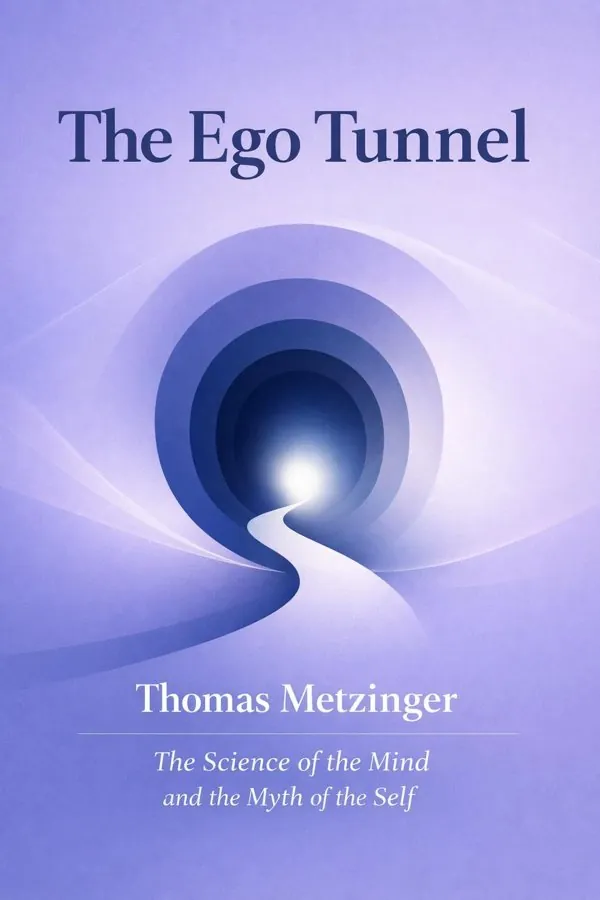
The Ego Tunnel: The Science of the Mind and the Myth of the Self: Summary & Key Insights
 10 min8 chaptersAudio available
What Is The Ego Tunnel: The Science of the Mind and the Myth of the Self About?
The Ego Tunnel: The Science of the Mind and the Myth of the Self by Thomas Metzinger is a neuroscience book spanning 8 pages. In this groundbreaking work, philosopher Thomas Metzinger explores how consciousness arises and why the sense of a stable self is an illusion. Drawing on insights from philosophy, neuroscience, and cognitive science, he argues that the self is a dynamic model created by the brain to navigate the world efficiently. The book challenges traditional notions of identity and consciousness, offering a compelling scientific and philosophical account of what it means to be human.
This FizzRead summary covers all 8 key chapters of The Ego Tunnel: The Science of the Mind and the Myth of the Self in approximately 10 minutes, distilling the most important ideas, arguments, and takeaways from Thomas Metzinger's work. Also available as an audio summary and Key Quotes Podcast.
The Ego Tunnel: The Science of the Mind and the Myth of the Self
In this groundbreaking work, philosopher Thomas Metzinger explores how consciousness arises and why the sense of a stable self is an illusion. Drawing on insights from philosophy, neuroscience, and cognitive science, he argues that the self is a dynamic model created by the brain to navigate the world efficiently. The book challenges traditional notions of identity and consciousness, offering a compelling scientific and philosophical account of what it means to be human.
Who Should Read The Ego Tunnel: The Science of the Mind and the Myth of the Self?
This book is perfect for anyone interested in neuroscience and looking to gain actionable insights in a short read. Whether you're a student, professional, or lifelong learner, the key ideas from The Ego Tunnel: The Science of the Mind and the Myth of the Self by Thomas Metzinger will help you think differently.
- ✓Readers who enjoy neuroscience and want practical takeaways
- ✓Professionals looking to apply new ideas to their work and life
- ✓Anyone who wants the core insights of The Ego Tunnel: The Science of the Mind and the Myth of the Self in just 10 minutes
Want the full summary?
Get instant access to this book summary and 100K+ more with Fizz Moment.
Get Free SummaryAvailable on App Store • Free to download
Key Chapters
At the heart of consciousness lies the Phenomenal Self-Model, or PSM. This is the brain’s dynamic representation that integrates sensory data, emotions, intentions, and memories into a single, coherent experience of being someone. From the inside, we do not experience the brain’s operations; instead, we live within the unified model they produce.
Think of how, in every moment, you feel located behind your eyes, seeing the world through a single point of view. That apparent center of awareness is not an inner agent—it is the product of neural modeling. The PSM continually updates and maintains coherence among your perception, bodily sensations, and thoughts, enabling you to act as if you were a single individual. Without this ongoing construction, normal consciousness could not exist.
Scientific research into body ownership illusions, such as the rubber hand experiment, shows how flexible this model is. When sensory inputs are manipulated, the brain quickly incorporates alien sensations into the self-model. Similarly, out-of-body experiences demonstrate how the sense of location can shift dramatically when the model’s integration breaks down. These phenomena expose the underlying principle: the self is not a thing inside the body, but the way the brain represents the body and its relation to the world.
In writing of the PSM, my purpose is not merely to describe a mechanism, but to suggest how deeply our subjective continuity depends on it. We wake each morning into a seamless 'I' because the brain rehearses selfhood automatically. But this unity is functional, not metaphysical—it helps organize perception, memory, and action for survival and communication. By studying the PSM, we can bridge the philosophical gap between first-person experience and third-person neuroscience, discovering how subjective life arises from biological computation.
We do not see the inner workings of our minds. We see the world as if it were given directly, without mediation. This 'transparency' of mental models is what makes subjective experience so convincing. When you look around, you do not perceive neural representations—you perceive objects that seem to exist independently. The same applies to the self. The content of the self-model is transparent to us: we do not recognize it as a model, just as we do not notice the pixels on a screen while absorbed in a film.
Transparency is the key to the illusion of selfhood. The brain’s representations of the world and of 'I' are effectively invisible as representations—they present themselves as reality. This is what traps us in the ego tunnel: we mistake the model for the world, and the self for substance. Yet the scientific and philosophical insight that the self is an illusion does not entail that consciousness is unreal. It only means that what we take to be an unchanging self is in fact a dynamic representation, continuously updated by sensory and cognitive processes.
Understanding this transparency is liberating. When you realize that emotions, memories, and self-images are constructions, you gain perspective on their impermanence. The experience remains vivid, but you no longer have to believe that there is an immutable observer behind it. This awareness does not diminish life—it enriches it, allowing you to navigate your own tunnel with clarity and compassion.
+ 6 more chapters — available in the FizzRead app
All Chapters in The Ego Tunnel: The Science of the Mind and the Myth of the Self
About the Author
Thomas Metzinger is a German philosopher and professor at Johannes Gutenberg University Mainz. He is known for his influential work in the philosophy of mind, consciousness studies, and neuroethics, and is regarded as one of the leading thinkers in contemporary philosophy of consciousness.
Get This Summary in Your Preferred Format
Read or listen to the The Ego Tunnel: The Science of the Mind and the Myth of the Self summary by Thomas Metzinger anytime, anywhere. FizzRead offers multiple formats so you can learn on your terms — all free.
Available formats: App · Audio · PDF · EPUB — All included free with FizzRead
Download The Ego Tunnel: The Science of the Mind and the Myth of the Self PDF and EPUB Summary
Key Quotes from The Ego Tunnel: The Science of the Mind and the Myth of the Self
“At the heart of consciousness lies the Phenomenal Self-Model, or PSM.”
“We do not see the inner workings of our minds.”
Frequently Asked Questions about The Ego Tunnel: The Science of the Mind and the Myth of the Self
The Ego Tunnel: The Science of the Mind and the Myth of the Self by Thomas Metzinger is a neuroscience book that explores key ideas across 8 chapters. In this groundbreaking work, philosopher Thomas Metzinger explores how consciousness arises and why the sense of a stable self is an illusion. Drawing on insights from philosophy, neuroscience, and cognitive science, he argues that the self is a dynamic model created by the brain to navigate the world efficiently. The book challenges traditional notions of identity and consciousness, offering a compelling scientific and philosophical account of what it means to be human.
You Might Also Like
Anxious
Joseph LeDoux
10 min
Hallucinations
Oliver Sacks
10 min
The Biological Mind: How Brain, Body, and Environment Collaborate to Make Us Who We Are
Alan Jasanoff
10 min
The Feeling of Life Itself: Why Consciousness Is Widespread but Can't Be Computed
Christof Koch
10 min
The No-Nonsense Meditation Book
Steven Laureys
10 min
A General Theory of Love
Thomas Lewis, Fari Amini, Richard Lannon
10 minBrowse by Category
Ready to read The Ego Tunnel: The Science of the Mind and the Myth of the Self?
Get the full summary and 100K+ more books with Fizz Moment.