
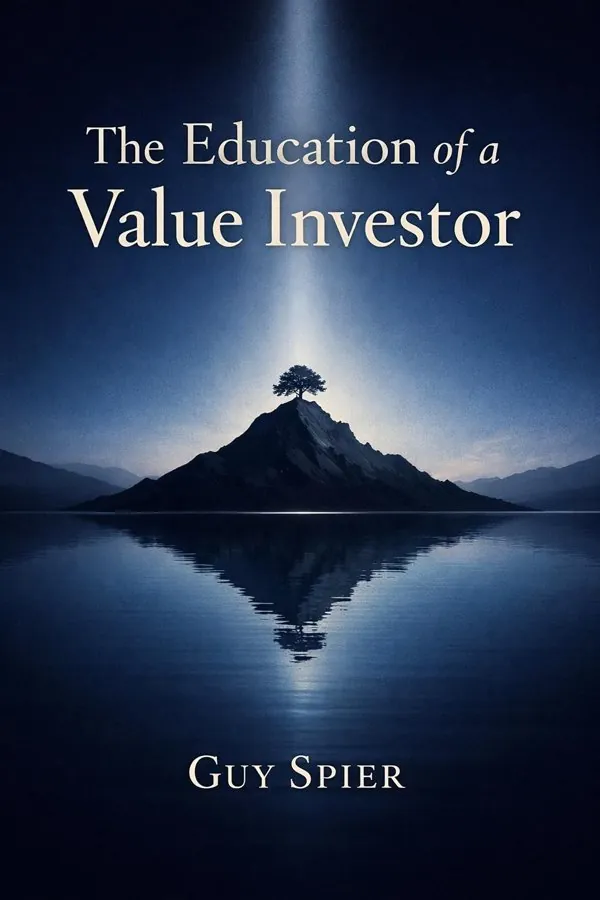
The Education of a Value Investor: My Transformative Quest for Wealth, Wisdom, and Enlightenment: Summary & Key Insights
by Guy Spier
 10 min9 chaptersAudio available
Key Takeaways from The Education of a Value Investor: My Transformative Quest for Wealth, Wisdom, and Enlightenment
A brilliant résumé does not protect you from becoming the wrong kind of person.
Sometimes the fastest way to transform your life is to find better heroes.
We like to imagine that discipline is purely internal, but often the mind follows the map.
An investment fund is not just a portfolio; it is a container for its manager’s habits, fears, and beliefs.
The market is full of analytical challenges, but some of the most expensive mistakes begin as emotional ones.
What Is The Education of a Value Investor: My Transformative Quest for Wealth, Wisdom, and Enlightenment About?
The Education of a Value Investor: My Transformative Quest for Wealth, Wisdom, and Enlightenment by Guy Spier is a finance book spanning 8 pages. The Education of a Value Investor is not just a book about beating the market. It is a memoir of moral repair, psychological discipline, and intellectual reinvention. In it, Guy Spier tells the story of how he moved from a status-driven, insecure, and ethically compromised young financier into a calmer, more principled investor shaped by the ideas of Warren Buffett and other value investing mentors. The result is a rare finance book that treats investing not merely as a technical exercise, but as a reflection of character. What makes the book matter is its honesty. Spier does not present himself as a born sage. He writes candidly about bad decisions, envy, ego, social comparison, and the corrupting incentives of Wall Street. He shows that superior investing often begins with improving the investor: choosing the right environment, controlling emotional triggers, building good habits, and defining success on healthier terms. Spier brings unusual authority to these lessons. Educated at Oxford and Harvard Business School and later manager of the Aquamarine Fund, he combines elite financial training with hard-earned humility. His memoir offers both practical investing wisdom and a deeper guide to living more rationally, ethically, and intentionally.
This FizzRead summary covers all 9 key chapters of The Education of a Value Investor: My Transformative Quest for Wealth, Wisdom, and Enlightenment in approximately 10 minutes, distilling the most important ideas, arguments, and takeaways from Guy Spier's work. Also available as an audio summary and Key Quotes Podcast.
The Education of a Value Investor: My Transformative Quest for Wealth, Wisdom, and Enlightenment
The Education of a Value Investor is not just a book about beating the market. It is a memoir of moral repair, psychological discipline, and intellectual reinvention. In it, Guy Spier tells the story of how he moved from a status-driven, insecure, and ethically compromised young financier into a calmer, more principled investor shaped by the ideas of Warren Buffett and other value investing mentors. The result is a rare finance book that treats investing not merely as a technical exercise, but as a reflection of character.
What makes the book matter is its honesty. Spier does not present himself as a born sage. He writes candidly about bad decisions, envy, ego, social comparison, and the corrupting incentives of Wall Street. He shows that superior investing often begins with improving the investor: choosing the right environment, controlling emotional triggers, building good habits, and defining success on healthier terms.
Spier brings unusual authority to these lessons. Educated at Oxford and Harvard Business School and later manager of the Aquamarine Fund, he combines elite financial training with hard-earned humility. His memoir offers both practical investing wisdom and a deeper guide to living more rationally, ethically, and intentionally.
Who Should Read The Education of a Value Investor: My Transformative Quest for Wealth, Wisdom, and Enlightenment?
This book is perfect for anyone interested in finance and looking to gain actionable insights in a short read. Whether you're a student, professional, or lifelong learner, the key ideas from The Education of a Value Investor: My Transformative Quest for Wealth, Wisdom, and Enlightenment by Guy Spier will help you think differently.
- ✓Readers who enjoy finance and want practical takeaways
- ✓Professionals looking to apply new ideas to their work and life
- ✓Anyone who wants the core insights of The Education of a Value Investor: My Transformative Quest for Wealth, Wisdom, and Enlightenment in just 10 minutes
Want the full summary?
Get instant access to this book summary and 100K+ more with Fizz Moment.
Get Free SummaryAvailable on App Store • Free to download
Key Chapters
A brilliant résumé does not protect you from becoming the wrong kind of person. One of the book’s most powerful lessons is that external success can coexist with internal confusion, especially when ambition outruns judgment. Guy Spier begins his journey as a highly credentialed young professional eager to prove himself in the world of high finance. He joins D. H. Blair, a brokerage firm that gives him access to money, prestige, and opportunity. But that environment also exposes him to manipulation, short-termism, and ethically dubious behavior that slowly distorts his own standards.
Spier’s insight is that people are more vulnerable to their surroundings than they think. He did not wake up one day intending to compromise his values. Instead, he adapted gradually to the incentives, language, and norms around him. That is how moral erosion often happens: not through one dramatic collapse, but through repeated small accommodations. His early Wall Street experience becomes a painful education in the cost of ignoring character.
This idea matters far beyond finance. In any career, the culture around you influences what you normalize, reward, and excuse. A salesperson may begin exaggerating to hit quota. A founder may start cutting corners to impress investors. A young lawyer may confuse aggression with excellence. Spier’s story reminds us that environments shape identity.
The practical application is simple but demanding: audit the systems you live inside. Ask whether your workplace rewards honesty or gamesmanship, patience or vanity, learning or posturing. If success in your environment requires becoming someone you do not respect, the problem is not merely tactical. It is existential.
Actionable takeaway: Examine the incentives, role models, and daily behaviors in your professional life, and remove yourself from environments that steadily train you to betray your own values.
Sometimes the fastest way to transform your life is to find better heroes. For Spier, the turning point came when he encountered Warren Buffett’s philosophy and later developed a close friendship with investor Mohnish Pabrai. What drew him in was not only Buffett’s investment record, but the emotional texture of Buffett’s approach: patience instead of frenzy, rationality instead of ego, independence instead of imitation, and integrity instead of performance.
Buffett represented a radically different model from the one Spier had absorbed on Wall Street. Rather than chasing excitement, Buffett focused on understandable businesses, sensible prices, and long-term compounding. He did not need to sound brilliant every day or react to every market move. He built a life and process designed to reduce noise. Pabrai reinforced these lessons in a more immediate way. Through conversation, shared curiosity, and practical example, he helped Spier see that great investing could be simpler, calmer, and more ethical than he had imagined.
A major insight here is that learning is social. We often think self-improvement comes from reading more books or developing more willpower. But Spier shows that proximity to better thinkers can rewire your standards. If your peers obsess over short-term gains, you begin to do the same. If your peers talk about intrinsic value, temperament, and lifelong learning, your attention changes.
In practical terms, this means choosing intellectual mentors carefully. You may never meet Buffett, but you can study his letters, speeches, and decisions. You can spend more time with people who think clearly and behave decently. You can model your calendar and workflow on people whose outcomes you admire.
Actionable takeaway: Identify two or three people whose principles deserve imitation, then deliberately shape your reading, conversations, and routines around their way of thinking.
We like to imagine that discipline is purely internal, but often the mind follows the map. Spier’s move away from New York becomes a crucial part of his transformation because it reduces the constant psychological pressure of comparison, speed, and status competition. New York had offered access, energy, and opportunity, but it also amplified anxiety and encouraged a style of investing driven by noise rather than clarity. Leaving that environment allowed him to think more independently.
This is one of the book’s most practical insights: physical setting influences mental quality. In a city or workplace built around urgency, it becomes harder to be reflective. When everyone around you is reacting, boasting, or competing, your nervous system absorbs that tempo. Spier recognized that if he wanted to invest like Buffett, he could not remain immersed in a culture built around the opposite values.
His relocation was not an act of retreat, but of design. By creating distance from Wall Street’s emotional weather, he gave himself a better chance to make long-term decisions. This principle applies broadly. Writers rent cabins to finish books. Founders block off deep-work days away from meetings. Families move neighborhoods to align daily life with their priorities. Good decisions become easier in good settings.
The deeper message is that self-control is often overrated compared with self-architecture. Rather than trying to resist temptation every minute, build a context where the temptations are weaker and the signals are cleaner. If market commentary makes you impulsive, consume less of it. If social media fuels envy, reduce exposure. If your office destroys concentration, redesign your workspace.
Actionable takeaway: Make one environmental change this week—physical, digital, or social—that removes noise and makes thoughtful long-term behavior easier.
An investment fund is not just a portfolio; it is a container for its manager’s habits, fears, and beliefs. As Spier rethinks his philosophy, he begins to reshape the Aquamarine Fund to reflect sounder principles. This means rejecting the need to appear constantly active, resisting the pressure to mimic competitors, and focusing instead on a smaller number of understandable opportunities approached with patience and discipline.
Spier learns that process matters more than image. In the early stages of a career, it is easy to confuse activity with competence. Constant trading feels intelligent. Elaborate analysis can feel superior. But value investing requires the opposite temperament: waiting for rare moments when price and value diverge enough to create a favorable risk-reward profile. That approach can look uneventful from the outside, yet it is often more effective.
He also adopts practical rules to reduce avoidable errors. These include being more careful about how he researches investments, how he handles ideas from others, and how he separates independent thinking from social influence. In essence, Aquamarine becomes not just a fund but a personal operating system designed to protect judgment.
The lesson for readers is that every serious pursuit benefits from explicit principles. An investor can define a circle of competence, valuation discipline, and checklist. A manager can define hiring standards and decision rights. A household can define spending rules and savings goals. Systems reduce the power of mood.
Spier’s example shows that long-term excellence rarely comes from brilliance alone. It comes from aligning structure with principle, then repeating the process consistently over time.
Actionable takeaway: Write down the three to five rules that should govern your most important decisions, and use them as a filter before acting under pressure.
The market is full of analytical challenges, but some of the most expensive mistakes begin as emotional ones. Spier is unusually candid about how ego, envy, and the desire for status distorted his judgment. He compares himself to other investors, wants to keep up, and sometimes allows admiration or insecurity to override independent analysis. The result is a painful realization: intelligence is not enough if your inner life remains unmanaged.
One of the book’s strongest contributions is this psychological honesty. Investors often like to believe they are objective, but they are vulnerable to social ranking just like everyone else. Seeing others get rich faster can trigger recklessness. Wanting to appear sophisticated can lead to complexity for its own sake. A bruised ego can prevent admitting mistakes. Spier understands that emotional discipline is not an optional supplement to investing; it is central to survival.
This lesson extends well beyond markets. Professionals compare titles, entrepreneurs compare funding rounds, and ordinary people compare lifestyles. The comparison instinct is endless because there is always someone richer, faster, younger, or more celebrated. Left unchecked, it produces chronic dissatisfaction and poor choices.
Spier’s response is not to become emotionless, but to become more observant and less reactive. He learns to notice envy without obeying it, to avoid unnecessary exposure to status triggers, and to define success in more inward terms. That shift creates space for better decisions and a more stable sense of self.
In practical life, this may mean limiting performance gossip, reviewing your own goals before major decisions, or pausing when you feel urgency generated by someone else’s success. Awareness breaks the spell.
Actionable takeaway: The next time you feel rushed by comparison, stop and ask: is this decision driven by intrinsic value, or by my need to match someone else?
A famous lunch can be memorable because of the setting, but transformative because of what it reveals about a life. Spier famously paid a large sum at a charity auction for the opportunity to have lunch with Warren Buffett. On the surface, this may look like a networking stunt or an extravagant splurge. In reality, the experience becomes a symbol of commitment and a source of deeper learning about generosity, simplicity, and the intelligent use of success.
What Spier takes from Buffett is not a secret stock tip or market prediction. Instead, he observes a man whose public greatness is matched by coherence of character. Buffett’s combination of intellectual rigor, emotional steadiness, humility, and philanthropy offers Spier a broader model of what a successful life can be. Wealth, in this framework, is not an end in itself. It is a byproduct of sound thinking and, ideally, a resource to be used responsibly.
The episode also highlights the value of paying for access when it meaningfully accelerates growth. Many people spend generously on status symbols but hesitate to invest in experiences that sharpen judgment. Spier’s lunch represents a deliberate choice to place learning over display. The return came not as immediate profit, but as reinforced conviction about the kind of investor and person he wanted to become.
Readers can apply this idea by investing in high-quality learning opportunities: mentorship, seminars, conferences, coaching, or even time with thoughtful peers. The key is intentionality. Spend not to impress, but to improve.
Actionable takeaway: Redirect one discretionary expense toward an experience, conversation, or educational opportunity that could meaningfully elevate your thinking for years to come.
Willpower is unreliable; design is underrated. One of Spier’s most practical themes is that wise behavior becomes more likely when you intentionally shape the conditions around you. Rather than relying on heroic self-discipline, he develops routines, boundaries, and informational filters that reduce distraction and emotional interference. In doing so, he treats investing as an ecological problem: if the environment is unhealthy, judgment will suffer.
This leads him to make specific choices about how he works. He limits exposure to noisy market commentary. He becomes more careful about meetings that can bias his thinking. He structures his reading and research so that original analysis comes before outside opinion. He adopts checklists and process tools to prevent impulsive errors. Each of these changes may seem small, but together they create a calmer, more rational decision environment.
The lesson is powerful because it can be applied anywhere. If you want to save money, automate transfers so discipline is built in. If you want to read more, place books where your phone used to be. If you want better meetings, create agendas and decision rules in advance. If you want less emotional reactivity, build pauses before responding to difficult emails or market moves.
Wisdom often looks mystical from a distance, but in practice it is frequently logistical. Better defaults produce better lives. Spier does not wait to become perfectly enlightened before acting wisely; he builds scaffolding that supports wiser action now.
Actionable takeaway: Choose one recurring weak point in your decision-making and redesign the environment around it so the better choice becomes the easier choice.
Great investing is less about brilliant predictions than about repeatable habits that protect you from self-inflicted damage. Throughout the book, Spier emphasizes the importance of cultivating routines that improve patience, clarity, and resilience over many years. These habits are deceptively simple: read widely, think independently, keep a long horizon, use checklists, avoid overtrading, and stay within your circle of competence.
What makes these habits powerful is that they compound. A checklist prevents one major error. A reading habit gradually deepens pattern recognition. A long-term orientation reduces churn and taxes. Emotional restraint preserves capital during periods when others panic. Over a decade or two, these seemingly modest behaviors can create a dramatic edge.
Spier also highlights the value of reflection. Writing down mistakes, reviewing decisions, and understanding why an investment succeeded or failed helps transform experience into judgment. Without reflection, time merely passes. With reflection, time teaches. This is relevant to anyone building expertise. Athletes review game film. Pilots use post-flight analysis. Leaders conduct after-action reviews. Learning requires feedback loops.
Another key habit is selective attention. Because opportunities are unevenly distributed, the investor does not need to act constantly. He needs to be ready when the right opportunity appears. That means preserving mental energy instead of wasting it on every headline or idea.
The broader implication is encouraging: you do not need to be a genius to improve outcomes. You need a small set of durable practices followed consistently.
Actionable takeaway: Create a personal investing or decision journal and record the thesis, risks, emotions, and outcome of your major decisions so your future self can learn systematically.
The deepest transformation in Spier’s memoir is not financial but philosophical. Over time, he realizes that the point of investing is not merely to accumulate money, but to build a life defined by autonomy, integrity, peace of mind, and meaningful relationships. This is why the book resonates even with readers who care little about stock analysis. It is really about the difference between living reactively and living deliberately.
Early in his life, success meant credentials, money, prestige, and proximity to elite circles. Those goals delivered recognition but not calm. By contrast, the value-investing mindset gradually teaches him to prefer substance over spectacle, patience over performance, and self-respect over status. This shift has practical consequences. He becomes more selective about where he lives, whom he spends time with, how he works, and what he measures.
Inner freedom, in Spier’s account, comes from reducing dependence on external validation. When your identity no longer hinges on beating rivals, impressing peers, or proving your intelligence every day, decision quality improves. So does life. You become harder to manipulate because fewer external rewards can bait you into bad choices.
This is a valuable framework for any ambitious person. Career achievement is worthwhile, but it should serve a larger aim. If money buys comfort but destroys character, the trade is poor. If success expands options while deepening wisdom and generosity, it is more complete.
Actionable takeaway: Define success in a sentence that includes character and freedom, not just income or status, and use that definition to evaluate your biggest commitments.
All Chapters in The Education of a Value Investor: My Transformative Quest for Wealth, Wisdom, and Enlightenment
About the Author
Guy Spier is a Zurich-based investor, author, and manager of the Aquamarine Fund. Educated at the University of Oxford and Harvard Business School, he began his career in finance with the conventional markers of elite success, but later became known for rejecting many of Wall Street’s more corrosive values. Deeply influenced by Warren Buffett and by the principles of value investing, Spier built a reputation for disciplined long-term thinking, ethical reflection, and psychological self-awareness. His writing stands out for combining financial insight with unusual candor about ego, envy, mistakes, and personal growth. Through his memoir and public speaking, he has become a respected voice not only on investing, but also on how environment, character, and temperament shape both performance and a meaningful life.
Get This Summary in Your Preferred Format
Read or listen to the The Education of a Value Investor: My Transformative Quest for Wealth, Wisdom, and Enlightenment summary by Guy Spier anytime, anywhere. FizzRead offers multiple formats so you can learn on your terms — all free.
Available formats: App · Audio · PDF · EPUB — All included free with FizzRead
Download The Education of a Value Investor: My Transformative Quest for Wealth, Wisdom, and Enlightenment PDF and EPUB Summary
Key Quotes from The Education of a Value Investor: My Transformative Quest for Wealth, Wisdom, and Enlightenment
“A brilliant résumé does not protect you from becoming the wrong kind of person.”
“Sometimes the fastest way to transform your life is to find better heroes.”
“We like to imagine that discipline is purely internal, but often the mind follows the map.”
“An investment fund is not just a portfolio; it is a container for its manager’s habits, fears, and beliefs.”
“The market is full of analytical challenges, but some of the most expensive mistakes begin as emotional ones.”
Frequently Asked Questions about The Education of a Value Investor: My Transformative Quest for Wealth, Wisdom, and Enlightenment
The Education of a Value Investor: My Transformative Quest for Wealth, Wisdom, and Enlightenment by Guy Spier is a finance book that explores key ideas across 9 chapters. The Education of a Value Investor is not just a book about beating the market. It is a memoir of moral repair, psychological discipline, and intellectual reinvention. In it, Guy Spier tells the story of how he moved from a status-driven, insecure, and ethically compromised young financier into a calmer, more principled investor shaped by the ideas of Warren Buffett and other value investing mentors. The result is a rare finance book that treats investing not merely as a technical exercise, but as a reflection of character. What makes the book matter is its honesty. Spier does not present himself as a born sage. He writes candidly about bad decisions, envy, ego, social comparison, and the corrupting incentives of Wall Street. He shows that superior investing often begins with improving the investor: choosing the right environment, controlling emotional triggers, building good habits, and defining success on healthier terms. Spier brings unusual authority to these lessons. Educated at Oxford and Harvard Business School and later manager of the Aquamarine Fund, he combines elite financial training with hard-earned humility. His memoir offers both practical investing wisdom and a deeper guide to living more rationally, ethically, and intentionally.
You Might Also Like




Browse by Category
Ready to read The Education of a Value Investor: My Transformative Quest for Wealth, Wisdom, and Enlightenment?
Get the full summary and 100K+ more books with Fizz Moment.