
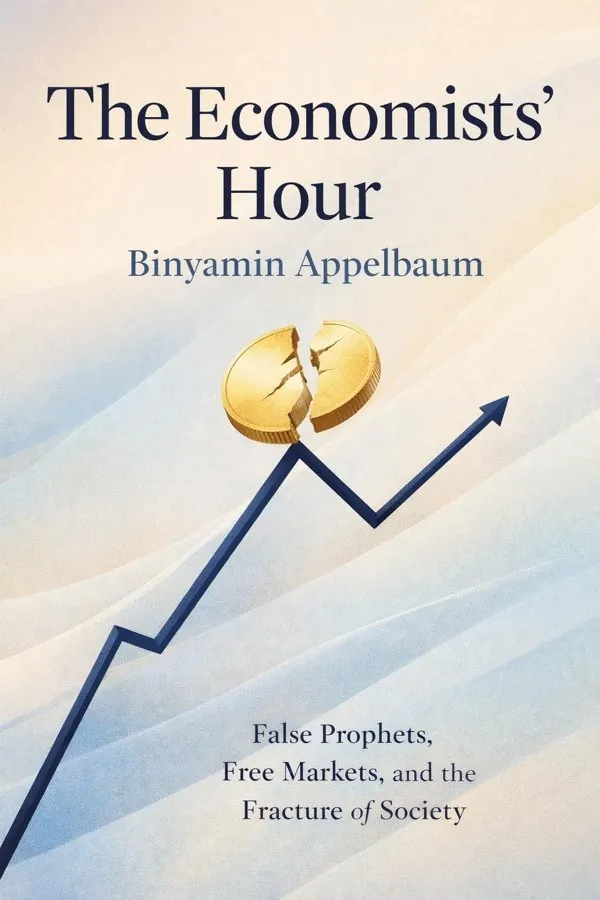
The Economists’ Hour: False Prophets, Free Markets, and the Fracture of Society: Summary & Key Insights
 10 min10 chaptersAudio available
What Is The Economists’ Hour: False Prophets, Free Markets, and the Fracture of Society About?
The Economists’ Hour: False Prophets, Free Markets, and the Fracture of Society by Binyamin Appelbaum is a economics book spanning 10 pages. The book explores how economists gained influence over public policy from the 1960s onward, shaping governments’ approaches to markets, regulation, and inequality. Appelbaum traces the rise of free-market thinking and its consequences for social and political life, arguing that the dominance of economic reasoning has contributed to widening inequality and weakened democratic institutions.
This FizzRead summary covers all 10 key chapters of The Economists’ Hour: False Prophets, Free Markets, and the Fracture of Society in approximately 10 minutes, distilling the most important ideas, arguments, and takeaways from Binyamin Appelbaum's work. Also available as an audio summary and Key Quotes Podcast.
The Economists’ Hour: False Prophets, Free Markets, and the Fracture of Society
The book explores how economists gained influence over public policy from the 1960s onward, shaping governments’ approaches to markets, regulation, and inequality. Appelbaum traces the rise of free-market thinking and its consequences for social and political life, arguing that the dominance of economic reasoning has contributed to widening inequality and weakened democratic institutions.
Who Should Read The Economists’ Hour: False Prophets, Free Markets, and the Fracture of Society?
This book is perfect for anyone interested in economics and looking to gain actionable insights in a short read. Whether you're a student, professional, or lifelong learner, the key ideas from The Economists’ Hour: False Prophets, Free Markets, and the Fracture of Society by Binyamin Appelbaum will help you think differently.
- ✓Readers who enjoy economics and want practical takeaways
- ✓Professionals looking to apply new ideas to their work and life
- ✓Anyone who wants the core insights of The Economists’ Hour: False Prophets, Free Markets, and the Fracture of Society in just 10 minutes
Want the full summary?
Get instant access to this book summary and 100K+ more with Fizz Moment.
Get Free SummaryAvailable on App Store • Free to download
Key Chapters
When I look back to the decades immediately after World War II, I see a very different kind of faith guiding economic life. Governments did not hesitate to intervene. The lessons of the Great Depression had forged a global consensus: unfettered markets were dangerous, prone to collapse under their own contradictions. Inspired by John Maynard Keynes, policymakers saw government as an indispensable stabilizer, the institution responsible for maintaining full employment and ensuring social security. The state built highways, guaranteed mortgages, invested in education, and regulated industries that were thought too essential—too intertwined with public welfare—to be left purely to private hands.
This was capitalism with an active conscience. In America, the GI Bill turned veterans into homeowners and college graduates. In Europe, welfare states grew like fortresses against the return of the interwar despair. Across much of the developed world, citizens took for granted that the government’s role was not only to protect them from external threats but also to safeguard them from the insecurities of the market.
Yet embedded within this consensus were seeds of discontent. Bureaucracy looked sluggish to young economists who saw inefficiency everywhere they turned. Inflation, wage controls, and rigid industrial policies seemed like signs of stagnation. The Keynesian model had built prosperity, but it also created dependency on constant management from above. A new generation of thinkers began asking whether all this government guidance was really necessary—or even desirable.
Out of that questioning arose what I call the economists’ rebellion. Milton Friedman, George Stigler, and their colleagues at the University of Chicago led a quiet but radical counterrevolution. They argued that markets were not fragile, as Keynesians believed, but resilient, self-correcting, and wiser than any government technocrat could ever be. If only regulation would step aside, prices and incentives would do what bureaucrats could not: allocate resources efficiently, encourage innovation, and respect individual choice.
For Friedman, the moral core of economics was freedom itself. Each regulation was a constraint on the ability of individuals to choose. He believed that government authorities, however well-intentioned, would inevitably distort outcomes, capture special interests, and impose hidden costs. These ideas struck a chord precisely because the visible machinery of mid-century governance—massive agencies, inflationary budgets, wage and price controls—seemed increasingly out of step with an age of burgeoning consumer aspiration.
The 1960s and ’70s became a crucible for these competing visions. Market economists found allies among business leaders who resented regulation, and among politicians disillusioned by the limits of Keynesianism. Gradually, the intellectual pendulum began to swing. Economics, once a tool for balancing capitalism’s inequities, started to evolve into an argument for letting capitalism run free.
+ 8 more chapters — available in the FizzRead app
All Chapters in The Economists’ Hour: False Prophets, Free Markets, and the Fracture of Society
About the Author
Binyamin Appelbaum is an American journalist and editorial writer for The New York Times, specializing in economics and public policy. Before joining the Times, he reported for The Washington Post and The Charlotte Observer, where his work on the housing crisis earned national recognition.
Get This Summary in Your Preferred Format
Read or listen to the The Economists’ Hour: False Prophets, Free Markets, and the Fracture of Society summary by Binyamin Appelbaum anytime, anywhere. FizzRead offers multiple formats so you can learn on your terms — all free.
Available formats: App · Audio · PDF · EPUB — All included free with FizzRead
Download The Economists’ Hour: False Prophets, Free Markets, and the Fracture of Society PDF and EPUB Summary
Key Quotes from The Economists’ Hour: False Prophets, Free Markets, and the Fracture of Society
“When I look back to the decades immediately after World War II, I see a very different kind of faith guiding economic life.”
“Out of that questioning arose what I call the economists’ rebellion.”
Frequently Asked Questions about The Economists’ Hour: False Prophets, Free Markets, and the Fracture of Society
The Economists’ Hour: False Prophets, Free Markets, and the Fracture of Society by Binyamin Appelbaum is a economics book that explores key ideas across 10 chapters. The book explores how economists gained influence over public policy from the 1960s onward, shaping governments’ approaches to markets, regulation, and inequality. Appelbaum traces the rise of free-market thinking and its consequences for social and political life, arguing that the dominance of economic reasoning has contributed to widening inequality and weakened democratic institutions.
You Might Also Like
Business Adventures
John Brooks
10 min
Nudge
Richard H. Thaler, Cass R. Sunstein
10 min
The Hitchhiker"s Guide to the Galaxy
Douglas Adams
10 minThe Muqaddimah
Ibn Khaldun
10 minThe Outsiders
William N. Thorndike
10 min
A Little History of Economics
Niall Kishtainy
10 minBrowse by Category
Ready to read The Economists’ Hour: False Prophets, Free Markets, and the Fracture of Society?
Get the full summary and 100K+ more books with Fizz Moment.