
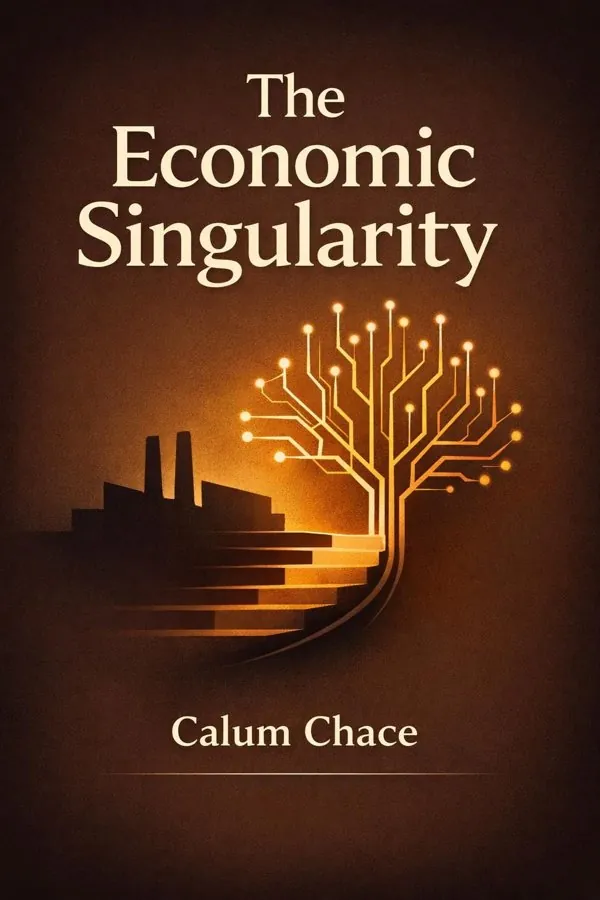
The Economic Singularity: Artificial Intelligence and the Death of Capitalism: Summary & Key Insights
by Calum Chace
 10 min7 chaptersAudio available
What Is The Economic Singularity: Artificial Intelligence and the Death of Capitalism About?
The Economic Singularity: Artificial Intelligence and the Death of Capitalism by Calum Chace is a ai_ml book spanning 7 pages. The Economic Singularity explores the profound economic and social transformations that may occur as artificial intelligence advances to the point where most human labor becomes obsolete. Calum Chace examines the potential consequences of mass technological unemployment, the need for new economic models such as universal basic income, and the philosophical implications of a post-scarcity world driven by intelligent machines.
This FizzRead summary covers all 7 key chapters of The Economic Singularity: Artificial Intelligence and the Death of Capitalism in approximately 10 minutes, distilling the most important ideas, arguments, and takeaways from Calum Chace's work. Also available as an audio summary and Key Quotes Podcast.
The Economic Singularity: Artificial Intelligence and the Death of Capitalism
The Economic Singularity explores the profound economic and social transformations that may occur as artificial intelligence advances to the point where most human labor becomes obsolete. Calum Chace examines the potential consequences of mass technological unemployment, the need for new economic models such as universal basic income, and the philosophical implications of a post-scarcity world driven by intelligent machines.
Who Should Read The Economic Singularity: Artificial Intelligence and the Death of Capitalism?
This book is perfect for anyone interested in ai_ml and looking to gain actionable insights in a short read. Whether you're a student, professional, or lifelong learner, the key ideas from The Economic Singularity: Artificial Intelligence and the Death of Capitalism by Calum Chace will help you think differently.
- ✓Readers who enjoy ai_ml and want practical takeaways
- ✓Professionals looking to apply new ideas to their work and life
- ✓Anyone who wants the core insights of The Economic Singularity: Artificial Intelligence and the Death of Capitalism in just 10 minutes
Want the full summary?
Get instant access to this book summary and 100K+ more with Fizz Moment.
Get Free SummaryAvailable on App Store • Free to download
Key Chapters
Throughout history, every technological revolution has transformed labor. The agricultural era gave way to industrialization, which in turn birthed the digital economy. When steam engines arrived, many feared displacement, yet new industries compensated for lost jobs. The same pattern followed with electricity, internal combustion, and computing. Productivity soared, living standards improved, and economic growth fueled employment in newly invented sectors. But the coming wave—driven by artificial intelligence and robotics—differs in kind, not just degree.
In earlier transitions, human input remained essential. Machines extended our reach but did not independently generate creativity or cognition. The industrial revolution replaced muscle; the digital revolution began to nibble at cognition. The AI revolution threatens to render both obsolete. Historical perspective teaches caution: to assume the past guarantees a similar future may be naive. Where previous technologies created complementary jobs, AI tends toward substitution—replacing, rather than augmenting, human capability. This distinction is the seed of the singularity.
Reflecting on the evolution of productivity helps grasp why capitalism functions at all. The system depends on wages feeding consumption, consumption stimulating production, and production generating profits that recycle back into wages. When workers no longer earn, this cycle breaks. History offers examples—mechanization of weaving, the collapse of certain trades—but always in isolated industries. The economic singularity foresees systemic redundancy, as automation permeates every profession, from logistics to law.
Automation today is no longer confined to manufacturing lines. With the fusion of machine learning, big data, and robotics, machines are acquiring judgment. They diagnose illnesses, analyze contracts, and optimize systems beyond human comprehension. The rise of machine learning—the ability of algorithms to improve without explicit programming—transforms automation from mechanical repetition to intellectual substitution.
Consider autonomous vehicles. Driving is complex, requiring perception, prediction, and quick reflexes. Yet vehicles trained on vast datasets now outperform human drivers in safety metrics. Multiply this competence across all sectors: administrative tasks, translation, design, and even creative arts. The consequences ripple through every economy. Employment, traditionally the means of distributing wealth, falters.
The point is not that technology is inherently destructive, but that its acceleration outpaces our capacity to adapt social structures. Capitalism evolved under conditions of human scarcity; automation produces abundance with minimal human input. When scarcity vanishes, value must be redefined. In this section, I urge the reader to see AI not only as a technical marvel but as an economic force—an engine reshaping the entire foundation of human exchange and purpose.
+ 5 more chapters — available in the FizzRead app
All Chapters in The Economic Singularity: Artificial Intelligence and the Death of Capitalism
About the Author
Calum Chace is a British author and speaker specializing in the impact of artificial intelligence on society and the economy. He has written several books on AI, including 'Surviving AI' and 'The Economic Singularity', and is known for his accessible explanations of complex technological trends.
Get This Summary in Your Preferred Format
Read or listen to the The Economic Singularity: Artificial Intelligence and the Death of Capitalism summary by Calum Chace anytime, anywhere. FizzRead offers multiple formats so you can learn on your terms — all free.
Available formats: App · Audio · PDF · EPUB — All included free with FizzRead
Download The Economic Singularity: Artificial Intelligence and the Death of Capitalism PDF and EPUB Summary
Key Quotes from The Economic Singularity: Artificial Intelligence and the Death of Capitalism
“Throughout history, every technological revolution has transformed labor.”
“Automation today is no longer confined to manufacturing lines.”
Frequently Asked Questions about The Economic Singularity: Artificial Intelligence and the Death of Capitalism
The Economic Singularity: Artificial Intelligence and the Death of Capitalism by Calum Chace is a ai_ml book that explores key ideas across 7 chapters. The Economic Singularity explores the profound economic and social transformations that may occur as artificial intelligence advances to the point where most human labor becomes obsolete. Calum Chace examines the potential consequences of mass technological unemployment, the need for new economic models such as universal basic income, and the philosophical implications of a post-scarcity world driven by intelligent machines.
You Might Also Like
Life 3.0
Max Tegmark
10 min
Superintelligence
Nick Bostrom
10 min
TensorFlow in Action
Thushan Ganegedara
10 min
AI Made Simple: A Beginner’s Guide to Generative AI, ChatGPT, and the Future of Work
Rajeev Kapur
10 min
AI Snake Oil
Arvind Narayanan, Sayash Kapoor
10 min
AI Superpowers: China, Silicon Valley, and the New World Order
Kai-Fu Lee
10 minBrowse by Category
Ready to read The Economic Singularity: Artificial Intelligence and the Death of Capitalism?
Get the full summary and 100K+ more books with Fizz Moment.