
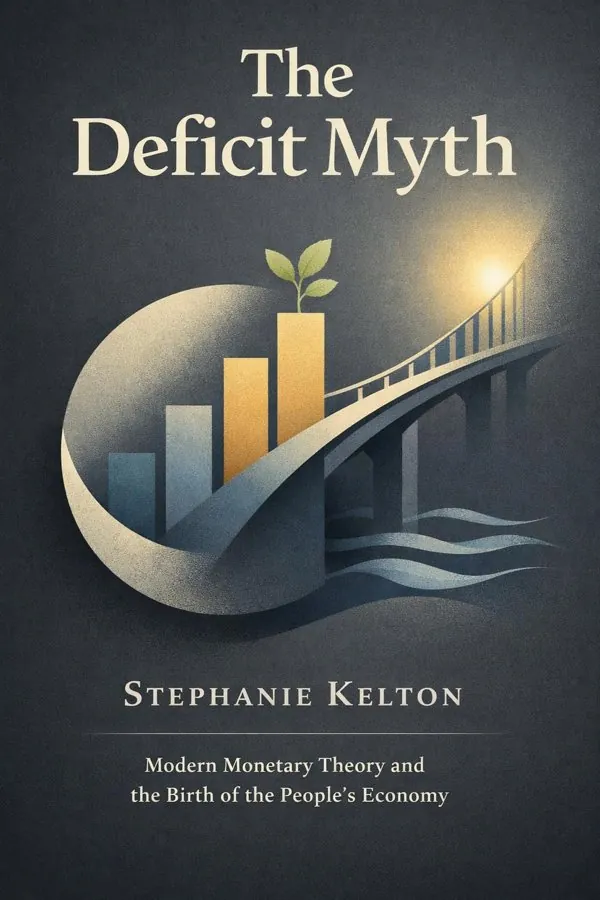
The Deficit Myth: Modern Monetary Theory and the Birth of the People's Economy: Summary & Key Insights
 10 min11 chaptersAudio available
What Is The Deficit Myth: Modern Monetary Theory and the Birth of the People's Economy About?
The Deficit Myth: Modern Monetary Theory and the Birth of the People's Economy by Stephanie Kelton is a economics book spanning 11 pages. In The Deficit Myth, economist Stephanie Kelton challenges conventional views about government spending and national debt. Drawing on Modern Monetary Theory (MMT), she argues that countries issuing their own currency are not constrained by deficits in the same way households are. Kelton explains how rethinking fiscal policy can help address social needs such as healthcare, education, and climate change without fear of 'running out of money.'
This FizzRead summary covers all 11 key chapters of The Deficit Myth: Modern Monetary Theory and the Birth of the People's Economy in approximately 10 minutes, distilling the most important ideas, arguments, and takeaways from Stephanie Kelton's work. Also available as an audio summary and Key Quotes Podcast.
The Deficit Myth: Modern Monetary Theory and the Birth of the People's Economy
In The Deficit Myth, economist Stephanie Kelton challenges conventional views about government spending and national debt. Drawing on Modern Monetary Theory (MMT), she argues that countries issuing their own currency are not constrained by deficits in the same way households are. Kelton explains how rethinking fiscal policy can help address social needs such as healthcare, education, and climate change without fear of 'running out of money.'
Who Should Read The Deficit Myth: Modern Monetary Theory and the Birth of the People's Economy?
This book is perfect for anyone interested in economics and looking to gain actionable insights in a short read. Whether you're a student, professional, or lifelong learner, the key ideas from The Deficit Myth: Modern Monetary Theory and the Birth of the People's Economy by Stephanie Kelton will help you think differently.
- ✓Readers who enjoy economics and want practical takeaways
- ✓Professionals looking to apply new ideas to their work and life
- ✓Anyone who wants the core insights of The Deficit Myth: Modern Monetary Theory and the Birth of the People's Economy in just 10 minutes
Want the full summary?
Get instant access to this book summary and 100K+ more with Fizz Moment.
Get Free SummaryAvailable on App Store • Free to download
Key Chapters
Let me begin with the heart of the matter—the myth itself. For generations, political debate has framed fiscal responsibility as synonymous with balanced budgets and low deficits. We have come to fear red ink as a sign of recklessness. But the truth is, those government deficits we worry about are nothing more than accounting reflections of our own financial surpluses. When the government spends more than it taxes, that excess becomes someone else’s income or savings.
The obsession with balancing the budget has led to unnecessary suffering. Every time policymakers choose austerity in the name of fiscal discipline, they are choosing to leave people unemployed, infrastructure decaying, and the social fabric weakened. A government deficit is not inherently good or bad—it must always be understood in context. Are we using our economic capacity to its fullest to achieve public purpose? Or are we strangling it because of a misplaced analogy between a household and a sovereign nation?
The myth of the deficit is powerful because it is intuitive. Households indeed cannot spend beyond their means without going broke. But governments that issue their own currency, such as the United States, the UK, or Japan, can. They can always meet future payment obligations in their own money. This truth is not an invitation to spend without thought, but a reminder that public perception has been built on misunderstanding rather than logic or economics.
Once we recognize that sovereign governments differ from households, we can start to see how money really operates within a modern economy. A nation that issues its own free-floating currency—like the U.S. with the dollar—can never involuntarily run out of money. Its constraint is not solvency, but inflation.
When the U.S. government spends, it creates dollars by crediting bank accounts. When it taxes, it deletes dollars from those accounts. Between those flows, it issues Treasury bonds, which serve as safe interest-bearing assets for the private sector. The result? Federal deficits translate into private sector surpluses.
Compare that to a country that uses, but does not issue, a currency—such as Greece within the Eurozone. Greece cannot create euros at will and thus must borrow to fund spending, exposing itself to default risk. The distinction between issuer and user is critical because it separates the possible from the impossible.
Understanding sovereign currency changes how we view all fiscal policy debates. Questions like “how will we pay for it?” become less about finding money and more about managing real resources effectively—labor, skills, technology, and raw materials. The government’s role is not to balance numbers, but to balance the economy’s goals against its capacities.
+ 9 more chapters — available in the FizzRead app
All Chapters in The Deficit Myth: Modern Monetary Theory and the Birth of the People's Economy
About the Author
Stephanie Kelton is an American economist and professor of public policy and economics at Stony Brook University. She is a leading advocate of Modern Monetary Theory and has served as chief economist for the U.S. Senate Budget Committee and as an economic advisor to political campaigns.
Get This Summary in Your Preferred Format
Read or listen to the The Deficit Myth: Modern Monetary Theory and the Birth of the People's Economy summary by Stephanie Kelton anytime, anywhere. FizzRead offers multiple formats so you can learn on your terms — all free.
Available formats: App · Audio · PDF · EPUB — All included free with FizzRead
Download The Deficit Myth: Modern Monetary Theory and the Birth of the People's Economy PDF and EPUB Summary
Key Quotes from The Deficit Myth: Modern Monetary Theory and the Birth of the People's Economy
“Let me begin with the heart of the matter—the myth itself.”
“Once we recognize that sovereign governments differ from households, we can start to see how money really operates within a modern economy.”
Frequently Asked Questions about The Deficit Myth: Modern Monetary Theory and the Birth of the People's Economy
The Deficit Myth: Modern Monetary Theory and the Birth of the People's Economy by Stephanie Kelton is a economics book that explores key ideas across 11 chapters. In The Deficit Myth, economist Stephanie Kelton challenges conventional views about government spending and national debt. Drawing on Modern Monetary Theory (MMT), she argues that countries issuing their own currency are not constrained by deficits in the same way households are. Kelton explains how rethinking fiscal policy can help address social needs such as healthcare, education, and climate change without fear of 'running out of money.'
You Might Also Like

Business Adventures
John Brooks
10 min
Nudge
Richard H. Thaler, Cass R. Sunstein
10 min
The Hitchhiker"s Guide to the Galaxy
Douglas Adams
10 minThe Muqaddimah
Ibn Khaldun
10 minThe Outsiders
William N. Thorndike
10 min
A Little History of Economics
Niall Kishtainy
10 minBrowse by Category
Ready to read The Deficit Myth: Modern Monetary Theory and the Birth of the People's Economy?
Get the full summary and 100K+ more books with Fizz Moment.