
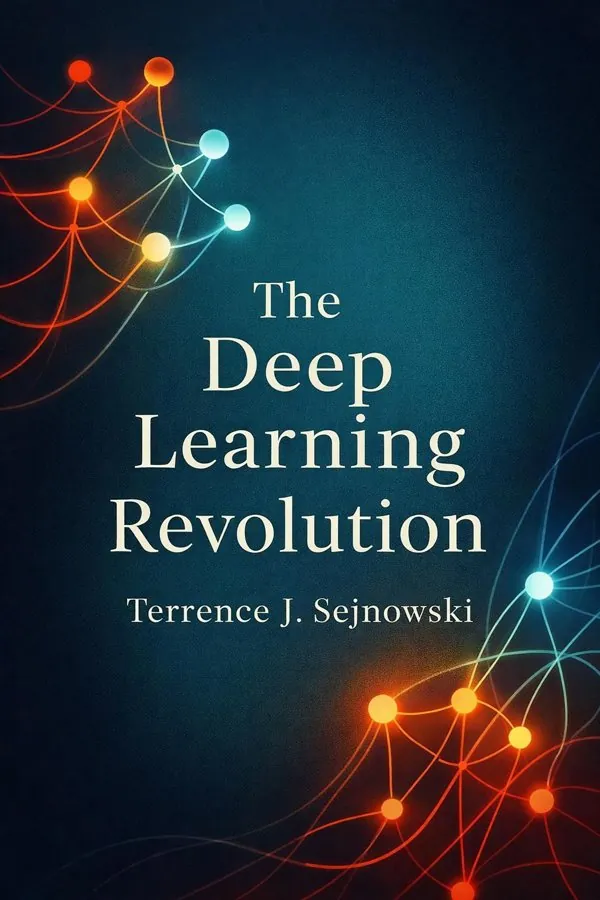
The Deep Learning Revolution: Summary & Key Insights
 10 min10 chaptersAudio available
What Is The Deep Learning Revolution About?
The Deep Learning Revolution by Terrence J. Sejnowski is a ai_ml book spanning 10 pages. The Deep Learning Revolution traces the development of deep learning from its origins in neuroscience and artificial intelligence to its transformative impact on modern technology. Terrence J. Sejnowski, one of the pioneers in computational neuroscience, explains how deep learning models emulate the brain’s ability to learn from data and how this revolution is reshaping science, industry, and society.
This FizzRead summary covers all 10 key chapters of The Deep Learning Revolution in approximately 10 minutes, distilling the most important ideas, arguments, and takeaways from Terrence J. Sejnowski's work. Also available as an audio summary and Key Quotes Podcast.
The Deep Learning Revolution
The Deep Learning Revolution traces the development of deep learning from its origins in neuroscience and artificial intelligence to its transformative impact on modern technology. Terrence J. Sejnowski, one of the pioneers in computational neuroscience, explains how deep learning models emulate the brain’s ability to learn from data and how this revolution is reshaping science, industry, and society.
Who Should Read The Deep Learning Revolution?
This book is perfect for anyone interested in ai_ml and looking to gain actionable insights in a short read. Whether you're a student, professional, or lifelong learner, the key ideas from The Deep Learning Revolution by Terrence J. Sejnowski will help you think differently.
- ✓Readers who enjoy ai_ml and want practical takeaways
- ✓Professionals looking to apply new ideas to their work and life
- ✓Anyone who wants the core insights of The Deep Learning Revolution in just 10 minutes
Want the full summary?
Get instant access to this book summary and 100K+ more with Fizz Moment.
Get Free SummaryAvailable on App Store • Free to download
Key Chapters
To appreciate the scope of the revolution, we have to begin in the 1940s, when the idea of artificial neurons first crystallized. Warren McCulloch and Walter Pitts proposed a mathematical model of a neuron—an abstract device that took in signals and fired if a certain threshold was reached. This was more than a clever analogy; it was an attempt to formalize thinking itself through logic and computation. Around the same time, Donald Hebb introduced his famous learning rule—the notion that 'neurons that fire together, wire together.' Hebb’s insight was monumental because it described a biological mechanism for learning: synaptic strength changing through experience.
I often think of those years as the dawn of computational neuroscience. The excitement was palpable: the brain was seen as an information-processing organ, and we were beginning to imagine machines that could emulate it. Yet those early models were crude. The first generation of neural networks could classify simple patterns but lacked the sophistication to capture real complexity. Still, they planted the seed of a new paradigm—learning through modification—long before it was technically possible to bring it to life.
At the time, computation was primitive. The concept of digital computers was barely mature, and even basic simulation of neural systems was difficult. The beauty of McCulloch and Pitts’ framework was that it merged logic, biology, and philosophy—it reimagined cognition as emergent from simple rules. Hebb’s learning theory complemented it by introducing adaptation. These two ideas—the neuron as a computational unit and learning as connection strength adjustment—became the twin pillars upon which modern deep learning would eventually rise.
In the 1950s and 1960s, the field caught fire again, thanks to Frank Rosenblatt’s perceptron. A perceptron was a direct descendant of the McCulloch–Pitts neuron but endowed with learning capacity. Rosenblatt built physical machines—arrays of sensors and weights—to demonstrate that a system could learn to recognize patterns through reinforcement. The press adored him. Headlines proclaimed the dawn of intelligent machines that could see and learn. There was genuine optimism that human-level intelligence was just around the corner.
I remember studying these developments later and sensing the extraordinary energy of that period. Rosenblatt believed in the power of connectionism—the idea that distributed processing could give rise to intelligence without explicit symbolic programming. The perceptron’s ability to learn linearly separable patterns seemed miraculous at the time. But as promising as it was, it had a fatal limitation: it couldn’t solve problems that required combining multiple layers of abstraction. That flaw wasn’t obvious at first—but it would soon become the basis of a major critique that derailed progress for decades.
Even in its infancy, the perceptron taught us something crucial: learning is possible without a teacher dictating rules. It hinted at emergent intelligence, the same way the brain discovers representations through distributed activation. That idea never died—it simply waited for the right tools and mathematical breakthroughs to reemerge stronger.
+ 8 more chapters — available in the FizzRead app
All Chapters in The Deep Learning Revolution
About the Author
Terrence J. Sejnowski is a neuroscientist and computational biologist, a professor at the Salk Institute for Biological Studies, and a member of the National Academy of Sciences. He is known for his pioneering work in neural networks and computational neuroscience, contributing significantly to the foundations of deep learning.
Get This Summary in Your Preferred Format
Read or listen to the The Deep Learning Revolution summary by Terrence J. Sejnowski anytime, anywhere. FizzRead offers multiple formats so you can learn on your terms — all free.
Available formats: App · Audio · PDF · EPUB — All included free with FizzRead
Download The Deep Learning Revolution PDF and EPUB Summary
Key Quotes from The Deep Learning Revolution
“To appreciate the scope of the revolution, we have to begin in the 1940s, when the idea of artificial neurons first crystallized.”
“In the 1950s and 1960s, the field caught fire again, thanks to Frank Rosenblatt’s perceptron.”
Frequently Asked Questions about The Deep Learning Revolution
The Deep Learning Revolution by Terrence J. Sejnowski is a ai_ml book that explores key ideas across 10 chapters. The Deep Learning Revolution traces the development of deep learning from its origins in neuroscience and artificial intelligence to its transformative impact on modern technology. Terrence J. Sejnowski, one of the pioneers in computational neuroscience, explains how deep learning models emulate the brain’s ability to learn from data and how this revolution is reshaping science, industry, and society.
You Might Also Like
Life 3.0
Max Tegmark
10 min
Superintelligence
Nick Bostrom
10 min
TensorFlow in Action
Thushan Ganegedara
10 min
AI Made Simple: A Beginner’s Guide to Generative AI, ChatGPT, and the Future of Work
Rajeev Kapur
10 min
AI Snake Oil
Arvind Narayanan, Sayash Kapoor
10 min
AI Superpowers: China, Silicon Valley, and the New World Order
Kai-Fu Lee
10 minBrowse by Category
Ready to read The Deep Learning Revolution?
Get the full summary and 100K+ more books with Fizz Moment.