
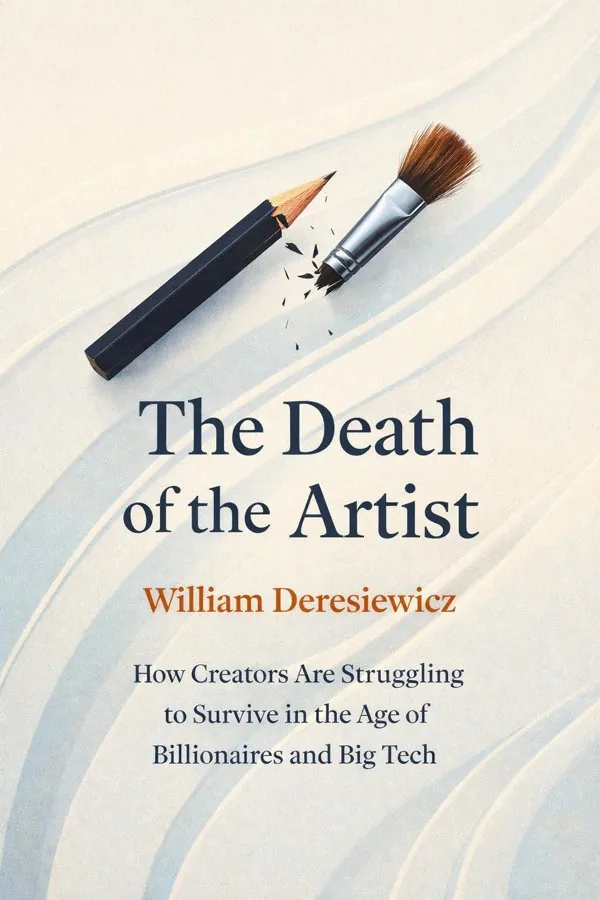
The Death of the Artist: How Creators Are Struggling to Survive in the Age of Billionaires and Big Tech: Summary & Key Insights
 10 min11 chaptersAudio available
What Is The Death of the Artist: How Creators Are Struggling to Survive in the Age of Billionaires and Big Tech About?
The Death of the Artist: How Creators Are Struggling to Survive in the Age of Billionaires and Big Tech by William Deresiewicz is a digital_culture book spanning 11 pages. In this incisive work, William Deresiewicz explores how the digital revolution has transformed the lives of artists. He examines how writers, musicians, visual artists, and other creators navigate a world dominated by tech platforms, where traditional gatekeepers have vanished but economic precarity has intensified. Drawing on interviews and cultural analysis, the book reveals the paradox of newfound creative freedom amid the erosion of sustainable artistic careers.
This FizzRead summary covers all 11 key chapters of The Death of the Artist: How Creators Are Struggling to Survive in the Age of Billionaires and Big Tech in approximately 10 minutes, distilling the most important ideas, arguments, and takeaways from William Deresiewicz's work. Also available as an audio summary and Key Quotes Podcast.
The Death of the Artist: How Creators Are Struggling to Survive in the Age of Billionaires and Big Tech
In this incisive work, William Deresiewicz explores how the digital revolution has transformed the lives of artists. He examines how writers, musicians, visual artists, and other creators navigate a world dominated by tech platforms, where traditional gatekeepers have vanished but economic precarity has intensified. Drawing on interviews and cultural analysis, the book reveals the paradox of newfound creative freedom amid the erosion of sustainable artistic careers.
Who Should Read The Death of the Artist: How Creators Are Struggling to Survive in the Age of Billionaires and Big Tech?
This book is perfect for anyone interested in digital_culture and looking to gain actionable insights in a short read. Whether you're a student, professional, or lifelong learner, the key ideas from The Death of the Artist: How Creators Are Struggling to Survive in the Age of Billionaires and Big Tech by William Deresiewicz will help you think differently.
- ✓Readers who enjoy digital_culture and want practical takeaways
- ✓Professionals looking to apply new ideas to their work and life
- ✓Anyone who wants the core insights of The Death of the Artist: How Creators Are Struggling to Survive in the Age of Billionaires and Big Tech in just 10 minutes
Want the full summary?
Get instant access to this book summary and 100K+ more with Fizz Moment.
Get Free SummaryAvailable on App Store • Free to download
Key Chapters
Looking back on the twentieth century, we can see that the so-called old system wasn’t a monolith but a network of institutions—publishers, record labels, galleries, studios—that offered some degree of stability and hierarchy. Artists might rail against them, yet those structures, for all their flaws, made professional art possible. To be a writer often meant signing with a publishing house that provided editing, marketing, and distribution. Musicians depended on labels to finance recordings and tours. Painters sought representation by galleries that could place their work in front of collectors. The gatekeepers enforced standards, yes, but they also absorbed risk.
This system accomplished two vital things: it separated art from commerce, allowing artists to focus on craft, and it offered middle-class security for those who succeeded. Yet even within it, inequality was rampant. The majority of artists still struggled, patronage remained concentrated, and success often depended on privilege, connections, or sheer chance. Still, an artist could aspire to professionalism—to define their identity around the work rather than around self-promotion. It was this fragile equilibrium that the internet would soon blow apart.
The arrival of the internet in the 1990s and the proliferation of digital platforms in the 2000s changed everything. It began with Napster and file-sharing, spread through Amazon and YouTube, and culminated in streaming and social media. Suddenly, the gatekeepers were gone. Artists could distribute directly to audiences without needing a label or publisher. The result was an exhilarating sense of possibility—and an invisible transfer of risk and responsibility from institutions to individuals.
Everyone, it seemed, could now be an artist. But competition exploded, and prices collapsed. The musician releasing tracks on Spotify discovered their streams earned fractions of a cent. Self-published authors faced oceans of undifferentiated content. Visual artists posted their work to Instagram, hoping for visibility but rarely for pay. New intermediaries emerged in the guise of platforms—Apple, Google, Facebook, Amazon—claiming neutrality while siphoning most of the revenue. The digital revolution promised empowerment, but it delivered precarity dressed up as freedom. In dismantling the old system, we lost not merely its hierarchy but its economic infrastructure.
+ 9 more chapters — available in the FizzRead app
All Chapters in The Death of the Artist: How Creators Are Struggling to Survive in the Age of Billionaires and Big Tech
About the Author
William Deresiewicz is an American author, essayist, and critic known for his works on education, culture, and the arts. A former English professor at Yale University, he has written for publications such as The Atlantic, Harper’s, and The New York Times. His books include 'Excellent Sheep' and 'A Jane Austen Education.'
Get This Summary in Your Preferred Format
Read or listen to the The Death of the Artist: How Creators Are Struggling to Survive in the Age of Billionaires and Big Tech summary by William Deresiewicz anytime, anywhere. FizzRead offers multiple formats so you can learn on your terms — all free.
Available formats: App · Audio · PDF · EPUB — All included free with FizzRead
Download The Death of the Artist: How Creators Are Struggling to Survive in the Age of Billionaires and Big Tech PDF and EPUB Summary
Key Quotes from The Death of the Artist: How Creators Are Struggling to Survive in the Age of Billionaires and Big Tech
“Artists might rail against them, yet those structures, for all their flaws, made professional art possible.”
“The arrival of the internet in the 1990s and the proliferation of digital platforms in the 2000s changed everything.”
Frequently Asked Questions about The Death of the Artist: How Creators Are Struggling to Survive in the Age of Billionaires and Big Tech
The Death of the Artist: How Creators Are Struggling to Survive in the Age of Billionaires and Big Tech by William Deresiewicz is a digital_culture book that explores key ideas across 11 chapters. In this incisive work, William Deresiewicz explores how the digital revolution has transformed the lives of artists. He examines how writers, musicians, visual artists, and other creators navigate a world dominated by tech platforms, where traditional gatekeepers have vanished but economic precarity has intensified. Drawing on interviews and cultural analysis, the book reveals the paradox of newfound creative freedom amid the erosion of sustainable artistic careers.
You Might Also Like
An Ugly Truth: Inside Facebook’s Battle for Domination
Sheera Frenkel, Cecilia Kang
10 min
Cyber Citizens
Ian Goodfellow
10 min
Digital Minimalism: Choosing a Focused Life in a Noisy World
Cal Newport
10 min
E‑Books & Beyond
Various Authors
10 min
The Future of Media
Various Authors
10 min
This Is Why We Can't Have Nice Things
Whitney Phillips
10 minBrowse by Category
Ready to read The Death of the Artist: How Creators Are Struggling to Survive in the Age of Billionaires and Big Tech?
Get the full summary and 100K+ more books with Fizz Moment.