
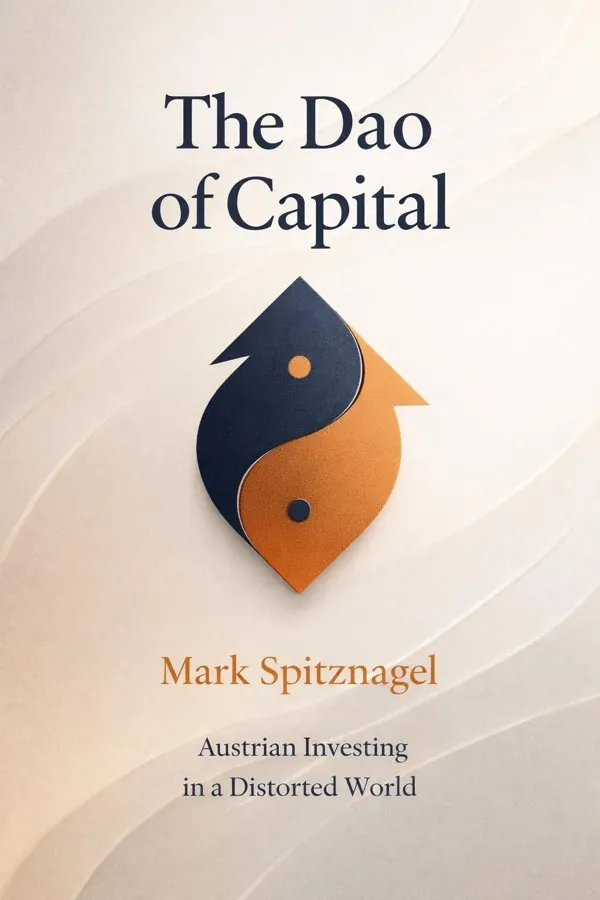
The Dao of Capital: Austrian Investing in a Distorted World: Summary & Key Insights
 10 min4 chaptersAudio available
What Is The Dao of Capital: Austrian Investing in a Distorted World About?
The Dao of Capital: Austrian Investing in a Distorted World by Mark Spitznagel is a finance book spanning 4 pages. In this book, Mark Spitznagel, a hedge fund manager and disciple of Austrian economics, explores how the principles of Austrian School thought can be applied to investing. He argues that successful investing requires a contrarian, roundabout approach—what he calls the 'Dao of Capital'—that embraces short-term pain for long-term gain. Drawing on insights from economics, philosophy, and history, Spitznagel connects the ideas of Ludwig von Mises and Friedrich Hayek to modern financial markets, offering a framework for understanding risk, value, and time in a distorted economic environment.
This FizzRead summary covers all 4 key chapters of The Dao of Capital: Austrian Investing in a Distorted World in approximately 10 minutes, distilling the most important ideas, arguments, and takeaways from Mark Spitznagel's work. Also available as an audio summary and Key Quotes Podcast.
The Dao of Capital: Austrian Investing in a Distorted World
In this book, Mark Spitznagel, a hedge fund manager and disciple of Austrian economics, explores how the principles of Austrian School thought can be applied to investing. He argues that successful investing requires a contrarian, roundabout approach—what he calls the 'Dao of Capital'—that embraces short-term pain for long-term gain. Drawing on insights from economics, philosophy, and history, Spitznagel connects the ideas of Ludwig von Mises and Friedrich Hayek to modern financial markets, offering a framework for understanding risk, value, and time in a distorted economic environment.
Who Should Read The Dao of Capital: Austrian Investing in a Distorted World?
This book is perfect for anyone interested in finance and looking to gain actionable insights in a short read. Whether you're a student, professional, or lifelong learner, the key ideas from The Dao of Capital: Austrian Investing in a Distorted World by Mark Spitznagel will help you think differently.
- ✓Readers who enjoy finance and want practical takeaways
- ✓Professionals looking to apply new ideas to their work and life
- ✓Anyone who wants the core insights of The Dao of Capital: Austrian Investing in a Distorted World in just 10 minutes
Want the full summary?
Get instant access to this book summary and 100K+ more with Fizz Moment.
Get Free SummaryAvailable on App Store • Free to download
Key Chapters
When I first encountered Ludwig von Mises’s work, I was struck by his profound respect for time in economic order. Mises and Hayek understood that all production is temporal; every act of investment is a commitment to future consumption. This idea—time preference—is the beating heart of Austrian economics. Humans naturally prefer satisfaction sooner rather than later. Interest rates are the market’s reflection of that preference, coordinating production across time. When these rates are distorted—usually by central bank intervention—the natural coordination of economic activity collapses.
Think of the economy as an intricate lattice of capital goods arranged in time, what Hayek illustrated as an 'Austrian triangle.' Its base is the simplest consumption, and its apex is the most remote, indirect stage of production. When we interfere with interest rates, we alter the triangle’s proportions, seducing investors into 'malinvestment'—resources poured into projects that only appear profitable under artificially low rates. These distortions sow the seeds for inevitable correction, the bust following the boom.
From this understanding, I built my own philosophy of investing. Just as the economy’s healthy function depends on patience, so too does successful capital allocation. The investor must accept the slow rhythm of accumulation, resist the lure of immediate victory. The Austrian approach reminds us that true capital growth is always roundabout—it requires enduring short-term pain in exchange for sustainable, long-run advantage. Without that discipline, capital becomes brittle, unable to withstand the shocks of reality.
Roundaboutness is the central metaphor that bridges Austrian economics and Daoist philosophy. In nature, every durable accomplishment follows an indirect path. Trees grow slowly; ecosystems find balance through feedback, decay, and renewal. No straight line ever leads to lasting stability. This principle applies equally to investing. The most effective strategies often appear counterintuitive—they hurt at first, they require patience, they expose you to discomfort. But in that pain lies potential energy, waiting to unfold.
I often say that success is earned through the 'pain of discipline' rather than the 'pain of regret.' The roundabout process is discipline in motion: forgoing easy profits today to allow the processes of value creation to compound uncorrupted. As a hedge fund manager, I’ve lived through many moments where not acting—where holding back—was the most difficult choice, yet the most powerful one. Like Hayek’s spontaneous order, the roundabout approach respects complexity. We cannot force outcomes; we can only position ourselves within the system’s natural tendencies and wait.
This waiting is not passive—it’s strategic. It’s about placing capital in structures that benefit from the passage of time and the inevitability of correction. In my own practice, this translated into building positions that profit when excess and distortion unwind. It’s the investment analog to wu wei, the Daoist principle of non-forcing. By aligning with the natural rhythm of market correction instead of fighting it, we achieve harmony with the process of value restoration.
+ 2 more chapters — available in the FizzRead app
All Chapters in The Dao of Capital: Austrian Investing in a Distorted World
About the Author
Mark Spitznagel is an American investor, hedge fund manager, and author known for his work in tail-risk hedging and Austrian economics. He is the founder and chief investment officer of Universa Investments and has collaborated with Nassim Nicholas Taleb. Spitznagel’s writings focus on risk management, market cycles, and the philosophical underpinnings of investing.
Get This Summary in Your Preferred Format
Read or listen to the The Dao of Capital: Austrian Investing in a Distorted World summary by Mark Spitznagel anytime, anywhere. FizzRead offers multiple formats so you can learn on your terms — all free.
Available formats: App · Audio · PDF · EPUB — All included free with FizzRead
Download The Dao of Capital: Austrian Investing in a Distorted World PDF and EPUB Summary
Key Quotes from The Dao of Capital: Austrian Investing in a Distorted World
“When I first encountered Ludwig von Mises’s work, I was struck by his profound respect for time in economic order.”
“Roundaboutness is the central metaphor that bridges Austrian economics and Daoist philosophy.”
Frequently Asked Questions about The Dao of Capital: Austrian Investing in a Distorted World
The Dao of Capital: Austrian Investing in a Distorted World by Mark Spitznagel is a finance book that explores key ideas across 4 chapters. In this book, Mark Spitznagel, a hedge fund manager and disciple of Austrian economics, explores how the principles of Austrian School thought can be applied to investing. He argues that successful investing requires a contrarian, roundabout approach—what he calls the 'Dao of Capital'—that embraces short-term pain for long-term gain. Drawing on insights from economics, philosophy, and history, Spitznagel connects the ideas of Ludwig von Mises and Friedrich Hayek to modern financial markets, offering a framework for understanding risk, value, and time in a distorted economic environment.
You Might Also Like


Browse by Category
Ready to read The Dao of Capital: Austrian Investing in a Distorted World?
Get the full summary and 100K+ more books with Fizz Moment.