
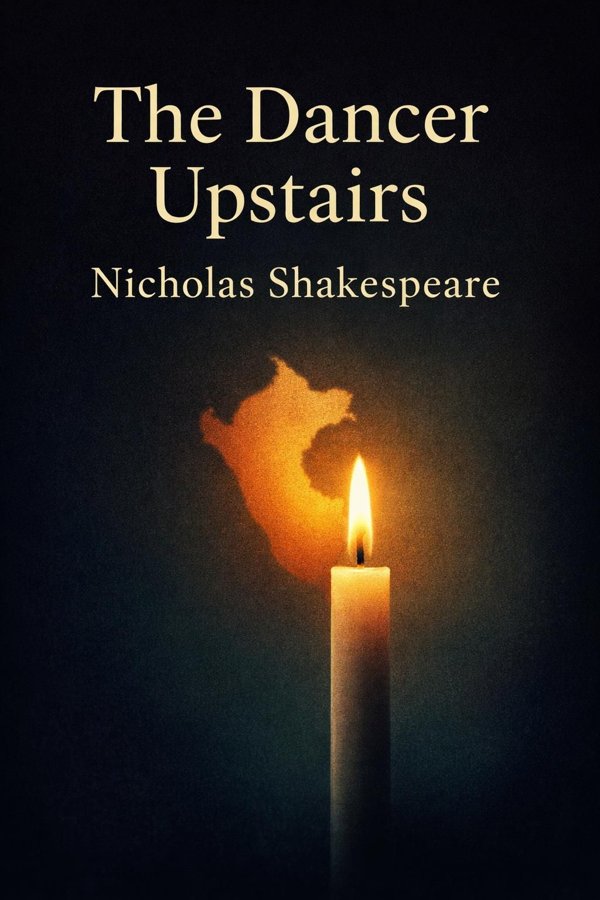
The Dancer Upstairs: Summary & Key Insights
 10 min9 chaptersAudio available
Key Takeaways from The Dancer Upstairs
A collapsing society rarely announces itself with one dramatic moment; more often, it unravels through daily habits of fear, resignation, and compromise.
The most frightening political figures are often powerful not because people fully know them, but because they can project themselves as myth.
In times of political violence, private feeling can become both refuge and vulnerability.
Solving a case does not necessarily resolve the moral crisis behind it.
Political terror becomes most effective when it persuades ordinary people to censor themselves before anyone explicitly orders them to.
What Is The Dancer Upstairs About?
The Dancer Upstairs by Nicholas Shakespeare is a bestsellers book spanning 4 pages. What happens when a society becomes so fractured that violence starts to feel ordinary? In The Dancer Upstairs, Nicholas Shakespeare turns that question into a tense, psychologically rich literary thriller. Set in an unnamed South American country inspired by Peru during the years of the Shining Path insurgency, the novel follows police detective Agustin Rejas as he investigates a wave of politically charged killings linked to the elusive revolutionary leader Ezequiel. But this is more than a manhunt. It is a story about how ideology infects daily life, how institutions corrode under fear, and how private longing survives in public catastrophe. Shakespeare writes with the precision of a journalist and the moral depth of a serious novelist, blending political realism with emotional intimacy. His portrait of revolution is never simplistic: the state is compromised, the rebels are ruthless, and ordinary people are trapped between them. That complexity is what gives the novel its lasting power. The Dancer Upstairs matters because it shows that political terror is not only a historical event; it is also a human experience shaped by doubt, compromise, desire, and the difficult search for justice.
This FizzRead summary covers all 9 key chapters of The Dancer Upstairs in approximately 10 minutes, distilling the most important ideas, arguments, and takeaways from Nicholas Shakespeare's work. Also available as an audio summary and Key Quotes Podcast.
The Dancer Upstairs
What happens when a society becomes so fractured that violence starts to feel ordinary? In The Dancer Upstairs, Nicholas Shakespeare turns that question into a tense, psychologically rich literary thriller. Set in an unnamed South American country inspired by Peru during the years of the Shining Path insurgency, the novel follows police detective Agustin Rejas as he investigates a wave of politically charged killings linked to the elusive revolutionary leader Ezequiel. But this is more than a manhunt. It is a story about how ideology infects daily life, how institutions corrode under fear, and how private longing survives in public catastrophe. Shakespeare writes with the precision of a journalist and the moral depth of a serious novelist, blending political realism with emotional intimacy. His portrait of revolution is never simplistic: the state is compromised, the rebels are ruthless, and ordinary people are trapped between them. That complexity is what gives the novel its lasting power. The Dancer Upstairs matters because it shows that political terror is not only a historical event; it is also a human experience shaped by doubt, compromise, desire, and the difficult search for justice.
Who Should Read The Dancer Upstairs?
This book is perfect for anyone interested in bestsellers and looking to gain actionable insights in a short read. Whether you're a student, professional, or lifelong learner, the key ideas from The Dancer Upstairs by Nicholas Shakespeare will help you think differently.
- ✓Readers who enjoy bestsellers and want practical takeaways
- ✓Professionals looking to apply new ideas to their work and life
- ✓Anyone who wants the core insights of The Dancer Upstairs in just 10 minutes
Want the full summary?
Get instant access to this book summary and 100K+ more with Fizz Moment.
Get Free SummaryAvailable on App Store • Free to download
Key Chapters
A collapsing society rarely announces itself with one dramatic moment; more often, it unravels through daily habits of fear, resignation, and compromise. That is the atmosphere Nicholas Shakespeare creates through Agustin Rejas, a police detective trying to preserve order in a capital city that feels both specific and universal. The country remains unnamed not because it lacks identity, but because Shakespeare wants to show that political breakdown follows recognizable patterns wherever institutions are weak and inequality is deep. Rejas moves through ministries, streets, and crime scenes where nothing functions cleanly. Politicians posture, officials look away, and violence seeps into ordinary life.
Rejas is compelling because he is not a heroic action figure. He is thoughtful, restrained, and morally serious, yet he works inside a corrupt system that constantly limits what he can achieve. That tension gives the novel its emotional and political force. He wants justice, but he must pursue it through compromised institutions. He believes in law, but the law itself is unstable. His investigation becomes a way of mapping the psychology of a nation on edge.
This idea applies far beyond the novel. In any workplace, city, or country under stress, people often normalize dysfunction long before they confront it. You see it when ethical shortcuts become routine, when trust disappears, or when leaders treat crisis as background noise. Shakespeare reminds us that decline is not only structural; it is psychological.
Actionable takeaway: Pay attention to the small signs of institutional decay in your own environment, because major breakdowns usually begin as everyday compromises no one challenges.
The most frightening political figures are often powerful not because people fully know them, but because they can project themselves as myth. Ezequiel, the novel’s insurgent mastermind, enters the story as rumor before he appears as a man. His presence is felt in coded messages, symbolic murders, and the growing sense that an invisible intelligence is orchestrating chaos. Shakespeare wisely withholds him at first, allowing ideology itself to become a form of suspense. Ezequiel is not merely a criminal target; he is the embodiment of abstract conviction turned lethal.
What makes him so unsettling is that he believes. He does not kill for pleasure or profit, but in service of a revolutionary vision that justifies cruelty as historical necessity. Shakespeare shows how ideology can seduce educated minds by offering moral clarity in a confusing world. Ezequiel transforms grievance into doctrine and doctrine into terror. In his worldview, individuals matter less than the cause, and once that logic is accepted, atrocity becomes easy to rationalize.
This is one of the novel’s central warnings. Extreme ideologies often flourish where people feel humiliated, excluded, or ignored. They offer belonging, explanation, and purpose. Whether in politics, organizations, or online communities, movements become dangerous when they divide the world into absolute virtue and absolute corruption. Anyone who questions the cause becomes an enemy.
The novel does not ask readers to dismiss injustice. Instead, it asks us to beware of solutions that promise purification through violence. Actionable takeaway: When evaluating any political or social movement, look closely at whether it allows complexity and dissent, or whether it turns moral certainty into permission for destruction.
In times of political violence, private feeling can become both refuge and vulnerability. One of the most memorable emotional threads in The Dancer Upstairs is Rejas’s relationship with Yolanda, a dance teacher whose grace, intelligence, and quiet self-possession awaken something long dormant in him. Their connection may seem secondary to the insurgency plot, yet it is essential to the novel’s design. Shakespeare uses Yolanda and the world of dance to introduce an alternative rhythm to terror: discipline without brutality, beauty without propaganda, movement shaped by human connection rather than ideological force.
Rejas is drawn to Yolanda partly because she represents a life not governed entirely by fear or procedure. Through her, he glimpses tenderness, culture, and possibility. But this emotional opening also complicates him. Desire weakens the illusion that he can remain detached, purely professional, or morally insulated. In a world where surveillance, suspicion, and manipulation are everywhere, intimacy itself carries risk.
The metaphor of dance matters. Dance requires trust, timing, restraint, and responsiveness to another person. It contrasts sharply with the rigid certainty of extremist politics. Where ideology demands obedience, dance requires mutual awareness. Where terror reduces people to symbols, dance restores individuality and presence.
Readers can apply this insight to modern life by recognizing the importance of preserving emotional and aesthetic spaces during periods of stress. Art, love, ritual, and friendship are not distractions from crisis; they are often what prevent people from becoming spiritually numb.
Actionable takeaway: Protect the relationships and practices that keep you human, especially when external pressures push you toward cynicism, isolation, or emotional hardness.
Solving a case does not necessarily resolve the moral crisis behind it. As Rejas closes in on Ezequiel, The Dancer Upstairs shifts from mystery toward reckoning. The suspense of pursuit gives way to a more difficult question: what does justice mean in a society already damaged by fear, corruption, and compromise? The capture of a revolutionary leader might appear to be a clean triumph, but Shakespeare refuses that simplicity. He shows that success inside a compromised political order can still leave bitterness, ambiguity, and personal cost.
Rejas’s achievement does not grant him complete moral peace. He has acted courageously and intelligently, yet he remains embedded in a system that may use justice selectively and reward loyalty unevenly. The state wants victories, but not always truth. Careers are shaped by politics, not merit. In that sense, the novel’s ending is powerful because it exposes the difference between solving a problem and healing a society.
This idea resonates in many real-world settings. Organizations often celebrate outcomes while ignoring the ethical damage done along the way. A scandal is contained, a threat is neutralized, a target is met, but deeper structural issues remain. The individual who does the right thing may not be honored; sometimes he is sidelined, misunderstood, or quietly sacrificed.
Shakespeare’s point is not cynical. It is mature. Moral action matters even when institutions fail to reward it properly. Rejas’s integrity still means something, even if it does not lead to a perfect ending.
Actionable takeaway: Judge success not only by whether a problem is eliminated, but by whether the process preserves your principles and addresses the deeper conditions that produced the crisis.
Political terror becomes most effective when it persuades ordinary people to censor themselves before anyone explicitly orders them to. Throughout the novel, Shakespeare captures how fear alters daily behavior. Citizens lower their voices, change routes, avoid questions, and learn not to notice what is in front of them. Bureaucrats become passive, witnesses grow unreliable, and neighborhoods begin to function through rumor rather than trust. Violence is not limited to explosions or murders; it spreads through anticipation.
This is a crucial insight because it shows that terror operates psychologically as much as physically. Ezequiel’s movement does not need to control every street to influence the entire society. A few symbolic acts can create an atmosphere where imagination does the rest. People begin to assume they are being watched. They infer danger everywhere. This magnifies the insurgency’s power and weakens the public sphere.
The same dynamic appears in less extreme forms in modern life. In workplaces, schools, or digital communities, a culture of intimidation can emerge even without constant overt punishment. If people fear humiliation, exclusion, or retaliation, they often silence themselves. The result is a community that appears calm but is actually organized around anxiety.
Shakespeare teaches readers to recognize fear as a social force. Once fear becomes normal, democratic habits weaken. Honest speech, public trust, and collective responsibility all deteriorate. Combating terror therefore requires more than security operations; it requires rebuilding confidence among ordinary people.
Actionable takeaway: Notice where fear is shaping behavior in your environment, and deliberately create conditions where truthful speech, mutual trust, and responsible action become safer than silence.
One of the novel’s most unsettling truths is that the state fighting terror is not morally pure. Rejas serves institutions marked by vanity, incompetence, class prejudice, and political calculation. Shakespeare refuses the comforting formula in which government represents order and insurgents represent chaos. Instead, both sides are capable of distortion. This does not mean they are equivalent, but it does mean that justice becomes difficult to pursue when the guardians of law are compromised.
Rejas’s integrity stands out precisely because it is unusual. He works among officials who care about appearances, promotions, and proximity to power. Investigations are shaped by status and convenience. Even genuine achievements can be appropriated by others. In such an environment, doing one’s job honestly requires stubbornness and emotional discipline.
This complexity makes the novel more realistic and more useful. In real societies, corruption often does not appear as cartoon villainy. It appears as evasion, patronage, selective enforcement, and the quiet acceptance that some people matter more than others. Over time, this destroys public faith. Citizens stop believing that institutions exist to serve them fairly.
The practical lesson is especially relevant in professional life. If rules are applied unevenly, people become cynical. If success depends more on connections than competence, trust erodes. Systems then become vulnerable not only to scandal, but to extremist alternatives that promise harsh clarity.
Actionable takeaway: Support fairness at the procedural level, not just in principle. Transparent standards, accountability, and equal treatment are not bureaucratic niceties; they are the foundation that keeps institutions from drifting toward fear, resentment, and collapse.
A murder investigation is never just about finding the killer; it is also about discovering what a society is willing to hide. Shakespeare uses the detective form brilliantly, not as a puzzle for its own sake, but as a method for exploring political reality. Every clue Rejas follows leads outward from individual crime toward larger systems of fear, ideology, and denial. The structure of detection becomes a way of asking who benefits from confusion, who manipulates truth, and how violence embeds itself in public life.
This is why The Dancer Upstairs feels richer than a conventional thriller. The suspense matters, but it always points beyond itself. Rejas reads patterns, listens carefully, and resists easy narratives. In doing so, he models a kind of civic intelligence. He is trying not only to catch Ezequiel, but to understand the conditions that allowed Ezequiel to become possible.
That approach has practical relevance. In complex situations, whether at work or in public affairs, surface events rarely explain themselves. A conflict between colleagues may reflect poor incentives. A crisis in an institution may reveal long-ignored weaknesses. A viral outrage online may conceal deeper economic or political drivers. Effective judgment requires tracing events back to systems.
Shakespeare also reminds us that interpretation is an ethical act. To investigate honestly, we must resist the comfort of simplistic explanations. The detective’s patience becomes a model for citizenship.
Actionable takeaway: When facing a troubling event, ask not only what happened, but what larger conditions made it possible, and let that broader inquiry guide your response.
The novel’s deepest achievement may be its insistence that beauty is not irrelevant in violent times. The world of dance, music, gesture, and emotional nuance stands in quiet opposition to the rigid absolutism of revolutionary terror. Shakespeare does not present art as escapism. Instead, he presents it as a form of moral resistance. Art preserves ambiguity, discipline, vulnerability, and delight, all qualities that extremist ideologies tend to crush.
This helps explain the symbolic force of the title. The dancer upstairs suggests a presence above the noise of politics, not detached from reality but moving according to a different logic. Dance is embodied, relational, and transient. It cannot easily be turned into doctrine. It values form without demanding fanaticism. In a novel crowded with slogans, brutality, and suspicion, that matters profoundly.
For Rejas, the artistic world connected to Yolanda offers more than romance. It reveals another way of ordering life. That contrast sharpens his awareness of what is being destroyed by violence: not merely safety, but texture, grace, and interior freedom. A society under siege loses more than lives; it risks losing its capacity for joy and subtlety.
This insight is highly practical. During periods of pressure, many people abandon the very habits that make resilience possible. They cut off music, reading, friendship, beauty, and contemplation in the name of urgency. Shakespeare suggests that this is a mistake.
Actionable takeaway: In stressful or polarized times, consciously maintain contact with art, beauty, and human creativity, because they strengthen the inner freedom that fear and fanaticism seek to erase.
All Chapters in The Dancer Upstairs
About the Author
Nicholas Shakespeare is a British novelist, biographer, and journalist born in 1957. He is known for fiction that combines literary elegance with sharp political and historical awareness. Over the course of his career, he has written acclaimed novels including The Vision of Elena Silves and The Dancer Upstairs, as well as major nonfiction and biographical works. His experience as a journalist and foreign correspondent helped shape his interest in power, conflict, and the ways private lives intersect with public upheaval. Shakespeare’s writing is often praised for its atmosphere, intelligence, and moral nuance. In The Dancer Upstairs, he brings those strengths together in a story inspired by the violence of Peru’s insurgent years, creating a novel that is both suspenseful and deeply reflective.
Get This Summary in Your Preferred Format
Read or listen to the The Dancer Upstairs summary by Nicholas Shakespeare anytime, anywhere. FizzRead offers multiple formats so you can learn on your terms — all free.
Available formats: App · Audio · PDF · EPUB — All included free with FizzRead
Download The Dancer Upstairs PDF and EPUB Summary
Key Quotes from The Dancer Upstairs
“A collapsing society rarely announces itself with one dramatic moment; more often, it unravels through daily habits of fear, resignation, and compromise.”
“The most frightening political figures are often powerful not because people fully know them, but because they can project themselves as myth.”
“In times of political violence, private feeling can become both refuge and vulnerability.”
“Solving a case does not necessarily resolve the moral crisis behind it.”
“Political terror becomes most effective when it persuades ordinary people to censor themselves before anyone explicitly orders them to.”
Frequently Asked Questions about The Dancer Upstairs
The Dancer Upstairs by Nicholas Shakespeare is a bestsellers book that explores key ideas across 9 chapters. What happens when a society becomes so fractured that violence starts to feel ordinary? In The Dancer Upstairs, Nicholas Shakespeare turns that question into a tense, psychologically rich literary thriller. Set in an unnamed South American country inspired by Peru during the years of the Shining Path insurgency, the novel follows police detective Agustin Rejas as he investigates a wave of politically charged killings linked to the elusive revolutionary leader Ezequiel. But this is more than a manhunt. It is a story about how ideology infects daily life, how institutions corrode under fear, and how private longing survives in public catastrophe. Shakespeare writes with the precision of a journalist and the moral depth of a serious novelist, blending political realism with emotional intimacy. His portrait of revolution is never simplistic: the state is compromised, the rebels are ruthless, and ordinary people are trapped between them. That complexity is what gives the novel its lasting power. The Dancer Upstairs matters because it shows that political terror is not only a historical event; it is also a human experience shaped by doubt, compromise, desire, and the difficult search for justice.
You Might Also Like

The Godfather
Mario Puzo
10 min
The Handmaid's Tale
Margaret Atwood
10 min
The Hunger Games
Suzanne Collins
10 min
The Nightingale
Kristin Hannah
10 min
The Seven Husbands of Evelyn Hugo
Taylor Jenkins Reid
10 min
Backwater Justice
Fern Michaels
10 minBrowse by Category
Ready to read The Dancer Upstairs?
Get the full summary and 100K+ more books with Fizz Moment.